
NIS, UNODC, Italy move to plug border security gaps with 30 vehicles, 60 computers, 18-month project targets remote, high-risk border areas amid growing threats

The Nigeria Immigration Service (NIS), the United Nations Office on Drugs and Crime (UNODC) and the Italian Government have launched an 18-month intervention to strengthen Nigeria’s border surveillance and control, with the deployment of 30 operational vehicles and 60 computers to immigration personnel across the country
The initiative, which was unveiled in Abuja, comes as Nigeria confronts increasingly complex challenges around its borders, including irregular migration, migrant smuggling, trafficking in persons and other forms of transnational organised crime.
The project is being implemented by UNODC with financial support from the Italian Government through the Ministry of the Interior’s Department of Public Security – Central Directorate for Immigration and Border Police.
The intervention is specifically designed to address mobility and technological deficiencies affecting immigration operations, particularly in remote and high-risk border locations where effective surveillance and rapid response can be difficult.
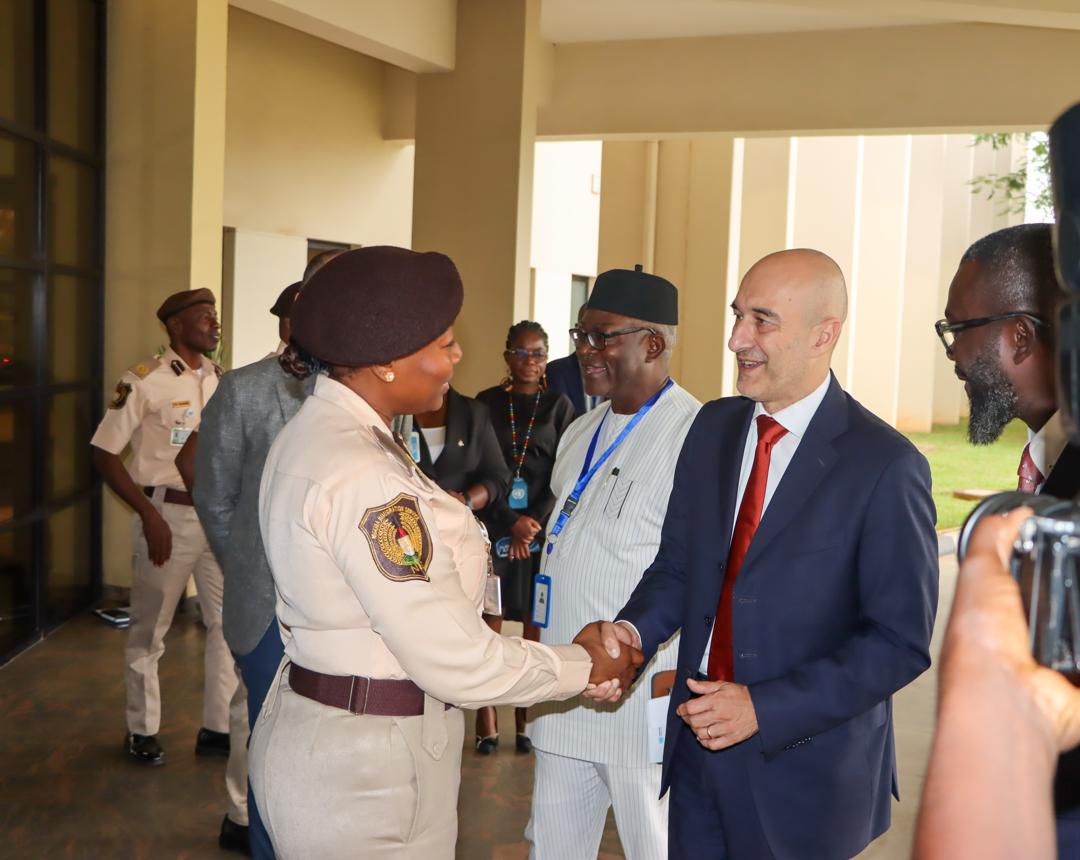
At the flag-off ceremony held at the United Nations House, Abuja, Comptroller-General of Immigration, Kemi Nandap, said the equipment would strengthen the Service’s mobility, surveillance capability, digital infrastructure and overall operational effectiveness.
She expressed appreciation to Italy and UNODC for their continued support towards improving the operational capacity of the NIS.
The Italian Ambassador to Nigeria, Roberto Mengoni, reaffirmed his country’s commitment to supporting Nigeria’s efforts to strengthen border management and institutional capacity.
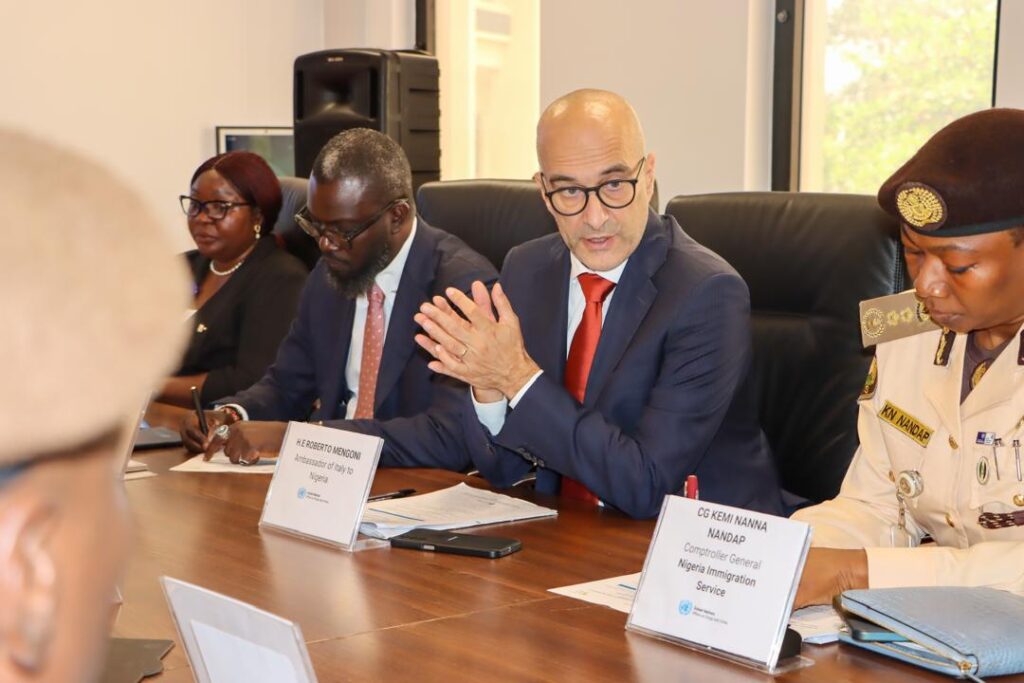
Also speaking, UNODC Country Representative, Cheikh Toure, said the high-level participation at the event demonstrated the importance attached to strengthening Nigeria’s border-management architecture.
He said the intervention was designed to help close existing mobility and technology gaps within the system.
The NIS subsequently pledged to ensure the judicious use of the equipment and deploy the support towards strengthening border management, national security and safe, orderly and regular migration.
The significance of the intervention extends beyond the provision of vehicles and computers. Nigeria’s extensive land, air and maritime borders present a formidable operational challenge for agencies responsible for controlling the movement of people and goods.
The NIS itself has a dedicated Border Management Directorate covering land control posts and patrols, airport control and aerial patrols, seaport control and marine patrols, as well as border services. Its structure also includes directorates responsible for migration, investigation and compliance, intelligence and surveillance, and ICT and cyber security.
International partners have repeatedly identified the need to improve Nigeria’s ability to monitor and respond to activity along hard-to-reach border corridors.
Earlier in 2026, the NIS, in partnership with the International Centre for Migration Policy Development and with support from the Netherlands Government, launched a Mobile Teams project aimed at improving rapid-response capacity in high-risk and hard-to-reach border areas. The initiative was designed to strengthen responses to irregular migration, migrant smuggling, trafficking in persons and emerging security threats.
The latest Italy-UNODC intervention therefore adds another layer to a growing international effort to strengthen Nigeria’s border-management system.
The 60 computers are particularly significant as border security increasingly depends on the ability of immigration officers to collect, process and share information rather than relying solely on physical patrols.
United Nations documentation on Nigeria’s border-security needs has highlighted the importance of electronic identity processing, biometric data, searchable databases and the integration of border information with international watch-list systems.
The UN has also identified the need to expand Nigeria’s border information infrastructure beyond existing equipped crossing points, particularly along vulnerable border corridors.
The combination of vehicles and computers under the new project is consequently aimed at strengthening both sides of border control: physical presence and intelligence-driven surveillance.
For the NIS, improved mobility could mean greater access to remote posts and border corridors, while enhanced digital capacity could enable officers to process information more efficiently and support faster identification and response to suspicious cross-border movements.
The project also has implications for Nigeria’s wider security architecture.
Porous borders have long been a concern in efforts to tackle cross-border criminal networks, trafficking and irregular migration. International border-security programmes have increasingly focused on preventing the movement of terrorists and organised criminal groups while maintaining lawful movement of people.
UN-led border-security programmes in West Africa have similarly stressed improved coordination, biometrics, information exchange and specialised border-management capabilities as tools for countering terrorism and transnational organised crime.
Against this backdrop, the 18-month project represents more than an equipment donation. It is an attempt to strengthen the operational infrastructure through which Nigeria monitors who enters and leaves the country, tracks migration patterns and responds to threats emerging along its borders.
The immediate challenge, however, will be ensuring that the new equipment reaches the locations where operational gaps are greatest and is maintained and deployed effectively.
For Nigeria, the effectiveness of the intervention will ultimately be measured not by the number of vehicles or computers delivered, but by whether they translate into stronger surveillance, faster response, better information-sharing and more effective control of the country’s borders.
