
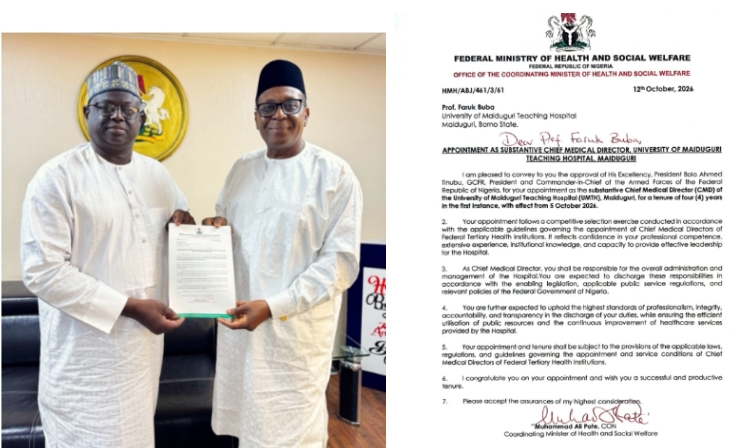
Congratulations Professor Buba on emergence as Chief Medical Director of the University of Maiduguri Teaching Hospital

Today, October 12, 2026, marks a remarkable moment in the history of the University of Maiduguri Teaching Hospital. The emergence of Professor Faruk Buba as the new Chief Medical Director is not merely an administrative transition; it is a significant development that inspires hope, confidence, and renewed commitment among the hospital’s staff, patients, stakeholders, and the wider community. This important appointment is a recognition of his professional excellence, leadership capacity, dedication to service, and years of meaningful contributions to the medical profession.
Professor Faruk Buba has fought a good fight. Through perseverance, competence, discipline, and an unwavering commitment to the ideals of healthcare, he has distinguished himself as a professional worthy of this responsibility. His emergence is therefore not accidental. It is the outcome of years of preparation, sacrifice, experience, and service. At a time when the University of Maiduguri Teaching Hospital requires purposeful leadership, his appointment offers an opportunity to strengthen the institution and reposition it for greater accomplishments.
The position of Chief Medical Director is one of enormous responsibility. It requires far more than medical knowledge or administrative authority. The office demands vision, integrity, courage, emotional intelligence, strategic thinking, and the ability to unite people around a common purpose. The Chief Medical Director must provide direction for clinical services, medical education, research, staff welfare, institutional development, and patient-centered care. Professor Buba’s professional background and demonstrated commitment provide strong reasons to believe that he is prepared for this demanding assignment.
The University of Maiduguri Teaching Hospital occupies a vital place in the healthcare system of northeastern Nigeria. It serves as a referral center for millions of people and remains an important institution for the training of doctors, nurses, pharmacists, laboratory scientists, and other healthcare professionals. Its influence extends beyond the walls of the hospital. The quality of its services affects families, communities, educational institutions, government agencies, and the general development of the region. Consequently, the leadership of the hospital is a matter of public importance.
At a time when the healthcare sector faces complex challenges, the need for visionary and responsive leadership has never been greater. Hospitals must manage rising patient numbers, limited resources, shortages of skilled personnel, increasing demands for specialized services, and the growing expectations of the public. They must also maintain high standards of professionalism while responding to emergencies, public health threats, and the changing nature of medical practice. These challenges require leadership that is practical, inclusive, transparent, and committed to continuous improvement.
Professor Buba’s appointment should therefore be seen as an opportunity to build on the achievements of previous administrations while introducing fresh ideas and new energy. No institution becomes great through the efforts of one individual alone. Progress is sustained when leaders recognize the value of institutional memory, respect established accomplishments, and create room for innovation. The new administration can draw from the strengths of the past while developing policies that address present realities and prepare the hospital for the future.
In this regard, the contributions of Professor Ahmed Ahidjo deserve special recognition. As a predecessor, Professor Ahidjo made an important mark in the history of the University of Maiduguri Teaching Hospital. His leadership and service helped strengthen the institution’s identity and reputation, contributing to its recognition as the largest hospital in Nigeria. His achievements represent a standard of excellence and a legacy that should inspire every subsequent leader. Professor Faruk Buba now has the opportunity to build upon that foundation and print his own name on the stone of history.
To achieve this, the new Chief Medical Director must pursue a clear and people-oriented agenda. The first priority should be the improvement of patient care. Every patient who enters the hospital should be treated with dignity, compassion, fairness, and respect. Professionalism must be visible in the conduct of all employees, from consultants and nurses to administrative officers, technicians, porters, and security personnel. Patients should experience a health facility where services are delivered efficiently, communication is clear, waiting times are reduced, and complaints are handled responsibly.
The hospital must also continue to strengthen its clinical services. The availability of essential equipment, functional laboratories, reliable diagnostic services, adequate drugs, and well-maintained facilities is essential to quality care. Where resources are limited, the administration should establish transparent priorities and pursue partnerships with government, development agencies, private organizations, alumni groups, and philanthropic individuals. Strategic collaboration can help the hospital expand its capacity without compromising accountability.
Staff welfare must occupy a central place in the new administration’s program. Healthcare workers cannot perform at their best when they are overburdened, poorly motivated, inadequately equipped, or uncertain about their professional future. Fair promotion, regular training, supportive working conditions, recognition of excellence, and respect for the rights of staff are vital to institutional stability. The administration should promote a culture in which employees feel valued and are encouraged to contribute ideas toward solving the hospital’s challenges.
Professional harmony will also be essential. A teaching hospital is a complex organization made up of different cadres, departments, unions, and professional interests. Differences are inevitable, but they must be managed through dialogue, fairness, and mutual respect. The Chief Medical Director should serve as a bridge among various groups, ensuring that no department or professional category feels excluded. An atmosphere of trust will improve productivity, reduce conflict, and help staff focus on the hospital’s central mission.
Medical education and research deserve equal attention. As a teaching hospital, UMTH must remain a center of learning and discovery. It should provide an environment in which students, residents, fellows, nurses, and other trainees can develop the competence and ethical standards required for modern healthcare. Training programs should be regularly reviewed to ensure that they reflect current medical knowledge, technological changes, and the healthcare needs of the region.
Research should not be treated as an optional activity. The hospital faces health challenges that require locally relevant solutions. Research into infectious diseases, maternal and child health, trauma care, non-communicable diseases, mental health, emergency medicine, and other regional priorities can directly improve patient outcomes. Professor Buba can strengthen research by encouraging collaboration, supporting young researchers, improving access to research resources, and promoting the publication and application of findings.
Digital transformation should also form part of the hospital’s development strategy. Effective use of electronic medical records, digital appointments, telemedicine, data management systems, and online training platforms can improve efficiency and enhance continuity of care. Technology cannot replace human compassion, but it can reduce errors, improve access to information, support decision-making, and make services more responsive. A modern hospital must be prepared to adopt appropriate innovations while ensuring data security and patient confidentiality.
The relationship between the hospital and the public should be strengthened through openness and effective communication. Members of the community need to understand the services available, the procedures required, and the limitations that may affect care. Regular engagement with patients, community leaders, professional bodies, media organizations, and civil society groups can promote trust and accountability. A hospital that listens to the people it serves is more likely to respond effectively to their needs.
Professor Buba must also be prepared to make difficult decisions. Leadership is not measured only by popularity. At times, the interests of the institution and the welfare of patients may require firm action, difficult reforms, or the enforcement of professional standards. Such decisions must be guided by justice, evidence, consultation, and the public interest. When people recognize that policies are fair and that resources are managed responsibly, they are more likely to support necessary changes.
The success of this administration will depend not only on the personality of the Chief Medical Director but also on the cooperation of the entire hospital community. Staff members must support the new leadership, offer constructive advice, and place institutional interests above personal disagreements. Stakeholders outside the hospital, including government authorities, professional associations, academic institutions, traditional leaders, and members of the public, should also contribute to the hospital’s progress. A great institution is built through collective responsibility.
Professor Faruk Buba should therefore know that he does not stand alone. We stand with him. We stand with his vision, his aspirations, and his commitment to service. We also stand ready to encourage him, advise him, and hold him accountable in the spirit of constructive partnership. Support does not mean silence in the face of challenges; rather, it means offering honest guidance and helping leadership succeed for the benefit of the institution and the people it serves.
This appointment is both an honor and a call to duty. It is an opportunity to transform experience into action, knowledge into service, and leadership into lasting institutional progress. The expectations are high because the needs are great. Yet, with humility, courage, collaboration, and determination, Professor Buba can lead the University of Maiduguri Teaching Hospital toward a new period of excellence.
As he assumes office, we congratulate him warmly and commend his past efforts. We pray that he will be granted wisdom, strength, good health, and the support necessary to fulfill the demands of this important responsibility. May his tenure be characterized by peace, innovation, professional growth, improved patient care, institutional expansion, and enduring achievements.
Professor Faruk Buba has fought a good fight, and this appointment is a deserved recognition of his service. The journey ahead will not be without challenges, but history often remembers those who accept difficult responsibilities and transform them into opportunities for progress. With the right vision and the cooperation of the hospital community, he can build upon the legacy of Professor Ahmed Ahidjo and establish a record that future generations will honor.
Congratulations, Professor Faruk Buba, on your emergence as the new Chief Medical Director of the University of Maiduguri Teaching Hospital. May your tenure bring renewed hope to patients, greater fulfillment to staff, stronger confidence to stakeholders, and a brighter future for the institution. May you not only occupy the office but also use it to make a lasting difference. May your name, like that of your predecessor, echo to lengths and breathe of this great country and beyond.
Bwala, PhD, writes from Abuja
