
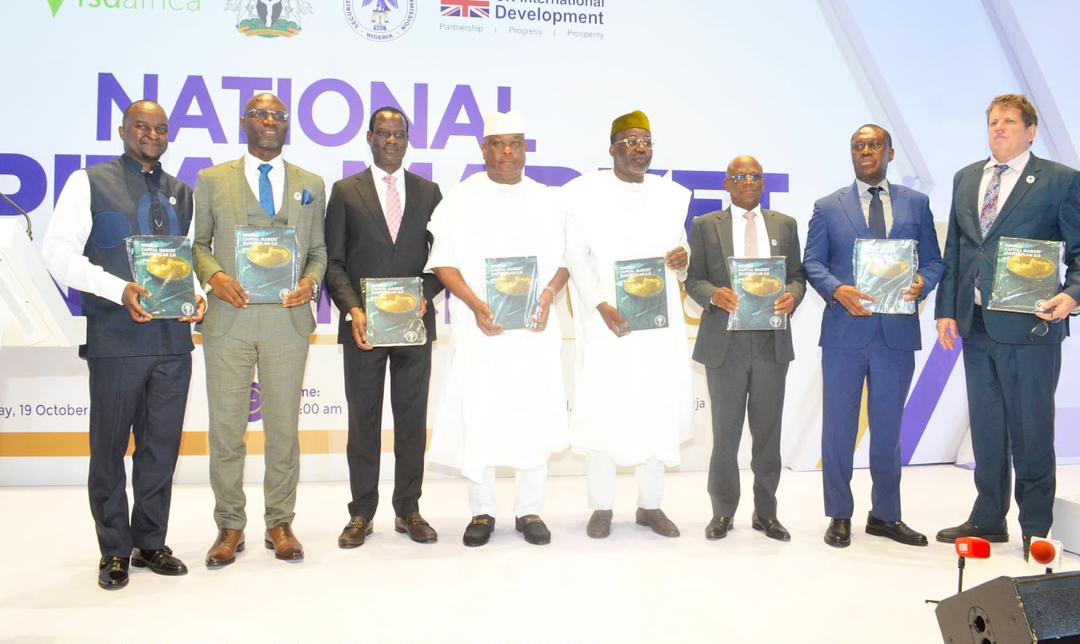

The Federal Government has unveiled a 10-year capital market masterplan and a National Savings Scheme to mobilise domestic and foreign investments, deepen financial markets and support Nigeria’s ambition to build a trillion economy by 2030
The Nigeria Capital Market Masterplan 2.0, covering 2026 to 2036, outlines reforms aimed at expanding investment opportunities, improving market efficiency and transparency, and positioning the country as a regional financial hub.
The plans were launched in Abuja on Monday by Vice-President Kashim Shettima, alongside the Minister of Finance and Coordinating Minister of the Economy, Taiwo Oyedele; the British High Commissioner to Nigeria, Peter Vowles, represented by Paul Healey; and the Chief Executive Officer of FSD Africa, Mark Napier.
Developed by the Securities and Exchange Commission (SEC), with technical support from FSD Africa funded by the UK Government, the masterplan seeks to channel more long-term capital into infrastructure, energy, small and medium-sized enterprises (SMEs), climate resilience, financial inclusion and job creation.
The roadmap sets ambitious targets for the next decade, including increasing assets under management in collective investment schemes from $5.6 billion to $56 billion, raising annual diaspora investment channelled into the capital markets from $4 billion to $10 billion, and increasing the proportion of institutional investment portfolios allocated to non-sovereign assets from about 40 per cent to 50 per cent.
It also targets a fivefold increase in corporate bonds, from 100 to 500, and an expansion in cross-border listings from five to 40 over the period.
Speaking at the launch, the Director-General of the SEC, Dr Emomotimi Agama, said the masterplan would help deepen the Nigerian capital market to the scale required to finance the country’s economic ambitions.
“Every great economy has, at its heart, a capital market that turns the savings of ordinary people into the factories, roads, homes and businesses that create jobs. Nigeria has the people, the enterprise and the ambition. What we are now building is a market to match them,” Agama said.
He said the decision to launch the masterplan alongside the National Savings Scheme reflected the government’s determination to mobilise domestic resources and channel them into productive investments.
“ Savings are the raw material of investment, and a nation that saves through its own capital market builds with its own resources,” he added.
The initiative is expected to broaden participation in the capital market by making it easier for businesses and state governments to raise funds, encouraging retail and diaspora investors, attracting more foreign institutional investors and expanding the range of financial instruments available to investors.
The proposed reforms also include measures to strengthen sustainable finance and support the development of digital and tokenised assets, while improving regulatory clarity, market infrastructure and enforcement.
The masterplan is organised around five pillars: regulatory clarity and enforcement; modernisation of market infrastructure; expansion of issuers and financial instruments; diversification of the investor base; and strengthening institutional and professional capacity.
Each pillar has a phased implementation framework with defined responsibilities, timelines and performance measures intended to track progress over the 10-year period.
The SEC said the new roadmap builds on the previous Capital Market Masterplan, which recorded an overall activity completion rate of 63 per cent. Although the earlier programme supported significant reforms, financial inclusion, regional integration, sustainable finance and the mobilisation of capital for priority sectors were identified as areas requiring further progress.
Representing the British High Commissioner, Paul Healey, Head of Green Growth and Private Sector Development at the British High Commission, said the UK was proud to have funded FSD Africa’s support for the development of the masterplan.
He described the initiative as a Nigerian-led reform that would help mobilise domestic and international investment and connect capital with commercial opportunities in businesses and infrastructure.
“Our support forms part of the wider UK and Nigeria’s Strategic Partnership, which has growth and jobs at its heart. By strengthening Nigeria’s capital markets and deepening links between our financial sectors, we can create new opportunities for investment, jobs and shared prosperity in both our countries,” he said.
Napier said the masterplan offered an opportunity to direct more domestic and international capital towards businesses, infrastructure and sustainable economic growth.
“Our support for Nigeria’s new Masterplan is grounded in the principle that capital markets need to work for the wider economy. With its scale and regional importance, Nigeria has a significant opportunity to mobilise more domestic and international capital towards businesses, infrastructure and sustainable growth,” he said.
He cited FSD Africa’s work in Zambia and Ethiopia, where support for financial market architecture and efforts to address regulatory and market constraints had helped establish conditions for greater capital mobilisation, including investment in renewable energy.
FSD Africa’s support for Nigeria has focused on strengthening the relationship between capital market development and wider economic priorities, including infrastructure financing, SME growth, financial inclusion and sustainable development.
Beyond domestic investment, the masterplan seeks to strengthen Nigeria’s position in African financial markets through greater cooperation with other countries, cross-border fundraising and listing arrangements, and closer alignment with initiatives under the African Continental Free Trade Area.
The government’s expectation is that a deeper and more diversified capital market will provide businesses with alternatives to bank lending, give investors access to a wider range of assets and help finance projects capable of generating employment and supporting economic expansion.
The success of the 2026–2036 roadmap will depend on the implementation of its proposed reforms, sustained investor confidence and the ability of the market to translate the targets into increased investment flows and productive economic activity.
