

The Federal Government’s new mineral investment framework with the United States has come under scrutiny from environmental campaigners, with the Health of Mother Earth Foundation (HOMEF) warning that the drive to attract American capital into Nigeria’s estimated 0 billion mineral resources must not reproduce the environmental and social devastation associated with oil extraction in the Niger Delta
HOMEF said the Nigeria-US agreement, while potentially opening new opportunities for investment and economic diversification, could expose mining communities to environmental degradation, displacement and loss of livelihoods if mineral development is accelerated without stringent environmental and social safeguards.
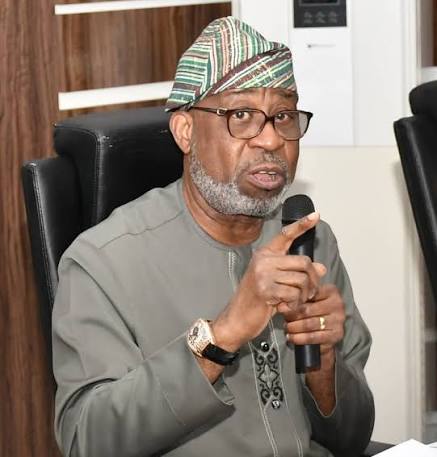
Nigeria and the United States signed the framework on September 23 on the sidelines of the 81st United Nations General Assembly in New York, with Minister of Solid Minerals Development, Dele Alake, and US Deputy Secretary of State, Christopher Landau, signing on behalf of the two countries. The framework covers cooperation in geological data and exploration, mineral development and processing, infrastructure and technical capacity.
The Federal Government has presented the agreement as part of its strategy to attract American investment, increase local processing and diversify the economy away from oil. Alake said Nigeria did not want to remain a supplier of raw materials while others captured most of the value, stressing that the country wanted local processing, skills, jobs and opportunities for Nigerian businesses.
But HOMEF Executive Director, Dr Nnimmo Bassey, urged the government to ensure that the pursuit of critical minerals does not create a new version of the resource exploitation that has scarred the Niger Delta.
“We must not reproduce that environmental genocide by replacing oil with minerals while sacrificing lives, lands, and ecosystems,” Bassey said.
He argued that without stringent safeguards, the agreement could entrench what he described as an extractive model in which international demand and investment take precedence over the rights and welfare of host communities.
The environmental group’s intervention comes as critical minerals such as lithium, cobalt, nickel and copper assume greater importance globally because of their use in batteries, renewable-energy technologies and advanced manufacturing. Nigeria’s government has increasingly sought to position its mineral resources as an alternative source of investment and economic growth.
For HOMEF, however, the central issue is not whether Nigeria should develop its mineral resources, but how that development will be carried out, who will bear its environmental costs and how much value will remain in the communities and country where the minerals are extracted.
The group expressed concern that pressure to satisfy rising global demand could encourage authorities and investors to prioritise speed of extraction and project approvals over comprehensive environmental assessment, community consultation and effective enforcement.
HOMEF said particular attention should be paid to lithium and other minerals whose extraction, it argued, could place pressure on water resources, agricultural land and rural livelihoods.
It warned that communities hosting mining projects should not be left with degraded land and contaminated water after the commercial value of the minerals has been extracted.
Bassey drew a parallel with the Niger Delta, where decades of oil production have generated longstanding disputes over pollution, environmental degradation, livelihoods and compensation.
He said Nigeria should learn from that experience before expanding another extractive industry.
“We have seen how international mining interests operate when oversight is weak, and profit is the sole motivation,” he said, warning that mineral wealth could become another resource curse if communities did not receive equitable benefits and adequate environmental protection.
HOMEF also linked its concerns to the recent deaths of 37 suspected artisanal miners in Niger State, using the incident to highlight what it described as the vulnerability of Nigerians operating in the informal mining economy.
Bassey said the incident illustrated the need to address the poverty and livelihood pressures that drive people into hazardous artisanal mining rather than relying primarily on punitive responses.
“We are deeply concerned that the rush to feed global demand for critical minerals will be prioritised over the livelihoods, health, and sovereignty of Nigerian communities,” he said.
The organisation called for greater transparency over the Nigeria-US framework, urging the Federal Government to release its full details rather than limiting public understanding to broad announcements about investment and critical-mineral supply chains.
It wants the public and civil society to know the precise environmental, labour, fiscal and community obligations attached to the agreement, as well as the mechanisms for monitoring compliance.
The demand comes against the background of the government’s stated intention that the framework should lead to more than the export of unprocessed minerals.
At the signing ceremony, Alake said the agreement was intended to facilitate cooperation in exploration, processing, infrastructure and technical capacity, while building value within Nigeria. He also acknowledged that the signing was only the beginning, saying implementation would have to produce measurable results.
“Now comes the harder and more important work: moving from agreement to implementation. A signature is a promise, results are the proof,” the minister said.
That implementation phase is where the competing expectations surrounding Nigeria’s mineral strategy are likely to become most consequential.
For the government, the opportunity lies in turning mineral deposits into investment, jobs, processing capacity, infrastructure and a new source of economic activity.
For environmental and community advocates, the concern is that the same process could reproduce familiar patterns in which raw materials leave host communities while pollution, degraded ecosystems and social disruption remain behind.
HOMEF therefore called for host communities, civil society organisations and other stakeholders to scrutinise the emerging mining framework, particularly its provisions on environmental protection, labour standards, community rights, revenue and local value addition.
The group also urged the government to ensure that environmental and social impact assessments remain robust and that community development commitments are properly implemented rather than treated as administrative requirements.
Nigeria’s mining sector has long struggled with illegal and artisanal mining, inadequate geological data, limited processing capacity, weak infrastructure and insufficient investment. The Federal Government has been seeking to formalise the sector and attract capital while increasing domestic value addition.
Washington has an interest of its own in diversifying critical-mineral supply chains, as countries increasingly compete for secure access to minerals needed for energy technologies, manufacturing and other strategic industries. Reuters recently reported that global competition for critical resources including rare earths, copper, lithium and gold is intensifying.
The US agreement with Nigeria is therefore not simply an investment initiative. It also sits within a wider international contest over access to strategic mineral resources and resilient supply chains.
That makes the question of governance particularly important, HOMEF argued.
Bassey said Nigeria’s mineral wealth should first serve the country’s development needs and should not be reduced to a source of raw materials for foreign industrial powers.
HOMEF’s call is not for Nigeria to abandon mineral development, but for the government to ensure that investment does not come at the expense of communities whose lands and livelihoods are directly affected by mining.
The organisation said Nigeria’s long-term prosperity depended on protecting ecosystems, strengthening local economies and ensuring that Nigerians captured meaningful value from their natural resources.
The government, meanwhile, has maintained that local value addition is central to its strategy. Alake said Nigeria’s objective was to move away from simply exporting raw materials by developing processing, skills, jobs and stronger opportunities for Nigerian businesses.
The challenge now will be translating that ambition into enforceable rules and measurable benefits at the point where mining actually takes place.
For communities sitting above Nigeria’s lithium and other strategic mineral deposits, the debate is therefore moving from how much investment the country can attract to what safeguards, jobs, revenues, infrastructure and environmental guarantees will accompany that investment.
As the Nigeria-US framework moves from signing to implementation, HOMEF is demanding that the government make those conditions clear before the rush for critical minerals gathers further momentum.
