

By Sam Israel
On October 1, 1996, Nasarawa State was created from the former Plateau State by the military administration of General Sani Abacha. Thirty years later, the state stands at an important crossroads—not merely celebrating its age, but reflecting on the journey from its difficult beginnings to the present moment.
When Nasarawa was created, it did not inherit the infrastructure or institutional advantages enjoyed by some of the other states created around the same period. At the recent Nasarawa@30 colloquium, former INEC Chairman Professor Attahiru Jega recalled that the state began with roughly one tarred road, no water board and no secretariat, while internally generated revenue accounted for only 3.7 per cent of the state’s budget in 1997.
Thirty years later, the picture is substantially different. Jega reported that the state now has about 1,500 kilometres of tarred roads, 1,659 public primary schools, 490 secondary schools, 895 primary healthcare centres and 18 tertiary institutions. He attributed the transformation to the cumulative efforts of successive administrations .
THE FOUNDATION YEARS: ABDULLAHI IBRAHIM AND BALA MANDE*
The first two administrations were military administrations.
Wing Commander Abdullahi Ibrahim served as the first Military Administrator from October 1996 to August 1998. His administration operated during the formative period when the new state was establishing its basic governmental identity and institutions.
He was succeeded by Lieutenant-Colonel Bala Mande, who administered the state from August 1998 until the restoration of democratic government on May 29, 1999.
Their period was essentially the foundation stage: establishing the machinery of a newly created state and preparing the ground for elected civilian government.
ABDULLAHI ADAMU: BUILDING THE FIRST CIVILIAN FOUNDATION*
On May 29, 1999, Abdullahi Adamu became Nasarawa’s first democratically elected governor. He served two terms, from 1999 to 2007.
His administration inherited a young state with major institutional and infrastructural deficiencies. Among the developments associated with that period was the establishment of Nasarawa State University, Keffi, in 2002. Other accounts of the administration also identify the establishment and development of tertiary institutions and rural-road construction among others.
The Adamu administration also pursued the development of the Farin Ruwa hydroelectric project, reflecting an early attempt to address the state’s energy deficit and exploit its natural resources. Contemporary historical accounts note that the project was substantially advanced but was not completed before the administration left office.
Adamu’s eight years therefore represent an important part of the state’s institutional foundation.
ALIYU AKWE DOMA: AGRICULTURE AND CONTINUITY*
Aliyu Akwe Doma succeeded Adamu in 2007 and governed until 2011.
Doma’s administration placed considerable emphasis on agriculture. Historical accounts particularly associate his government with the Bakodoshi agricultural programme and efforts to develop Nasarawa’s agricultural production and markets, including the promotion of yam exports.
His administration also inherited institutions and projects established under the preceding government and continued the process of consolidating a young state whose economy remained heavily dependent on agriculture and federal allocations.
Doma’s four-year tenure was relatively short compared with the eight-year administrations that preceded and followed it, but it forms part of the cumulative development story of Nasarawa.
TANKO AL-MAKURA: URBAN RENEWAL AND INFRASTRUCTURE*
In 2011, Umaru Tanko Al-Makura became governor, ending the PDP’s twelve-year hold on the governorship. He served from 2011 to 2019.
The Al-Makura administration became particularly associated with urban renewal and road construction, especially in Lafia and the Greater Karu axis.
Historical assessments credit the administration with substantial investment in roads, schools and healthcare infrastructure. A contemporary account of the period reported extensive rural-road construction and improvements to primary healthcare facilities, while another retrospective identified the transformation of Lafia’s physical environment as one of the administration’s prominent legacies.
Al-Makura’s tenure therefore represented another stage in Nasarawa’s development: moving beyond merely establishing institutions toward improving the physical appearance and infrastructure of communities and the state capital.
ABDULLAHI SULE: INDUSTRIALISATION, INVESTMENT AND CONSOLIDATION*
In May 2019, Engineer Abdullahi A. Sule became governor and remains in office until 2027.
With a background in engineering and the private sector, Sule entered government with an emphasis on economic development, investment, industrialisation and infrastructure. His administration’s development strategy has focused on creating an environment capable of attracting investment while expanding infrastructure and economic opportunities.
At the Nasarawa@30 colloquium, Professor Jega specifically highlighted the Sule administration’s record in urban renewal, health, agriculture, education, industrialisation and mining. He reported that approximately 639 kilometres of roads had been delivered during Sule’s tenure as of 2026.
The state’s growing profile in solid minerals, including lithium, has also become a major component of the economic conversation around Nasarawa. Wadada himself has identified energy and mineral resources as a major pillar of his proposed development framework.
Thus, the Sule years can be viewed as another phase in the state’s evolution—from building basic infrastructure toward attempting to position Nasarawa as an investment, industrial and mineral-resource destination.
THE NEXT CHAPTER: WHERE DOES NASARAWA GO FROM HERE?*
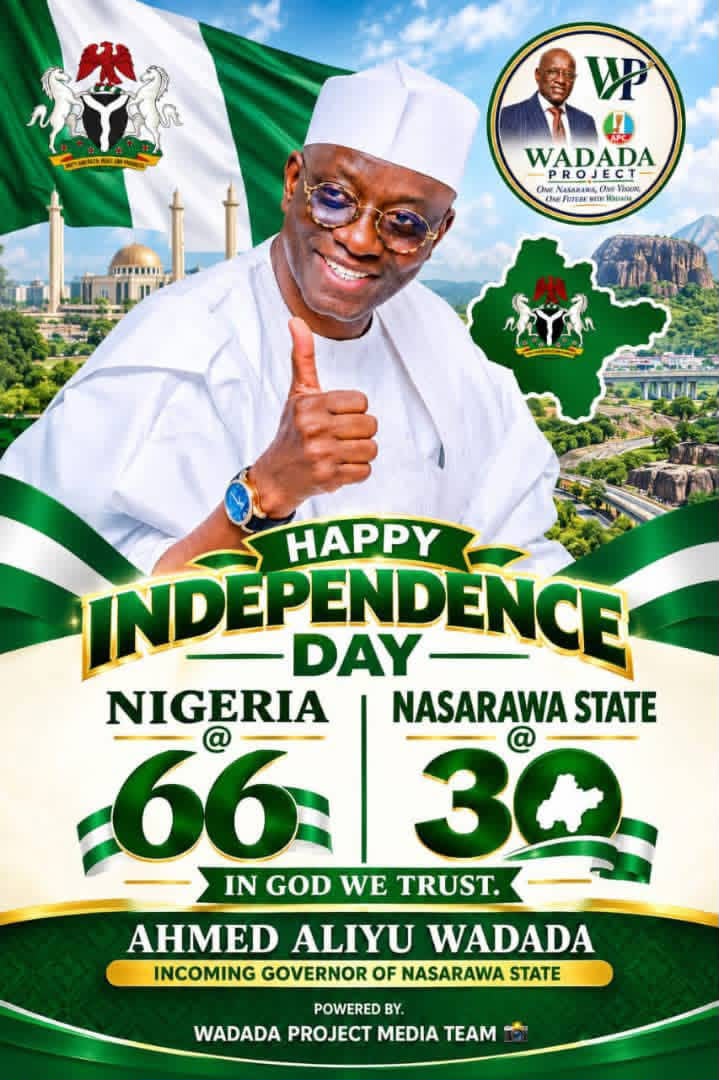
This is where Senator Ahmed Wadada Aliyu enters the political conversation surrounding 2027.
Wadada’s record predates his current Senate position. According to his official biography, he represented Keffi, Karu and Kokona Federal Constituency in the House of Representatives from 2003 to 2011, before becoming Senator for Nasarawa West in 2023. His legislative responsibilities have included committee assignments in areas such as capital markets, gas, national security, commerce and media.
His immediate past Senate responsibilities include serving as Chairman of the Senate Committee on Public Accounts, a position concerned with parliamentary scrutiny of public expenditure and government accounts.
During his Senate tenure, reports have attributed several legislative and constituency initiatives to him. These include advocacy for upgrading the Federal Polytechnic Nasarawa, which has received the approval of Mr. President and turned into a special science Univerestablishing a School of Fishery and Aquatic Sciences in Umaisha, upgrading the Nasarawa State Specialist Hospital in Lafia to a teaching hospital, and interventions concerning federal roads.
One particularly significant infrastructure matter associated with Wadada is the Keffi–Nasarawa–Toto–Abaji road corridor, which is currently being constructed through a special Federal Government fund as approved by President Ahmed Bola Tinubu.
THE HEARTS AGENDA*
Wadada has also publicly presented his proposed development framework for Nasarawa under the acronym HEARTS.
The components he has outlined include:
- H — Human Capital Development: education, healthcare and development of people.
- E — Energy and Mineral Resources: exploiting Nasarawa’s energy and mineral potential.
- A — Agriculture and Green Economy: agricultural production, food security and value chains.
- R — Rural and Urban Development: infrastructure and balanced community development.
- T — Trade, Investment and Industry: expanding economic opportunities and employment.
- S — Security: creating the conditions necessary for communities and businesses to prosper.
Wadada has described the agenda as an effort to sustain and deepen the development trajectory established by the Sule administration.
That distinction is important.
The political question before Nasarawa is not simply who can promise another road, another school or another project. It is how the next administration will convert three decades of accumulated public investment into a more productive economy, better human capital, stronger institutions, agricultural value chains, mineral-resource development, security and employment.
FROM FOUNDATION TO TRANSFORMATION—AND FROM TRANSFORMATION TO CONSOLIDATION*
Thirty years of Nasarawa history reveals a succession of development phases.
The military administrators established the basic machinery of the new state.
Abdullahi Adamu concentrated on establishing institutions and infrastructure during the transition to democratic government.
Aliyu Akwe Doma placed significant emphasis on agriculture and continuity.
Tanko Al-Makura became strongly associated with urban renewal and infrastructure.
Abdullahi Sule has emphasised investment, industrialisation, mining, infrastructure and economic diversification.
The next administration will inherit the accumulated achievements—and unresolved challenges—of all these periods.
That is the significance of 2027.
It is not simply about changing the occupant of the Government House. It is about determining what Nasarawa does with the foundation built during its first 30 years.
Senator Ahmed Wadada Aliyu has placed himself before the electorate as a candidate proposing continuity with the development achieved under Sule while introducing his own HEARTS framework. His experience across the House of Representatives and Senate, his current Public Accounts Committee leadership and his proposed policy agenda provide identifiable elements for citizens and analysts to examine .
NASARAWA @ 30: THE STORY CONTINUES*
From one tarred road to about 1,500 kilometres of tarred roads.
From no tertiary institution to 18 tertiary institutions.
From a state struggling to establish its basic administrative structures to a state attracting national attention for agriculture, solid minerals, investment and industrial development.
That is the Nasarawa story at 30.
But anniversaries are not only about celebrating the past. They are also opportunities to ask what the next generation deserves.
Thirty years have built the foundation. The next chapter must determine how effectively that foundation is converted into prosperity, opportunity, security and inclusive development for the people of Nasarawa State.
Happy 30th Anniversary, Nasarawa State.
Israel JP is the Senior Special Assistant on media to Senator Ahmed Wadada Aliyu.
