

|
Getting your Trinity Audio player ready...
|
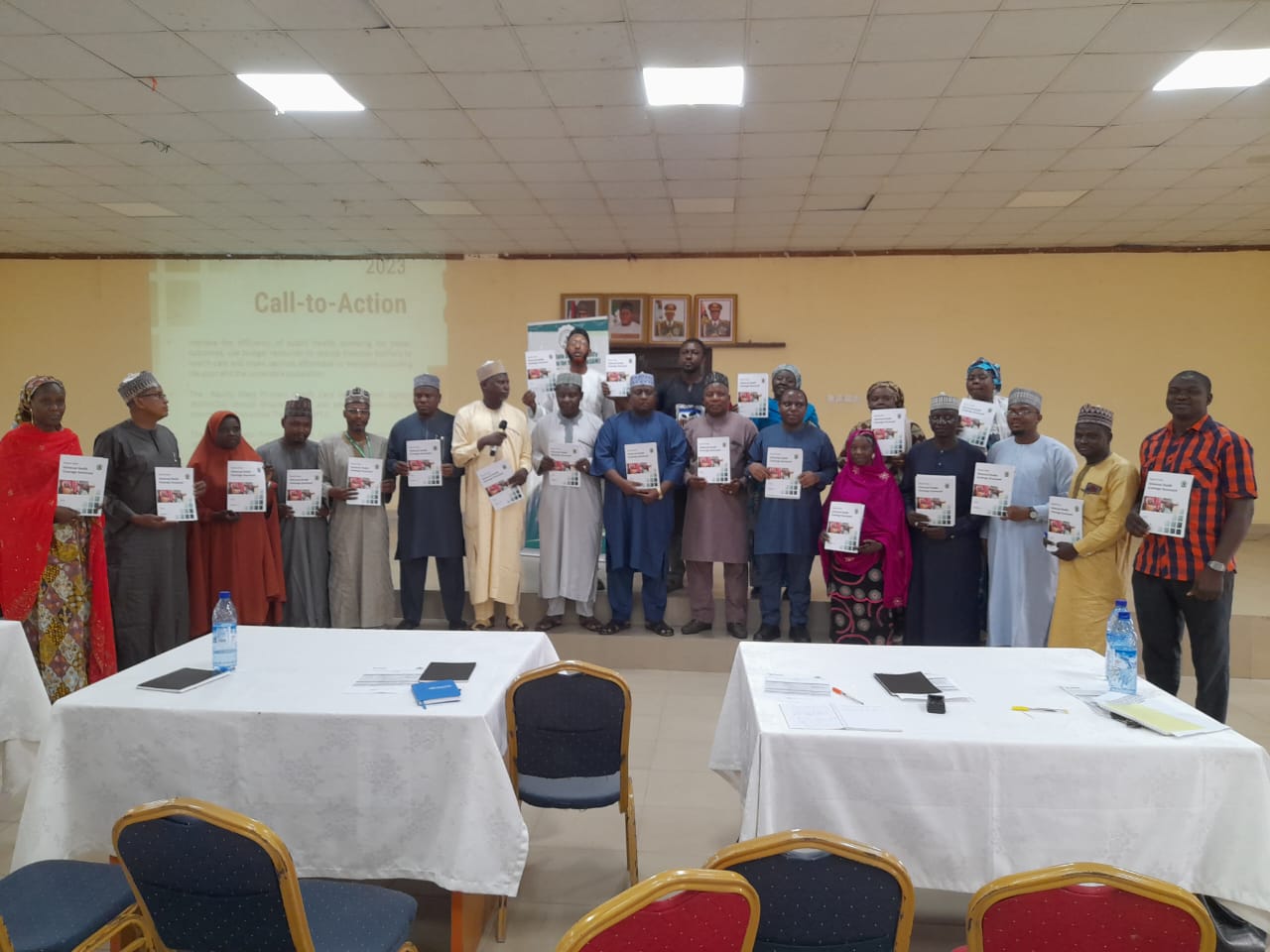
Participants at the UHC scorecard dissemination meeting
By Akanji Olowolodu, Bauchi
A Bauchi-based Civil Society Coalition, Bauchi State Accountability Mechanism for Maternal and Child Health (BaSAM), in continuation of its quest for improved healthcare delivery services in the State, has promised to use the Scorecard it developed to advocate for policy change that could be focused towards attaining Universal Health Coverage (UHC) in the State and the Nation at large.
This is inline with the global target of attaining Universal Health Coverage (UHC) by SDGs target of 2030, making the Coalition with technical support from USAID funded Integrated Health Program (USAID-IHP) developed and disseminated first ever Bauchi State UHC Scorecard.
A brief on how the UHC scorecard came about was given during the Quarterly Health Financing Technical Working Group and UHC scorecard dissemination held at the Command Guest House, Bauchi, by the State Ministry of Health in collaboration with USAID-IHP.
Co-Chair of BaSAM, Abu John Yusuf said that though this was not the first time BaSAM was developing health scorecard in the State, what makes the current one different, was the harmonization of all the health components in the areas of service delivery, quality improvement and health financing into one document for ease of use.
Abu John called on the State Government to increase investment in the health sector with a view to addressing some of the gaps identified in the new UHC scorecard.
While explaining the health financing component captured in the scorecard, USAID-IHP Health Financing Advisor, Pharmacist Khalid Kasimu said that, the state government’s spending on health is inadequate as the state has an increasing population with over 70 percent living below poverty line.
Pharmacist Kasimu further explained that the financial risk protection data indicates that less than 5 percent of the state population has financial risk protection, which implies that health expenditure is majorly through household out-of-pocket expenses.
This, according to the Health Financing Specialist, has the potential to push more households into poverty, a development he said will hamper the objectives of the UHC.
Khalid Kasimu also said that it has become imperative for Bauchi State Government to ensure timely release of equity funds for the enrollment of poor and vulnerable households into the financial risk protection scheme of the state health contributory scheme.
With regards to service delivery in the healthcare sector, USAID-IHP Monitoring and Evaluation Specialist, Adeyemi Samson said that Bauchi State is faced with an increase in maternal and child mortality despite the general increase in service delivery data from 2021 to 2022.
He said that the quality of Antenatal Care (ANC) services still need to improve as ANC 4, use of IPT and facility delivery is still below acceptable limits.
The M&E Specialist then suggested on the need to have a significant improvement towards achievement of the 2030 SDGs target of reducing maternal death to less than 70 per 1000 live birth per year.
Adeyemi Samson also gave the current status of under five children and neonatal mortality rate in the state as contained in the new UHC scorecard.
Earlier in a welcome address, Bauchi State Commissioner of Health, Dr. Sabiu Abdu Gwalabe commended the efforts of BaSAM and USAID-IHP for the giant strides in coming up with the first ever State UHC Scorecard, which he described as reference point for other States to follow.
Represented by the Permanent Secretary of the Ministry of Budget and Economic Planning, Alhaji Sale Idris Giade, the Commissioner said the state government would continue to improve its healthcare system through policy implementation and other programs in the health sector.
There were goodwill messages from Bauchi State Primary Healthcare Development Agency, WHO, UNICEF, USAID State2State and other partners, where they all commended the effort of BaSAM and USAID IHP in developing and disseminating the scorecard.
At the end of the dissemination meeting, BaSAM called the state government to:
Improve the efficiency of public health spending for better outcomes, use budget resources to reduce financial barriers to health and make services affordable to everyone including the poor and vulnerable population.
It also called that Bauchi State Primary Healthcare Development Agency should ensure regular and adequate provision of intermittent preventive treatment (IPT2) at all health facilities across the state.
The Agency should prioritize awareness creation on the use and availability of modern methods of contraceptives for women of child bearing age to increase Family Planning uptake.
Also, the State Government should revisit the challenges around human resource for health with a view to bridging the gaps occasioned by inadequate manpower.
The focus of Universal Health Coverage (UHC) is aimed at ensuring people have access to the health care they need without having to go through financial hardship. UHC target is that by 2030, the initiative will eliminate preventable maternal and child deaths, strengthen resilience to public emergencies, reduce financial hardship linked to illness, and further enhance the foundation for long term economic growth.
