

|
Getting your Trinity Audio player ready...
|
By Ibrahim Kaula Mohammed
Why EMOG Is Betting on Katsina State
One month after the curtains fell on the Katsina Economic and Investment Summit, its true significance is no longer measured by speeches or communiqués, but by action. Quietly and steadily, the Summit has begun to translate into concrete partnerships, institutional alignment, and investment decisions—none more symbolic than the strategic engagement between the Katsina State Government and Equatorial Marine Oil and Gas (EMOG) on the expansion of the Funtua Inland Dry Port.
What began as a bold conversation on Katsina’s economic future has now moved firmly into execution.
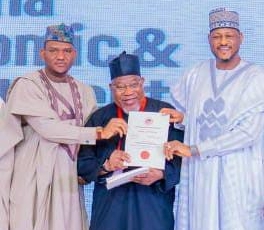
Revisiting his remarks at the Summit and the subsequent signing of a landmark Memorandum of Understanding, the Chairman of EMOG, Alhaji (Dr.) Umaru Abdul Mutallab, offered rare insight into why Katsina stood out—and why EMOG decided not just to announce interest, but to commit capital, equity, and long-term strategy to the state.
According to him, EMOG’s decision was shaped by ten critical post-Summit takeaways—not abstract promises, but practical signals that Katsina is fast emerging as a credible logistics, trade, and investment hub for Northern Nigeria and the wider Sahel.
Leadership Certainty and Policy Stability
At the heart of EMOG’s confidence, Dr. Mutallab explained, is the clarity and consistency of leadership coming from the Katsina State Government. Governor Dikko Umaru Radda’s economic vision, which deliberately prioritizes logistics, agriculture, and manufacturing, sent a clear message to investors: policy direction is stable, reform-driven, and anchored in long-term planning.
For an infrastructure-heavy investment like an inland dry port, this assurance was not optional—it was decisive.
Clear Ownership, Clear Accountability
One of the most significant post-Summit milestones was the formal creation of Funtua Inland Dry Port Limited, a special-purpose vehicle established to drive the next phase of the port’s development.
Under the agreed structure, EMOG holds 80 percent equity, while the Katsina State Government retains 20 percent. This arrangement, Dr. Mutallab noted, strikes a deliberate balance—protecting public interest while allowing private-sector discipline, technical expertise, and global market access to drive efficiency and performance.
It is a partnership model designed for delivery, not symbolism.
Federal Recognition That Unlocks Financing
The dry port’s gazetted status as a port of origin and final destination has fundamentally changed its investment profile. With full federal recognition, the Funtua Inland Dry Port is no longer a regional aspiration—it is a bankable logistics asset.
This status enables producers across Katsina, Zamfara, Sokoto, Kebbi, Kaduna, and even neighboring Niger and Chad, to access international markets directly, without routing cargo through congested coastal ports.
Institutions Aligned, Not Obstructing
Dr. Mutallab was clear that regulatory certainty played a crucial role. He acknowledged the Nigerian Shippers’ Council for providing strong regulatory leadership and the Nigeria Customs Service for facilitating the first import container into the port.
These actions, he said, sent an unmistakable signal that the project enjoys institutional support—not resistance—and that government agencies are aligned behind its success.
A Defined Investment Timeline
Unlike many post-Summit announcements that fade into uncertainty, EMOG’s engagement comes with a clear investment horizon. Over the next 12 to 18 months, the company is committing significant capital to expand and modernize the port’s infrastructure.
Planned investments include new cargo-handling equipment, expanded paved yards, upgraded warehouses, modern lighting, digital port management systems, and enhanced safety and security infrastructure—laying the foundation for a fully competitive inland logistics hub.
From Promises to a Five-Point Action Framework
At the Summit, EMOG outlined a five-point commitment framework. One month later, Dr. Mutallab confirmed that these commitments are now actively guiding implementation.
They include operational scale-up of the port, targeted support for exporters, the Sahel Transit Programme, youth skills development through the Katsina Logistics Careers Programme, and support for key enablers such as Free Zone licensing and tailored investment incentives.
In his words, the Summit marked the announcement; the aftermath is about execution.
Lower Costs, Stronger SMEs
A central motivation behind the port expansion is cost efficiency. The upgraded facility will shorten cargo turnaround times, improve access to empty containers, and significantly reduce logistics costs.
For small and medium-scale enterprises, this translates into lower pressure on working capital, improved competitiveness, and the ability to scale operations—particularly for export-oriented businesses that have long struggled with logistics bottlenecks.
Agriculture as the Anchor
Katsina’s strength in export-ready agricultural commodities remains a core driver of EMOG’s investment. Sesame, ginger, soya beans, hibiscus, and tiger nuts are already attracting international demand.
Plans are underway for dedicated stacking areas, predictable export cut-off times, and priority export lanes—measures designed to give exporters certainty and buyers confidence.
Opening the Sahel Corridor
Post-Summit engagements have also extended beyond Nigeria’s borders. Discussions with chambers of commerce and major cargo owners in Niger and Chad have revealed strong interest in routing transit and humanitarian cargo through Funtua.
This development reinforces Katsina’s emerging role as a natural gateway to the Sahel, positioning the state at the center of regional trade and humanitarian logistics.
Rail Connectivity and Long-Term Vision
Finally, Dr. Mutallab emphasized that Katsina State’s commitment to rail connectivity, particularly plans to link Funtua to the standard-gauge network, weighed heavily in EMOG’s long-term outlook.
Combined with continued policy stability and infrastructure investment, rail access strengthens the port’s future viability and cements Katsina’s place in national and regional supply chains.
From Summit to Strategy
In closing, Dr. Mutallab made one point unmistakably clear: EMOG’s investment is no longer a Summit headline.
It is a structured, equity-backed partnership, moving steadily into implementation—built on confidence in Katsina’s leadership, strategic geography, and economic vision.
More importantly, it is designed to deliver jobs, sustainable growth, and expanded trade not only for Katsina State, but for Northern Nigeria and the wider Sahel.
The Summit may have lasted days.
Its aftermath, it seems, is shaping years.

Comments are closed, but trackbacks and pingbacks are open.