

|
Getting your Trinity Audio player ready...
|
By Anthony Maliki
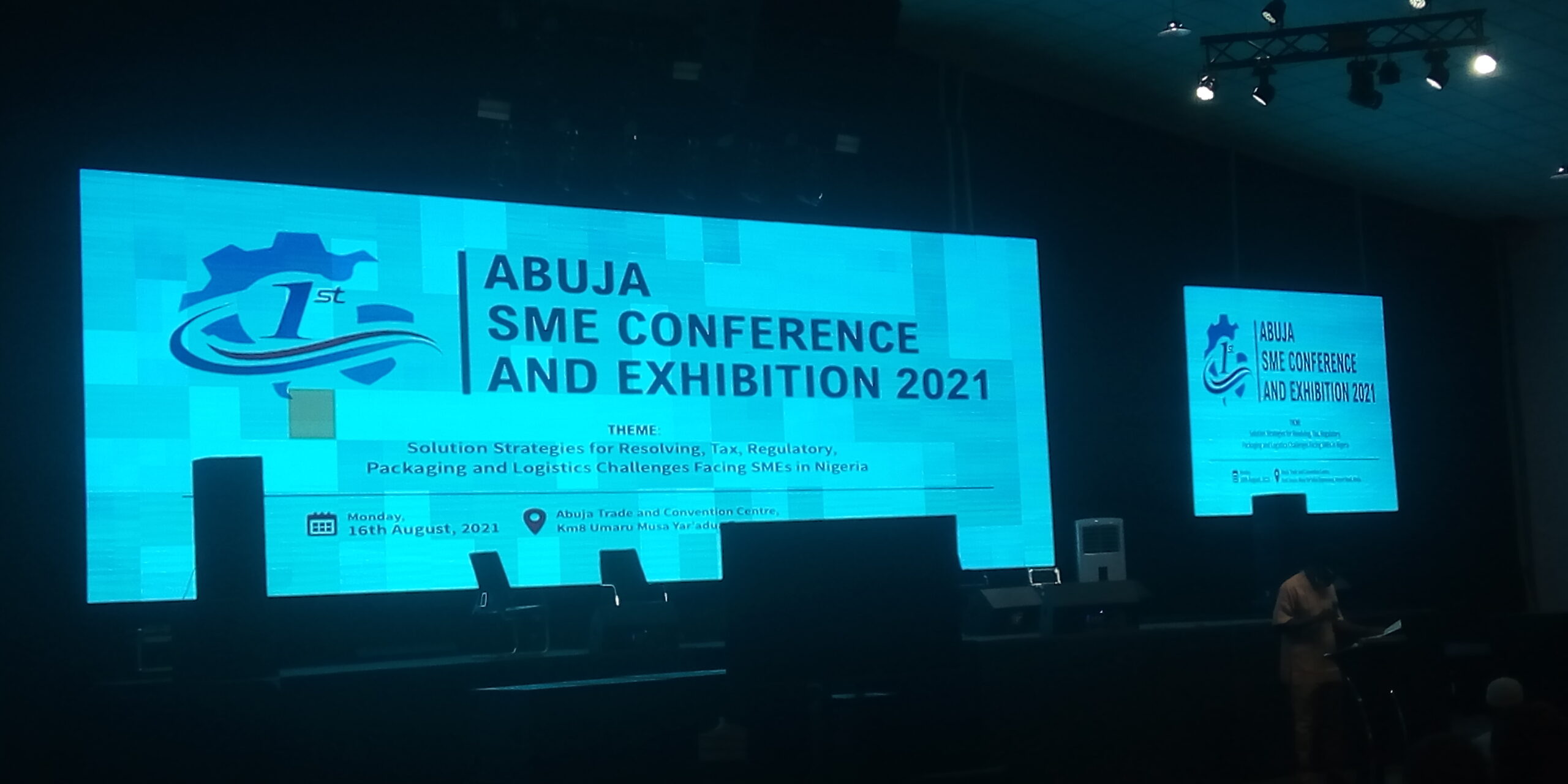
Nigeria Vice President, Professor Yemi Osinbajo and other stakeholders on Monday in Abuja agreed that multiple taxes are scuttling the growth of Small and Medium Enterprises (SMEs) in Nigeria and should be addressed.
They bear their minds at the maiden “Abuja SME Conference and Exhibition 2021” organised by the Abuja Chamber of Commerce and Industry (ACCI) in collaboration with Brandmarks Communication Limited, Federal Capital Territory Administration (FCTA), Federal Ministry of Trade and Investment and Sahel Standard Magazine.
The theme of the event was “Solution strategies for resolving, tax regulatory, packaging and logistics challenges facing Nigeria.”
The Vice President noted that in order to resolve some of these challenges, streamlining of taxes across national and sub-national levels must be done among others.
Osinbajo was represented by the Minister of State, Industry, Trade and Investment, Ambassador Mariam Katagum.
He also said some specific actions like sensitization and awareness creation, general capacity building, implementation of relevant sections of the Finance Acts, specific technical training on packaging and logistics, sharing of knowledge and peer review with SMEs in other jurisdictions, strict observance of international standards and regulatory authorities develop friendly criteria for SMEs must be put in place.
Professor Osinbajo noted that Nigerian businesses would have to adapt to the new form of competition, on the back of the trade environment, created by Africa Continental Free Trade Area, (AfCFTA) where a new market of 1.2 billion people and a cumulative GDP of over $3.4 trillion has been opened.

He explained that MSMEs have recorded over 41 million participating enterprises, accounting for about 76% of the Nigeria’s labour force and adding about 50% to the Gross Domestic Product (GDP).
“For a sub-sector faced with several inhibiting constraints such as poor access to finance, lack of access to local, regional and global markets, lack of access to quality skills, infrastructure, modern technology, lack of access to quality packaging, multiple taxation, logistics bottlenecks among others to have made such impact on our national economy, only goes to reinforce our resolve to deliberately support and optimize the level of competitiveness of our MSMEs sub-sector,” he stressed.
According to him, it is in that trajectory that the Federal Executive Council approved the revised MSME policy, which was the outcome of a rigorous exercise embarked upon by the stakeholders in the MSME ecosystem.
In his submission, the President, Abuja Chamber of Commerce and Industry, Dr. Al-Mujtaba Abubakar said in a letter to the President on behalf of the Chamber last month, it submitted that multiple taxation as the principal headache killing SMEs and in effect, deepening unemployment crisis.
According to him, the Chamber proposed a legislation to harmonize taxation for SMEs of which detailed submission also seeks a Presidential Executive Order collating all current incentives for SMEs and issuing directive for due compliance.
He, however, commended the Federal Government for introducing so many initiatives, interventions and innovations to develop the sector indicative of the administration’s commitment to the growth and development of the SME.
The Chairman, Senate Committee on Trade and Investment, Senator Francis Fadahunsi also noted that multiple taxation is a major problem and SMEs ought to be given tax holidays as done in many economies.
According to him, micro economies have been abandoned in Nigeria explaining that no country can grow without the SMEs as they are the foundation of the economy.
He said the national assembly is ready to assist in making the SME sub-sector successful but the driving agencies must include them in the budget.
A Consultant and SMEs operator, Dr. Franklin Akinyosoye while noting multiple taxes are the bane of SMEs in Nigeria, urged the government to provide the enabling environment to make small businesses strive.
“You cannot kill the SMEs and expect the economy to grow,” Dr. Akinyosoye stressed.
In a goodwill message to the occasion, the National President, Nigerian Association of Chambers of Commerce, Industry, Mines and Agriculture (NACCIMA), Ide John Udeagbala said SMEs are the engine room of every nation and play important and critical roles for the growth and development of every economy across the world.
The speech was read by 1st Vice President of NACCIMA, Dele Kelvin Oye, who is also Deputy Treasurer, Federation of West Africa Chambers of Commerce and Industry (FEWACCI).
According to him, the conference and exhibition provides a platform for relevant stakeholders to come together to showcase potentials of our SMEs and also draw attention to the challenges faced by them.
He also pointed out that it is important for the government at all levels to pay attention to the needs of the SMEs to enable them fully harness their potentials as veritable vehicles of inclusive economic growth and development.
Udeagbala also urged government to restrict massive importation of foreign goods, especially those goods that the SMEs can produce locally in order to protect them against competition with foreign firms.
