


|
Getting your Trinity Audio player ready...
|
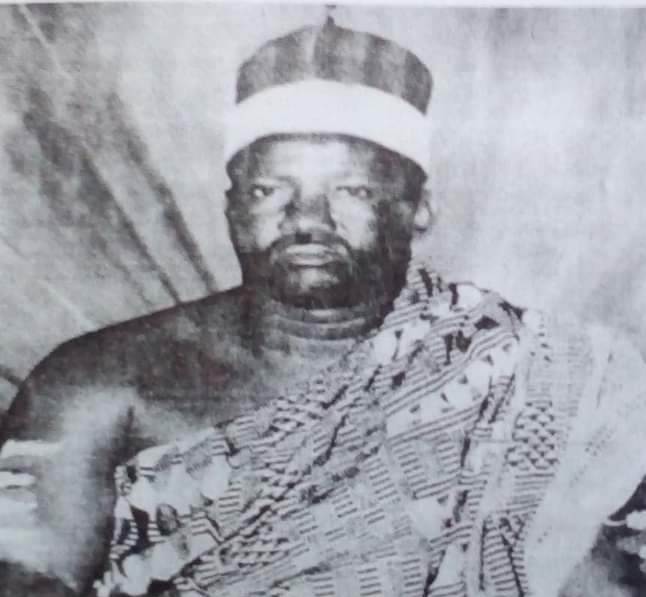
Former Akubise, late Clement Asuku Abayilo
By HRH Dr. Sabo Azyidoku Emmanuel
The man died, is still alive physically but spiritual the man died. THE MAN DIED is neither a summary, an epitome of Wole Soyinka’s prison notes, nor is it a perfect projection of a male person, of humans, of particular type of man, used as for addressing a male person, a husband as a sexual partner etc. But rather, the man died in THE MAN DIED, as a statement of facts, hypothetically, thus not hyperbolic, is about the person, male/female, who suffers depredation from being strong and brave. Such a person who is supposed to have other qualities that some people think are particularly male. Besides, the man died is the inability to man up, a situation to start or continue being brave or strong in order to deal with a difficult situation. This lax to tell or stand for what he really thinks is, is the man died in THE MAN DIED; a statement of facts to redeem to rescue, to resuscitate the Jukun Wanu brotherhood.
The man died has been instrumental to some woes, evils bedeviling the contemporary society today. When the man died, there is no wisdom but there is
intelligence. When the man died, there is no courage but there is pretex/cowardice.
When the man died, there is no love but infatuation. When the man died, there is no trustworthiness but hypocrisy. When the man died, there is no sacrifice but betrayal. When the man died, cultural identity is subsumed to alien cultures, etc.
Don’t doubt it Chers compatriots, for the man died is still alive. The man has body, but has no soul and spirit. May be a tutorial lesson from a Metaphysicist will
elucidate further and better. Away in the parable of the Sower: pleasures temptations, pestilence, phantasm, gullibility, dicta etc, all formed part to a whole to have made him the villain of the piece. Insistently, when the man died, people are diddled out of their wholesomeness by the villain. This odious scenario seldom generate odium to a blown-off affray that no amount of ablutions can make a touch up. Characteristically, the man died is an egoist, arrogant, schismatic, schadenfreude, thus has no milk of human kindness. The man died has no glamour of literary
appreciation of an Ode, but makes an Orgy of hocus-pocus as a Ruritanian. As he waddles and waggles, the man died has a disciple of fellowership in the usual
follow the leader game follow up; typically brazen. Painfully, the society accepts the man died as faux de mieux and exculpates the gambit. Thus, the society is
lovelorn. No ordour.
Alas, the man died is Lucifer incarnate, an inductee in the refresher course workshop, graduating in solipsism, philosophically. Hence the man died artistically
symbolized such actions in THE MAN DIED, that are below human comprehensions and standards. The man died could be in any body that exhibits those bizarre tendencies in a typically Jukun Wanu society, today, the writer inclusive, not at awol, anyway.
For instance, in religiosity, not religious, when the man died, the velvet hearted cap prophet, brother Jero, expressed banalities in action and deed that belittled the revered man of God. Corruption in whatever form or magnitude takes the centre stage and is being promoted and celebrated when the man died. Factually, vision, mission elude the cognoscenti in their imbecility for catholic tastes, now considered fait accompli. Invariably, the man died in a person has no leading voice of moderation and is seen begging the issues. Eventually, there is therefore, vulnerability of the man died.
This is a didactive piece for deductive/inductive reasonings for the man died to recuperate. The man died in THE MAN DIED, coute que coute is a statement of facts, tout court. This could be a bait, a balm for the intelligentsia.
