

|
Getting your Trinity Audio player ready...
|
Maryamu
By Akanji Alowolodu, Bauchi
It is not a fable that girl child education in the Northern part of the country is a no go area because many households do not support the system of sending girls to school particularly for Western education with no real reason other than the misconceptions that the girl child is only good for domestic purposes.
It was that misconceptions that necessitated the the coming of the United Nations Children Fund (UNICEF) under the funding of Foreign and Commonwealth Development Office (FCDO) of the UK to expend the sum of $109,198,039 for the implementation of the Girl Education Project (GEP) for the 10 years of the project which was aimed at increasing the enrollment of girls in schools.
The project was implemented in 6 Northern states of Bauchi, Kano, Katsina, Niger, Sokoto and Zamfara with commitment by each participating state based on collaboration which was a huge success as it exceeded the target set before the beginning of the project in 2012 with initial 5 states before Kano was included in 2018.
The aim of the project was to ensure that at the end of the implementation of the GEP, not fewer than one million girls would have been enrolled into the various stages of schools and the good news is that by the end of the project in September 2022, the project would have recorded a total of 1.4 million girls across the 6 implementing states. The aim and objectives of the project has been achieved”.
It is 10 years now that UNICEF introduced the Girls Education Project Phase 3 GEP 3 in six northern states with the aim of enrolling one million girls as well as ensuring their retention, completion and transition to higher level of education.
GEP 3 is a long term project that commenced in 2012 which is expected to end on September 30, 2022 seeking to improve school access, retention and learning outcomes for girls by piloting a series of interventions in primary schools and Integrated Qur’anic schools (IQS) which are most effective in improving education outcomes for girls will be scaled
Experts have agreed that dealing with the challenge of the more than 10.2 million out-of-school children in Nigeria has proved herculean over the years, especially in the northern part of Nigeria, due to street hawking by children of school age, lack of adequate attention to girl-child education and the Almajiri syndrome.
In Bauchi state, which is one of the benefiting states of the project, the impact has been positively felt as the number of girls enrolled in the schools has greatly improved as outlined by the Education Secretary of Ningi LGEA who said that the Girl Education Project (GEP3) which was aimed at correcting the consolidated gaps of the executed project of GEP-II which lasted for the period of 8 years has recorded a tremendous success.
In the LGA, 18 schools comprising 9 Primary Schools and 9 Junior Secondary Schools were Selected for the project and they received series of capacity building trainings including SBMC Roles and Responsibilities; Safe School and Learning as well as Psychosocial Support training and G4G training for both mentors and learners.
The Ningi Education Secretary, Danladi Sabo Mahmoud disclosed that the participants trained includes: 90 SBMC members of primary schools who received refresher training on safe school and learning.
Also, a total of 170 SBMC Members from JSS were trained on Safe school and Learning; 556 G4G Girls and 470 He4she were trained on Leadership and Life Skills just as 90 SBMC members from JSS were trained on their Roles and Responsibilities.
The training was also conducted for 54 participants who were mainly Head Teachers, Principals, SF Chairmen and Para-Counselors who were trained on psycho social support.
Further more, Danladi Sabo Mahmud said that 56 G4G mentors were trained on the Learning G4G Manual; 54 G4G officials from JSS were trained on Menstrual and Hygiene Management just as 650 G4G Girls were also trained on Menstrual Hygiene Management at school level training for the G4G officials.
The LGEA Education Secretary while analyzing the positive impact of THE6 project said that most of the school records were updated based on the training received by the School Managers as well as they are now more Committed towards their duties.
He also said that all the SBMCs are now active and functional through resources Mobilization for School improvement, enrollment drive Campaign by Sensitizing the community members as they now usually forwarded their request to the LGA with regards to the schools need.
Another positive impact according to him is that the attitude of most the girls have changed positively on personal hygiene and are now confident to speak infront of their colleagues without any fear or hesitation.
He added that some SBMCs have collaborated with various groups to ensure that their Schools are up and doing in learning activities.
For the LGEA contribution towards the success of the project, he said that the sum of N47,600 was spent for the refreshment and Conveyance of G4G officials to their destinations across the LGA while another sum of N22,200 was spent for the purchase of writing materials to all the 18 selected Schools for records update.
He however said that the most challenging aspect of the project is lack of adequate funds particularly for monitoring and Evaluation purposes because according to him, the LGA is a large one.
The Education Secretary added that more school building are needed to accommodate the increasing number of pupils and students who are being enrolled frequently calling on government to act in that direction.
Danladi Sabo Mahmud then commended UNICEF and its collaborating partners for the GEP3 project which he said has really changed the face of girls education in Ningi LGA calling for more of such intervention in the area.
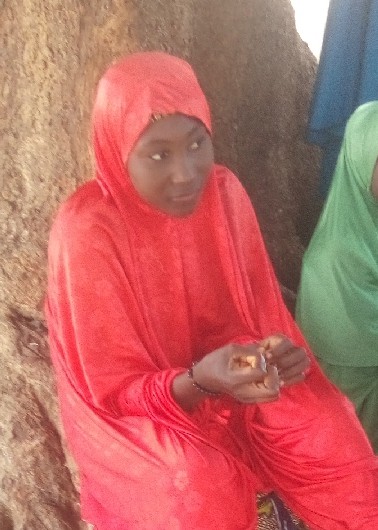
The above and other methods of implementation of the project are the reason, 17 years old Maryamu Abdullahi of Unguwar Barkodi, Sabuwar Tifi in Ningi, headquarters of Ningi LGA expressed interest in going to school even at that age rather than getting married.
Her story was a pathetic one, she is the fourth of seven children given birth to by her mother while her father is an old blind man who cannot engage in any venture to take care of the family thereby forcing the children to venture into things that will bring food to the table of the family at all cost.
Maryamu Alhassan while narrating her story at the point where she hawks groundnuts at the Primary School, Sabuwar Tiffi said that, “I could not attend school because I have to hawk in order to make money for the survival of my family. My mother is responsible for the upkeep of the family because my father is sick and blind”.
The most pathetic of the story is that, according to her, “We don’t have a house of our own, my family is squatting with a good Samaritan who gave us one room in his compound to stay in. It is indeed very difficult for us to survive. In the morning, I go to hawk Koko (pap) and in the afternoon I hawk groundnuts here in this school”.
According to her, “I make at least N4000 each day from the hawking I made from Koko and groundnuts. It is that money my mother will use to buy foodstuffs to feed the family everyday. It is really stressful for me but I have no choice”.
Asked if she does not want to be educated, Maryamu reacted saying, ‘I want to go to school, I don’t want to get married now, each time I see some of my friends in this school, I feel bad, I always want to be like them but my parents are not ready to let me go”.
She revealed that already, arrangements are almost concluded to get her married to a young Fulani man in a close by village saying that probably the marriage will take place around December after the harvest of farm produce a development she said is making her get scared that her dream of going to school may not be realistic.
According to her, two of her brothers went to school but did not know the reason she was not enrolled in school by her parents even though she has the desire to go to school.
Maryamu is appealing to UNICEF and other concerned people to come to her aid to ensure that she goes to school and become educated stressing that marriage is not on her mind now.
When contacted, Chairman of the School Based Management Committee (SBMC) of the School, Dahiru Ali promised to get to her parents and ensure that she was enrolled because according to him, the GEP 3 project has actually completed the efforts of his committee in ensuring that the number girls enrolled in the school increased.
Dahiru Ali further assured that, “I know her father, he is a gentleman even though he is blind but I know that when we talk to him about her request, he will not stop her. He has other children who went to school, I don’t the reason she was not in school all this years”.
He commended UNICEF for the GEP 3 project saying that apart from the enrollment of girls that has significantly increased, other aspects particularly the mensural hygiene system has greatly improved thereby making the girls to now have self confidence in relating with others.
The SBMC Chairman also expressed his impression about the security situation in the school which the GEP 3 project has improved upon saying that, the students are now security conscious particularly, “the boys are protecting the girls from harassment by a few boys along the way to school or back home”.
In order to sustain the positivity gained from the GEP 3 project in line with the appeal by UNICEF to ensure that the girl child project continues, Bauchi Assembly passed a bill on access to equal basic education to children under 5 years compulsory with attention on the girl child.
As contained in the bill, any parent who breaches the provisions, when eventually signed into law by the Governor will go to jail for one year or pay a fine of the sum of N100, 000 or both as the case maybe.
The passage of the bill followed the submission of report of the House Committee on Education on a Bill for a Law to Promote Children Access to Basic Education in Bauchi State and for Connected Matters which was laid by the Chairman of the Committee Hon. Babayo Muhammad representing Hardawa Constituency.
The Report contained that the Committee had engaged all stakeholders in the education sector with a view to gathering their opinions and concerns on the Bill.
It observed that the Bill seeks to guarantee the right of basic education to every child in the State who attains the age of 5 who shall be enrolled into schools.
The Bill according to the Committee, seeks to also eliminate inequalities and disparities in education where every child shall be entitled to basic education with equal opportunity for both male and female to be provided by the State.
The Committee recommended that under offence and penalty in the Bill, the penalty of any parent, husband or teacher who refuses to enrol any pupil or student into school without lawful cause, should be increased to one year imprisonment with an option of fine of N100,000 or both.
It further recommended that the House should adopt and pass the Bill into law which the House unanimously adopted all the recommendations of the Report.
Speaker of the House, Rt. Hon. Abubakar Y Suleiman representing Ningi Central Constituency requested the House to allow a Bill he sponsored for a Law to Promote Children Access to Basic Education in Bauchi State and for Connected Matters to undergo 3rd reading and he was seconded by Hon. Sabo Bako Sade representing Sade Constituency.
Upon approval by the House, the Speaker directed the Clerk of the House, Umar Yusuf Gital Esq to carryout the 3rd reading after which the Bill was therefore passed into law.
The House thereafter adjourned to Tuesday 20th September, 2022. as moved and seconded by the Deputy Majority Leader and the Minority Leader.
