
ACReSAL: World Bank $700m project aimed at mitigating climatic conditions of Bauchi communities

|
Getting your Trinity Audio player ready...
|
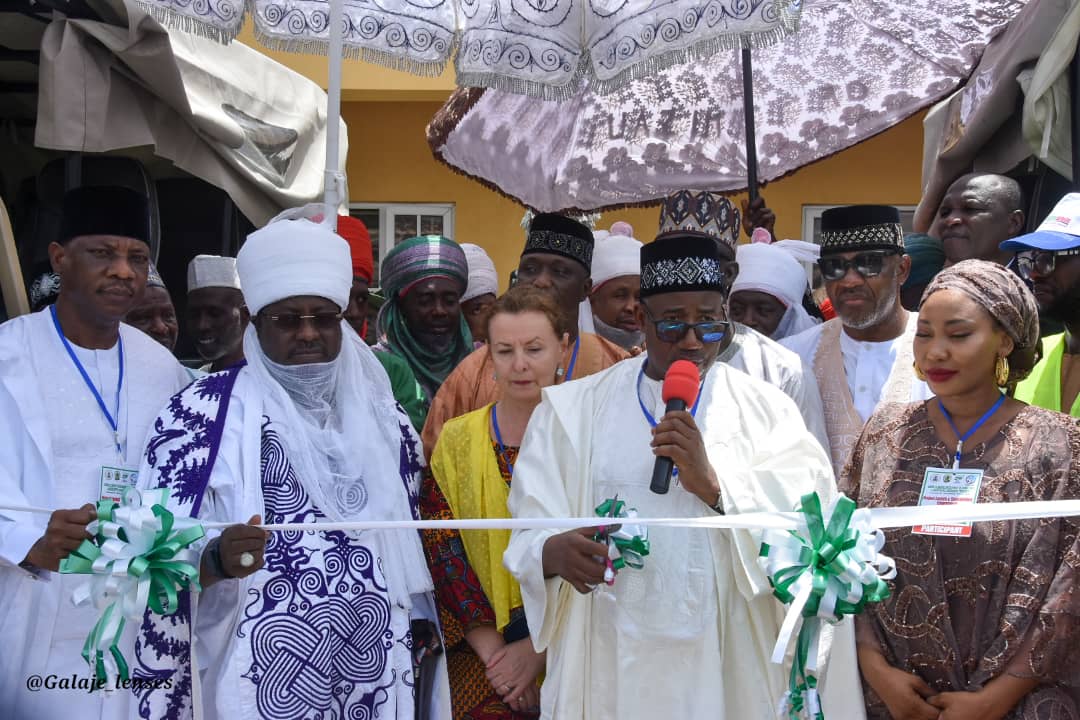
Bauchi Governor, Senator Bala Mohammed Assisted by the Emir of Katagum, Umar Farouk and other dignitaries cutting the tape to officially launch ACReSAL Project in Bauchi
By Akanji Alowoludo, Bauchi
Bauchi State is located between latitudes 9° 3′ and 12° 3′ North, longitudes 8° 50′ and 11° East, and covers 49,119 km2 (18,965 sq mi), or around 5.3 percent of Nigeria’s total land mass, with a population of around 6 million people including IDPs and other migrants who are mostly rural dwellers, fully engaged in arable farming all seasons, producing cash crops and for family consumption.
However, One of the most pressing environmental challenges has emerged for the population, most particularly, those in the rural areas, which is climate change. Bauchi state is particularly vulnerable to environmental degradation due to its unstable economy, low resilience, and limited adaptive capacity to environmental distortions despite the fact that Environmental resources support a substantial chunk of the economy.
The problem of climate change has two dimensions in Bauchi State as individuals and homes have noticed changes in climate variables such as temperature,
precipitation, and severe weather events.
Climatic change is caused by changes in the properties of the climate system, such as rainfall, temperature, atmospheric humidity, biosphere, pressure, and winds, or sophisticated relationships among such elements.
Anthropogenic factors include greenhouse gas emissions from
industrial and existing agricultural operations, acid rain, ozone layer destruction, and deforestation,
to name a few. Artificial and natural causes of climate change are usually distinguished.
Natural variables include changes in eruptions, sea temperature, westerly waves, solar activity, atmospheric
waves, and ice cap distribution. The environment has been harmed as a result of reckless exploitation of natural resources, which has been exacerbated by causes such as illiteracy, overcrowding,
selfishness, and poverty, among others. desertification, Pollution, flooding, erosion, and many sorts of severe weather occur as a result, all of which are linked to climate change.
There is a slew of environmental issues that need to be addressed. Environmental problems are more common in locations where socio-economic activity is high. The condition of heat energy, soil qualities, and rainfall all influence climate change.
The implications of man’s interaction with his environment include overpopulation, flooding, deforestation, and a variety of conflicts. People try to satisfy their unquenchable need for shelter, food, recreation, and facilities, which leads to these changes.
Environmental problems, on the other hand, can result from both environmental and manmade sources. The other causes flooding, desertification, erosion, urbanization, deforestation,
overpopulation, and other effects on the ecosystem’s three layers, whereas the former produces earthquakes, volcanism, droughts, tectonic movement, and tsunamis, among other things. Natural
difficulties, on the other hand, are substantial, particularly in volatile sections of the planet where
natural stability and tectonic action are lacking.
Urban difficulties and deterioration have come from quick pace of socioeconomic activity in Nigerian cities. The majority of cities have a high frequency of environmental problems, and it is one of the world’s communities with the lowest
approval indexes. Between 20 percent and 30 percent of the expanding poorest population is expected to have a decent level of life.
Among the most pressing concerns confronting governments in the
country’s South and North Eastern regions, where the impacts of environmental problems are readily
obvious, is how to handle these problems. Nigeria has an abundance of both natural and human resources.
However, the extraction and consumption of these vast resources are the source of the majority of the country’s environmental challenges.
It is in order to mitigate against all of the issues raised in the narrative above that the World Bank brought up an intervention for the 19 Northern states and FCT that are faced most pronely with the climate change issues. It is known as the Agro-Climatic Resilience in Semi-Arid Landscape (ACReSAL) Project.
The programme is designed to reactivate semi-arid landscapes in Northern Nigeria, a deforesting region and desert-prone area of South of the Sahara. It taps its vast water resources for optimal utilisation and boosts the ecosystems of the region which comprises the 19 Northern states and the FCT.
ACreSAL is targeting to resolve lingering issues around agriculture, environment and water resources with the objective of reclaiming at least One million hectares of degraded land in the entire Northern region of the country as contained in the context of the 4 years project.
The mandate of the project is to ensure increase in the adoption of sustainable landscape management practices in the targeted watersheds in Northern Nigeria and strengthen Nigeria’s long-term framework for integrated climate-resilient landscape management.
The ACreSAL project is targeted in arid to semi-arid states located in the Sahel, Sudan Guinea Savanna and Southern Guinea Ecosystem, characterised by dry semi-arid conditions, low precipitation and sparse vegetative cover.
Nigeria’s Northern region had since the early 1970s become prone to desertification with its encroachment at the rate of about 10 kilometres per decade just as the land degradation is coupled with insufficient annual rainfall with resultant decrease in food production often leading to famine, as it was witnessed in 1973/74 that affected the Northern fringes of the now states of Sokoto, Kebbi, Katsina, Kano, Jigawa, Bauchi, Yobe and Borno.
Since the 1973 experience, drought has continued to reoccur after every 10 years, devastating parts of the aforementioned states while the Federal and State Governments have been taking proactive measures to curtail the trend bedevilling the region. One of such measures was the introduction of tree planting programmes by the Northern states as shelter-belts against desert encroachment, but most of them have over the years abandoned the practice.
The Federal Government under the immediate past President Muhammadu Buhari-led APC administration vigorously pursued its Great Green Wall (GGW) programme being implemented in the country’s Northern frontiers in a bid to forestall desert encroachment to the hinterlands.
The total amount committed to the ACReSAL project by the World Bank is the sum of $700m to be implemented in collaboration with the Federal Government of Nigeria, the 19 Northern states and the FCT.
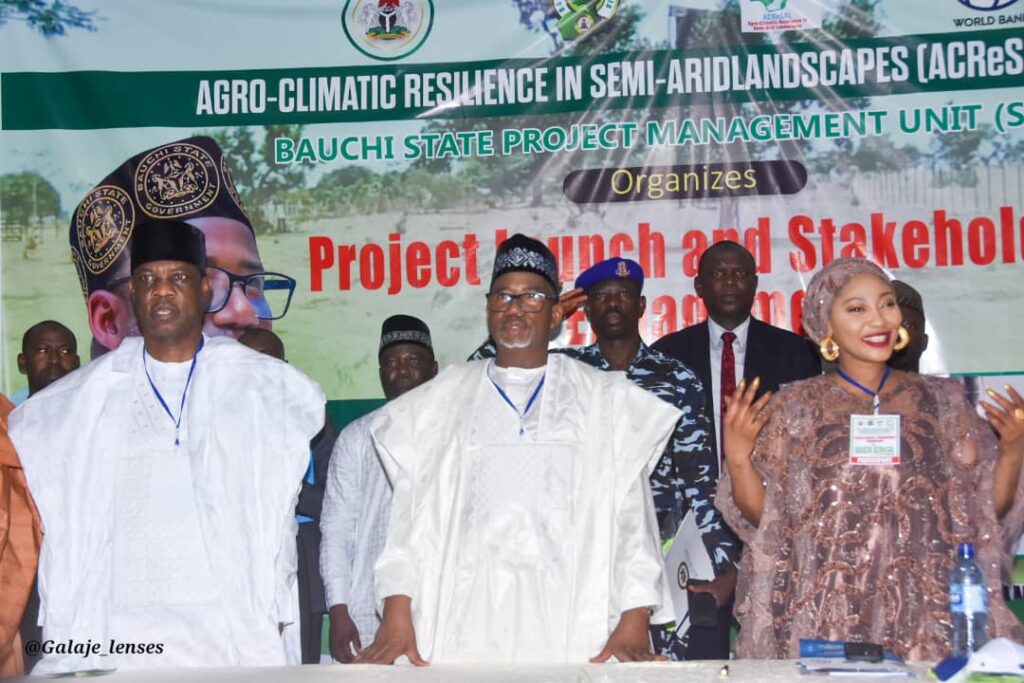
The project was officially launched in Bauchi recently by the State Governor, Sen Bala Mohammed Abdulkadir which the state to become the first among the participating states to officially and publicly unveilled the project implementation an occasion which was also well attended by representatives of other participating states as well as the National Project Implementation Unit led by the Task Team Leader, Dr Joy Iganya Agene.
While officially and publicly launching the Commencement of the project, Bala Mohammed observed that Bauchi State with its endowed natural resources and special ecosystems, game reserves, vast arable and irrigable lands, as well as water resources comprising 10 macro-watersheds, 46 micro-watersheds, seven major rivers, five lakes and ten wetlands, the state is optimistic that the ACReSAL project would go a long way in providing solutions to the state’s lingering ecological problems.
According to him, “ACReSAL projects are believed to be in tandem with the present administration’s policy of prioritising the sectors of agriculture, environment and water resources, according to the state governor, who disclosed that the projects would be implemented in seven out of the 20 local government areas of the state.”
The Governor added that,”It is the resolution of Bauchi State under the present administration to participate in the ACReSAL projects as an added effort towards tackling natural disasters and emergencies, while improving the lives of the people. It is also worthy to note that the Bauchi State government has within the past four years implemented a number of multi-sectoral initiatives, collaborating and leveraging technical and financial assistance from multi-national donors, federal MDAs, and bilateral donors to address the ecological challenges of the state.”
While describing the ACReSAL project as a turning point in the state’s lingering environmental and climatic problems, the Governor explained that the state’s interest in ACReSAL projects is immense as displayed in assiduously pursuing all the processes of providing the necessary requirements for participation in the projects.
He said that the World Bank has already released the sum of $2 million to the State implementation project while the state has paid the counterpart funding in two instalments of N500 million each in 2022 and this year to commence implementation of the projects.
“It is gratifying that apart from the four hectares of plantations in form of shelter-belts and biological gardens executed by the Bauchi ACReSAL projects, a gigantic support in form of two game-viewing trucks, scientific research and conservation gadgets have been provided for the Yankari Resort and Safari in the state,” he said.
Bala Mohammed had during the project’s official launch thanked the federal government and the World Bank for what he described as a timely and impactful programme designed to resuscitate the key sectors of environment, agriculture and water resources in the country.
The governor assured that Bauchi State is determined to make a difference as it has been doing in other projects supported by the World Bank, saying “As part of our initiatives to ease implementation of the ACReSAL project, we appointed an Emir (Umar Farouk II of Katagum Emirate) to serve as patron with the mandate of ensuring harmony between the project-benefiting communities.”
Task Team Leader (TTL) of the World Bank team, Dr Joy Agene Iganya while speaking at the official and public launch of the Project, congratulated the Bauchi State government under the leadership of Governor Bala Mohammed for being the first to launch the implementation of the project among the 19 participating Northern states and FCT.
She called on relevant stakeholders to help drive the implementation and ensure sustainability of the investment through waste management saying that, “Bauchi State is one of the key and good drivers of ACReSAL projects. We are happy that apart from the N500 million you released as the state’s counterpart funding, you have also provided vehicles to the state implementation committee unit for effective service delivery,”
While interacting with women during the occasion, Dr Joy Iganya Agene said that the project would provide livelihood support activities for them to be financially independent and to be able to send their children to school. She called on the women to grasp the opportunity for a better tomorrow.
In his remarks, the ACReSAL’s National Project Coordinator, Dr Abdulhamid Umar commended the implementation of the ACReSAL project worth $700 million in the entire Northern region to reclaim not less than one million hectares of land degraded in the region within the last six years.
According to him, “The sum of $700 million is to be accessed by the 19 Northern states and FCT for the purposes of fighting issues surrounding desertification, drought, land degradation and deprivation at the level of communities and the land that we live on, particularly in northern Nigeria,”
The National Coordinator, said that the team has visited Bauchi State to assess and review the implementation strategies of the ACReSAL project that has started over a year ago in the state to observe the level of achievements and the areas that need improvements.
“That is why we chose Bauchi as one of the states to come over to see things for ourselves and I am happy to tell you that Bauchi falls under category B which are states that did not participate in the initial project but are leading the pack now,” Umar stressed.
He explained that the project is to run for six years at the end of which it is expected that things would have turned around positively and the communities would become better and assured that the project would impact the lives of the people of the affected areas in the state positively as all degraded areas will be reclaimed.
The ACReSAL project will intervene in massive tree-planting, irrigation farming, agroforestry, green house farming, plant nursery development units, farm produce processing centres and integrated solar-powered borehole schemes across all the local government areas of the state.
Seven communities of the state, namely: Gwaram, Kirfi, Gololo, Gwallagan Mayaka, Duguri, Suleiman Adamu and Yakubun Bauchi are the initial beneficiaries of the first stage of the project implementation with huge interventions of civil works to include water-drainages and dams to avert effects of flooding and erosion.
The Emir of Katagum and patron of the project implementation team in Bauchi State, Alhaji Umar Farouk II, assured that they would do their best in ensuring its success, adding that “at the end of the six years of project implementation, there would be institutionalised arrangements to sustain the laudable project in which over three million Bauchi State indigenes would benefit.”
Considering the fact that the perennial problem of desertification has become obvious due to climate change, overwhelming human activities and climatic variation such as prolonged droughts and floods, the urgent and dire need to address the problem brought about the ACreSAL project by the government of Nigeria.
A delegation of the World Bank, Federal MDAs and FPMU had visited the district head of Galambi, Alh Shehu Adamu Kuma where the project’s National Coordinator, Dr Abdulhamid Umar said that the proposed water project intervention is aimed at ameliorating the sufferings of people of the area and for easy access to potable water for both human and animal consumption.
He called on beneficiaries for necessary support for the successful implementation to achieve the set objectives. He called for total support of the people to ensure sustainability when the project is successfully implemented.
State Project Coordinator for Bauchi State, Dr Ibrahim Kabir assured that the Government through the World Bank assisted Agro-Climatic Resilience in Semi Arid Landscape (ACRESAL) Project is set to provide Water Sources for the benefit of thousands of beneficiaries as well as their animals across the state.
He assured that the water will also boost the agricultural activities of the people in addition to curtailing the lingering farmers herders clashes.
The Coordinator informed the gathering that, the project is a six years world Bank assisted projects targets to resolve lingering issues around Agriculture, Environment and Water Resources, with the objective of reclaiming one million hectares of degraded land in the Nineteen Northern States and the FCT.
It was in appreciation for the visit that the district head turbanned both the bank’s team leader, Dr Joy Agene and the project national coordinator, Dr Abdulhamid Umar as Shugaban Matan Qasar Galambi and Sarkin Dajin Qasar Galambi respectively.
As for the Yankari Resort and Safari, the project has already trained staff on ways of discharging their responsibilities. A drone is also to be provided for the games’ reserve that could undertake supervision work of the over 1,300-square kilometre reserve, as well as the provision of other modern working equipment and materials such as communication gadgets and uniforms for the game ranchers, among others.
The World Bank financed Agro-Climatic Resilience in Semi-Arid Landscape (ACReSAL) project also expressed interest in reshaping the famous Yankari Game Resort and Safari in Bauchi state in order to regain its place of pride as an international Tourists attraction site.
In order to see the present situation, the World Bank and ACReSAL project team paid a 2-day assessment visit to the famous park during which they listened to presentation by the management of the park.
The teams led by the Team Leader, Dr Joy Iganya Agene lamented the deplorable situation of the park regretting that the present picture is completely not what story is told about it declaring that the park is living in its past glory.
The team stressed the need for a comprehensive documentation of the needs assessment of the entire structure in order to attract attention from potential investors and international agencies interested in eco-tourism.
The team however agreed that entire place needs a complete turn around in order to attract Tourists from across the world as it used to be when Tourists from across the world came to savour the serenity of the warm springs and other Fauna.
The team stressed the need for sensitization of the host communities through livelihoods assessment so that they will join in the fight against poaching activities going on in the park due to anger of neglect.
The team stressed the need for a total packaging of what the government wants the place to look like in the nearest future in order to make it a revenue source for the government.
In her remarks, the Team Leader, Dr Joy Iganya Agene declared that definitely, the place needs to be completely turned around in line with the components objectives of ACReSAL.
National Project Coordinator of ACReSAL, Abdulhamid Umar in a remarks assured that efforts will be made to make the park viable and attractive again very soon in partnership with the Bauchi State Project Coordinator of ACReSAL, Dr Kabir Ibrahim.
He however said that the Management of Yankari Game Reserve and Safari should work with the Project Coordinator of ACReSAL in order to have a comprehensive check list of the park for possible action.
Speaking earlier, Bauchi State ACReSAL Project Coordinator, Dr Kabir Ibrahim stressed the need for intervention in reclaiming the deplorable condition of Yankari Reserve in order for it to regain its lost glory.
He lamented that over the years, the place has been neglected and render ineffective and unattractive to Tourists even from Nigeria not to talk of from the outside as it used to be in the years past.
Kabir Ibrahim said that though ACReSAL has done a few things for the Park as part of its mandate, he stressed that a lot more meed to be done.
In his presentation earlier, the General Manager of Yankari Game Reserve and Resort, Mohammed Ladan outlined that the park has suffered neglect leading to dilapidation of infrastructure at the Camp leading to loss of patronage.
The GM appealed for intervention by the World Bank through ACReSAL project in order to revamp the place and make it attractive again by Tourists.
Mohammed Ladan expressed confidence that the Park can turn out to be a main revenue earner for the state and country at large as foreign visitors must part with money at entry point into the country just as local businesses will be boosted.
The ACreSAL project is embarked on by the Federal Government to build community resilience as well as improve the sustainable productivity of its natural resources in the 19 northern states of Nigeria namely; Bauchi, Borno, Gombe, Jigawa, Kano, Katsina, Kebbi, Sokoto, Yobe, Zamfara, Federal Capital Territory (FCT), Benue, Nasarawa, Kogi, Plateau, Adamawa, Taraba, Niger, Kwara and Kaduna. These northern states including the FCT are faced by rapid desert encroachment ranging from severe to moderate and marginal.
Other incentives of the project are the strengthening of the environment for integrated climate-resilient landscape management, fighting issues surrounding desertification, drought, landscapes degradation and deprivation at community levels as well as resuscitating the sectors of agriculture, environment and water.
Knowing that the Project cannot succeed without active participation of the Media practitioners, working Journalists in Bauchi state are to be trained and equipped on how to effectively and efficiently report issues around the environment with particular attention on Climate change.
The training which will revolve around 4 major components of ozone layer, climate change, climatic conditions and global warming, will be sponsored by the World Bank funded Agro-Climatic Resilience in Semi-Arid Landscape (ACReSAL), Bauchi State implementation project office.
This is In a renewed effort to build the capacity of the journalists to enable them report all the issues of climate change as it affects the environment and in turn, promote public health.
