



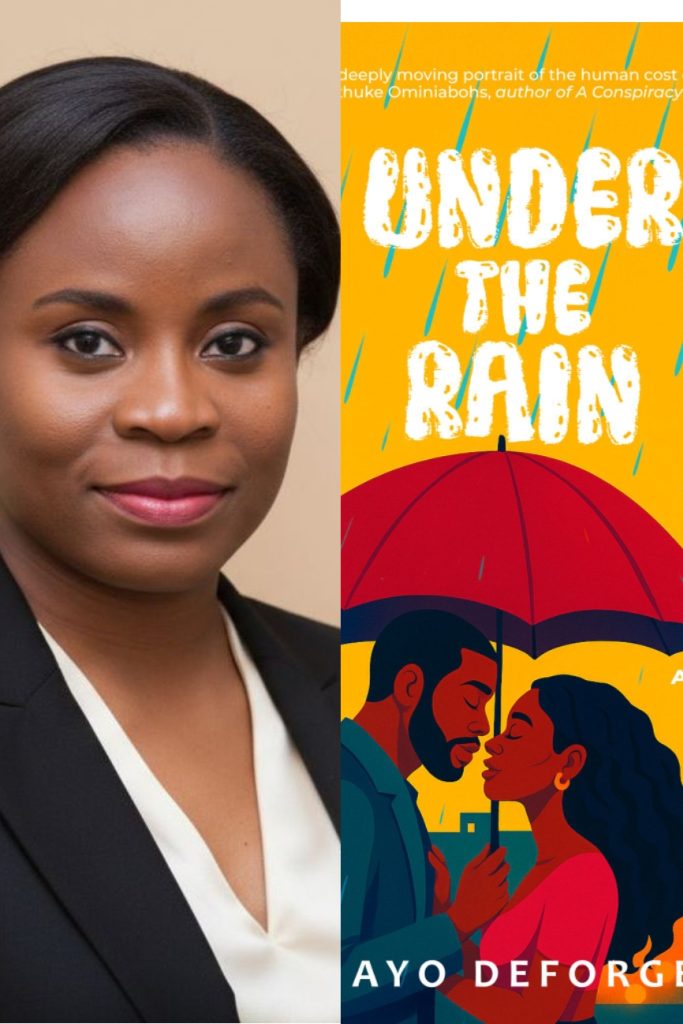
If you are looking for a novel that allows you to momentarily escape the daily hullabaloo of life or take a refreshing break from social media, Under The Rain by Ayo Deforge is an ideal companion. The novel is engaging, emotionally charged, and deeply suspenseful, with a storyline that remains largely unpredictable. Beyond its entertainment value, it is also profoundly thought-provoking.
Under The Rain is a love story intricately woven into medical fiction, with a particular focus on genotype incompatibility. The narrative follows Bolaji and Shola, childhood neighbours in a Lagos estate, whose bond begins at a tender age. Despite strict parental restrictions, the two repeatedly find time to be with each other, a testament to the innocence and intensity of their early affection. When Shola’s parents discover her secret meetings with Bolaji, her father responds with brutal punishment, flogging her severely. Bolaji’s decision to visit her home after days of not seeing her, despite the risk of being caught, highlights his youthful bravery and the quiet strength of his devotion. It becomes clear that only love could inspire such daring acts.
One of Bolaji’s major flaws is his inability to openly express his feelings. He carries a love letter everywhere, yet lacks the courage to hand it to Shola. In contrast, Shola is portrayed as vibrant and high-spirited, often surrounding herself with different boys from her school. This behaviour eventually places Bolaji in trouble, particularly when one of these boys gifts her a wristwatch and Shola’s father thinks it’s from Bolaji!
Ayo Deforge demonstrates a remarkable command of emotional storytelling. She skillfully evokes tension, provocation, and suspense, keeping the reader constantly eager to know what will happen next. The narrative’s unpredictability is one of its strongest assets and reflects the hallmark of effective storytelling, drawing readers deeper into the plot with each chapter.
The emotional peak of the novel occurs as Bolaji patiently waits for Shola to end her series of university relationships so he might finally confess his love. Deforge intensifies the emotional weight when Bolaji, instead of being honest, continues to support Shola through repeated heartbreaks, including accompanying her through multiple abortions after she is abandoned by the man who impregnates her. Despite these painful circumstances, Bolaji still struggles to declare his love, until the defining moment in an abortion room when Shola admits she loves him, prompting Bolaji to finally respond, “Shola, I’ve always loved you.”
Beyond romance, the novel tackles serious social and medical issues. One of its most thought-provoking elements is its portrayal of the struggles faced by sickle cell patients. This is vividly illustrated through Bamidele, Bolaji’s younger brother, who suffers not only physically but emotionally. The cruelty he faces from his own grandmother who calls him “half human”, reveals deep-seated stigma and selfish motivations, particularly her desire for Bolaji’s father to marry a second wife due to genotype complications.
Genotype incompatibility resurfaces as a major obstacle when it prevents Shola from marrying the man she truly loves. Although both characters go on to marry other partners, they remain emotionally attached to each other, unable to find fulfilment in their respective marriages.
Deforge also highlights pressing issues confronting women in contemporary society, including ectopic pregnancy and unsafe medical practices. Shola’s experiences, alongside those of other women in the novel, expose the dangers of misinformation and reliance on quack doctors, decisions that later lead to irreversible consequences in her marital life.
Another striking theme is female genital mutilation, portrayed through Yetunde, Bolaji’s wife. Deforge powerfully illustrates how harmful cultural practices affect women’s physical and emotional wellbeing. Yetunde’s inability to enjoy intimacy in her marriage, and her eventual fear of sex, underscore the long-term trauma of such practices, even to the point where she suggests her husband marry a second wife.
Shola’s parents are excessively strict, a trait that prevents her from opening up to them about her problems. As a result, her life becomes increasingly difficult, leaving too much room for vulnerability, reliance on peer advice, and repeated unwanted pregnancies, which ultimately shape her regrets later in life.
The novel’s conclusion is particularly commendable. Shola’s final choices reflect emotional maturity and compassion, and the way her marriage is handled adds complexity to the narrative, as it avoids easy resolutions.
Overall, Under the Rain is a compelling blend of romance, medical fiction, and social commentary. Ayo Deforge succeeds in delivering a powerful narrative that entertains while challenging readers to reflect on love, choice, culture, and consequence.

Comments are closed, but trackbacks and pingbacks are open.