

|
Getting your Trinity Audio player ready...
|
By Austin Asadu
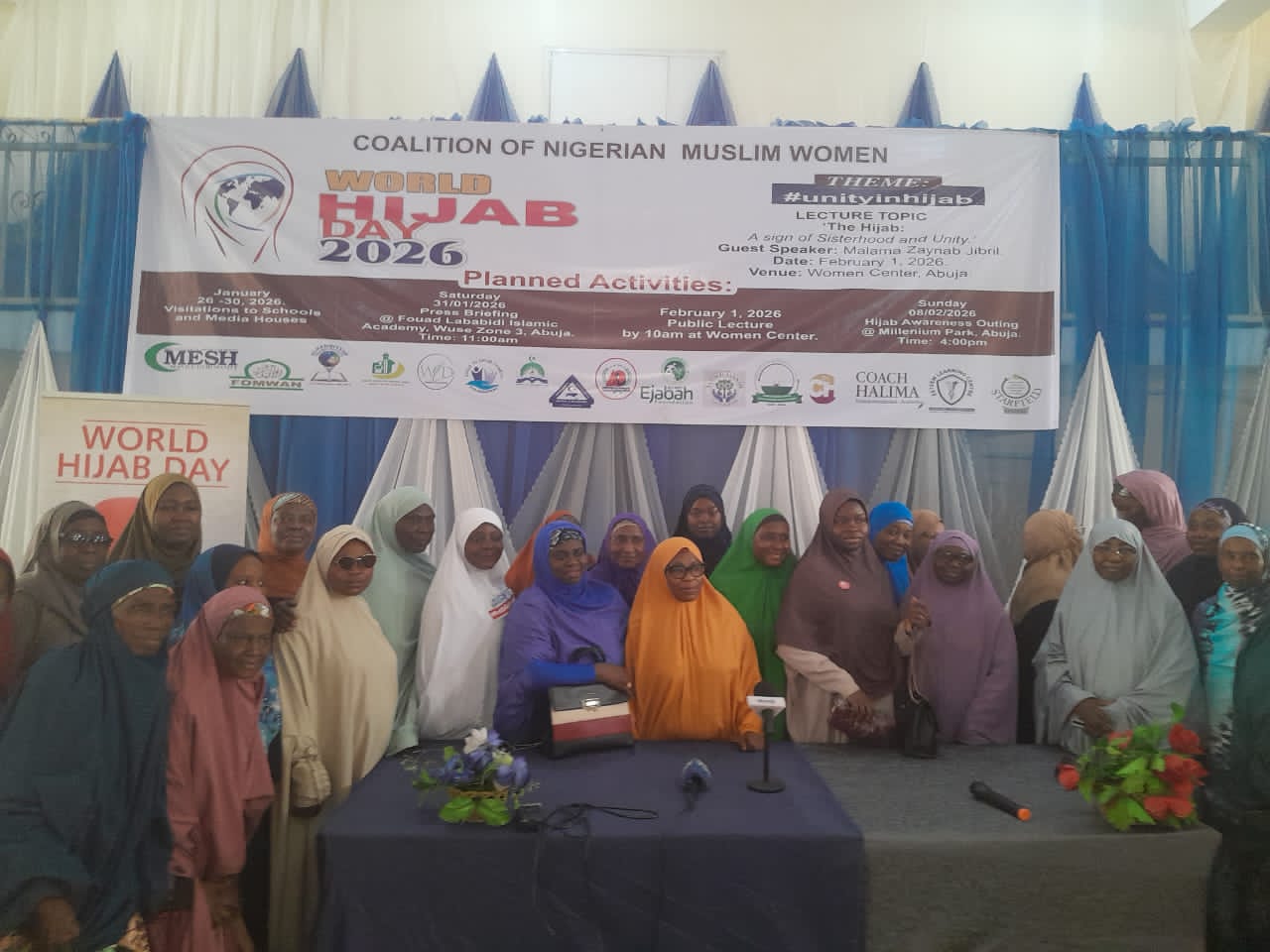
The Coalition of Nigerian Muslim Women, a congregation of women organizations, forums, associations and civil society groups dedicated to advancing the cause of Muslim women and girls across the nation marked the 13th World Hijab Day themed ‘Unity in Hijab’ with a world press conference at the Fo’uad Lababidi lslamic Academy, Wuse Zone 3, Abuja on the 31st of February, 2026.
The Coalition unites numerous faith based including, Women in Da’awah, FOMWAN, Hijab Rights Advocacy Initiative, NASFAT, JADAFIA, Criterion, Ansaruddeen, Education Social and Health Mission (MESH), Association of Model Islamic Schools (AMIS) Abuja, Abuja Muslim Forum, Al-Mu’minat, An-nisa Foundation, Sisters of Jannah, Initiative for Muslim Sisters, Hidaya Islamic Charity, Nigeria Association of Female Teachers of Arabic And Islamic Studies FCT, and other organizations dedicated to addressing challenges faced by women and girls, especially within the Muslim community while strategically tackling relevant issues to enhance visibility and positive outcomes.
Members of the Coalition present at the press conference included Hajiya Ramatu Sani, Dr Hadiza Gomina, Hajiya Zainab Umar, Hajiya Khadija, Hajiya Habibat and Hajiya Yusuf Aladi amongst other distinguished attendees.
After the opening prayer, Dr Hadiza Gomina addressed the press with a message of gratitude to numerous federal agencies that have assisted in protecting and advancing the rights and dignity of Hijab wearing Muslim and girls including
Ministry of Education, National Youth Service Corps, Council of Legal Education, Supreme Court of Nigeria, various state governments, the Nigerian Armed Forces, the Nigeria Police, the National Assembly and many other establishments.
Elaborating on this year’s theme ‘Unity in Hijab’, Dr Hadiza Gomina
stressed that the World Hijab Day is one of celebration of awareness, inviting women of all religions and backgrounds to experience wearing the hijab for a day and to gain a deeper appreciation for its meaning to Muslim women: ‘Through this initiative, countless individuals have come to see the hijab not just as a piece of clothing, but as a symbol of faith, strength, and identity. While much progress has been achieved, with increasing global recognition and support, the journey continues with renewed energy. Efforts to enhance positive awareness of the hijab and to ensure that those who wear it can do so with dignity and freedom remain vital.’
The World Hijab Day inspires hope, builds bridges of understanding, and works toward creating a world where every individual can proudly embrace their beliefs and choices without fear’ – Dr Gomina explained.
The keynote speaker further harped on the success stories of hijab wearing students in tertiary institutions who have excelled in their academic pursuits proving that the hijab is not a barrier
but a symbol of female empowerment and pledged the support of the coalition as they inspire the next generation of hijab-wearing trailblazers.
Some of the notable gains of the hijab advocacy movement includes legal recognition with the
Supreme Court of Nigeria ruling in 2022 that Muslim girls have the constitutional right to wear hijabs in public schools, solidifying their freedom of religion and expression.
Earlier in 2016, the Appeal Court in Lagos and the High Court in Osun State ruled that wearing a hijab is a fundamental right for Muslim women and girls. This legal affirmation has been crucial in promoting awareness and acceptance of hijabs within educational institutions and public life.
Also in 2020, the Nigerian Police Force officially allowed female officers to wear the hijab as part of their uniform, marking a significant breakthrough for Muslim women in law enforcement.
Hijab advocacy has also gained international momentum, with various countries modifying dress codes to accommodate hijabs. For instance, the U.S. Army and police forces in Canada, Scotland, Norway, and the UK have embraced policies allowing Muslim women to wear hijabs as part of their uniforms.
In 2020, the Kwara State government officially permitted Muslim girls to wear hijabs to school despite initial resistance from some schools. This ruling was a significant victory for hijab-wearing students in public schools, empowering them to continue their education without compromising their faith.
Recently the Nigerian Defence College Primary & Secondary School Ushafa students who were denied the use of hijab received an official approval to use the hijab.
In 2018, the Nigerian law schools began allowing female students to wear head coverings, culminating in Firdaus Amasa being called to the bar while wearing her hijab.
Also, the National Youth Service Corps (NYSC) announced that female corps members could wear white shoulder-length hijabs for religious purposes.
In the legislature, the Nigerian House of Representatives introduced a bill aimed at institutionalizing hijab use in schools, recognizing it as part of religious rights.
The establishment of National Hijab Day in the Philippines and exhibitions in Scotland marking World Hijab Day demonstrate global solidarity with the hijab movement.
Despite the notable achievements of the hijab advocacy movement, challenges and obstacles still remain like the Republic of France’s ban on athletes wearing hijabs during the Paris Olympics in 2024 citing secularism which excluded Muslim women wearing hijabs from competition while forcing them to choose between faith and sport.
Another Muslim woman in Hesse, Germany was legally barred from becoming a judge or prosecutor because she refused to remove her headscarf during court duties, with authorities saying wearing religious symbols conflicted with state neutrality.
This decision was widely censored by human-rights advocates as discriminatory and a direct barrier to her professional aspirations
Some teaching hospitals in Nigeria still force female Muslim nursing students to wear short skirts against the tenets of their faith.
The current uniform of the National Youth Service Corps (NYSC) has zero regard to the required dressing of Muslim women. The so-called approved “shoulder length” hijab expected to be worn on trousers and shorts is highly inadequate for Muslim female corps members. Those who choose to wear longer hijabs have been continuously harassed by soldiers and other NYSC officials even when the hijabs are in the prescribed colour (white).
There is the need for an overhaul review of the NYSC dress code to properly include Muslim female corps members and others:
‘We propose that Muslim students be allowed to wear a knee length hijab. Also, they should be exempted from the compulsory requirement to wear shorts for parade and wear long, free, white trousers instead’.
We also urge the National Assembly to prioritize the swift passage of outstanding bills to safeguard against discrimination based on appearance or faith.’
These legislations will demonstrate Nigeria’s commitment to justice and equity.’
The Coalition also called for the acceptance, encouragement, and a prejudice-free environment all hijabis, community-led initiatives for their empowerment, recognizing the hijab as a symbol of empowerment and inclusive services for hijab-wearing individuals.
The CNMW called for strict accountability measures to address harassment or discrimination against hijab-wearing individuals by public and private institutions and urged all schools to respect the Constitution of the land and the pronouncements of the Supreme Court on the inalienable right of female muslims to adorn hijab: ‘This is imperative so we don’t have to go through additional litigation to enforce the already established right’ .
In spreading awareness, the urged the print, electronic and online media to challenge existing stereotypes by promoting positive representations of hijab-wearing women.
The media stories should highlight their achievements as leaders, professionals, and role models while breaking down misconceptions about the hijab.
In conclusion, the Nigerian Muslim Women Coalition sincerely thanked ‘the esteemed members of the media for their continued support in attending today’s event, as well as other related activities’ . Your commitment to providing fair, and accurate, coverage of the Annual World Hijab Day is greatly appreciated’ – the CNMW communique stated.

Comments are closed, but trackbacks and pingbacks are open.