

|
Getting your Trinity Audio player ready...
|
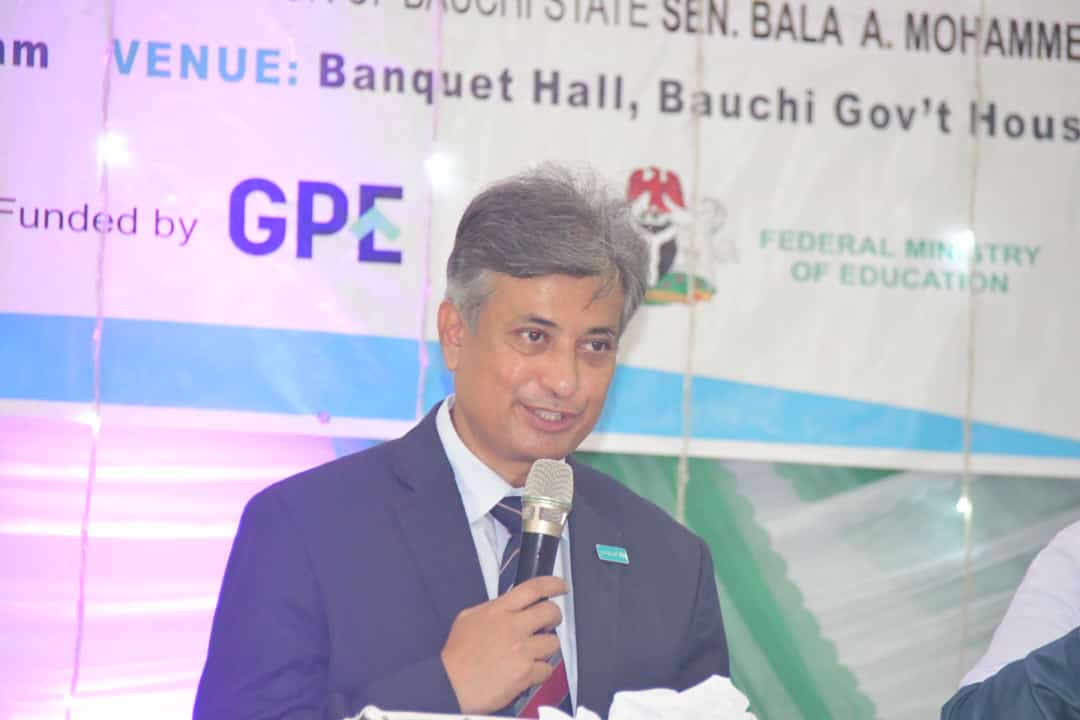
Dr Tushar Rane, Chief of Office, UNICEF Bauchi Field Office
By Akanji Alowolodu, Bauchi
The Nigerian Learning Passport (NLP) has been launched in Bauchi state with the aim of ensuring that every child has unhindered access to basic education.
Speaking at the launching of the passport at the Banquet Hall of the Government House, Bauchi on Thursday, Chief of Office, Bauchi UNICEF Field Office, Dr Tushar Rane lamented that the COVID-19 pandemic disrupted learning for about 50 million children because of school closure when it lasted.
The UNICEF Chief of Office further lamented that before the pandemic, attaining SDG4-Quality Education was already suffering setbacks, globally while the COVID-19 pandemic further derailed the efforts to advance education for children.
Tushar Rane also said that In Nigeria, the pandemic disrupted active learning for a long period adding that, “This has been further exacerbated by the attacks on schools and abduction of school children. On behalf of UNICEF, it is my pleasure to welcome you all to the launch of Nigeria Learning Passport in Bauchi State” .
He added that as the UN agency for children, UNICEF collaborates with the government, partners and Civil Society Organizations (CSOs) to ensure that children acquire the right skills to thrive and become nation builders.
According to the UNICEF Chief of Office, the Nigeria Learning Passport is an online, offline and mobile learning platform that will enhance the access to digital learning skills for students, especially in the times of the COVID-19 pandemic saying, “However, we must remain resolute in our pursuit for a world where every child has access to basic education”.
Tushar Rane explained that the Learning Passport -a digitally compliant learning mechanism has a critical role is ensuring we reach our goal adding that the Learning Passport is an easy to use, and easily deployed platform that enables children to access resources anytime, anywhere online and offline, making it fit for use in remote rural areas, where connectivity must not be at the best.
The Learning Passport will reach children in pre-primary, primary and secondary education levels with learning materials in major languages in Nigeria including English and Hausa.
With the apparent advancement in technology, the Learning Passport presents us opportunity to re-imagine education and enhance digital access for learners Bauchi State.
He stressed that, “As we launch this innovative solution today, I call on all stakeholders: parents, government, community leaders, the media and other partners, to provide the relevant support for a full roll-out across the state” .
“I wish to further reiterate that despite the challenges like COVID-19, which the world is facing, we cannot afford to fail the current generation of our children. The duty lies on us to ensure that they access the education they need for a better future”, he stressed.
According to him, “Many a times, we have seen that, equipped with the skills and opportunities, young people can drive the transformation we need for all round sustainable development” .
He then assured that, “At UNICEF, we remain committed to championing innovations and partnerships strengthen the development of every child, not only in education but in he nutrition, protection, and others. Once again, congratulations the Bauchi state government, particularly, the Ministry of Education for this great occasion”.
Tushar Rane then commended the continued support of the State Governor, Senator Bala Muhammed to the development of education in the state.
