

|
Getting your Trinity Audio player ready...
|
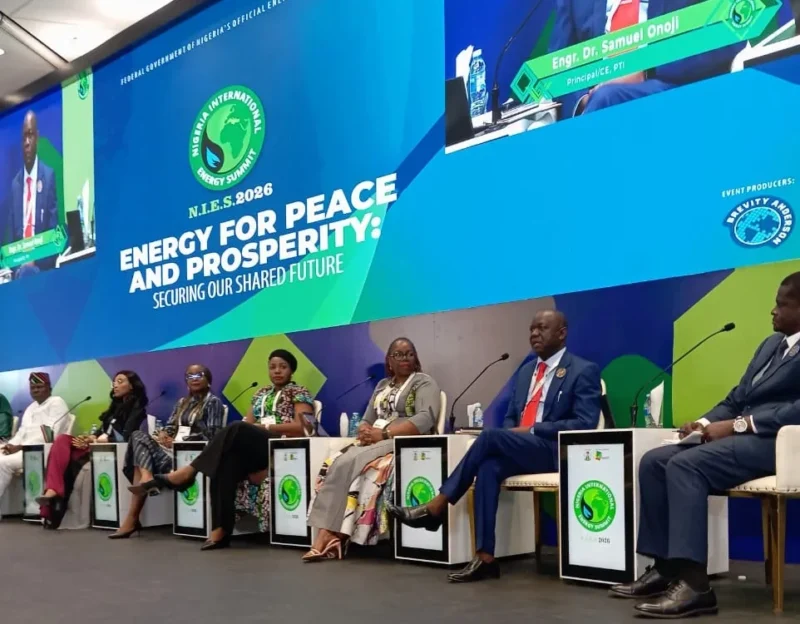
Stakeholders at the 2026 Nigeria International Energy Summit (NIES) have underscored the critical role of human capital and skills development in sustaining Nigeria’s oil, gas, and energy transition agenda.
The stakeholders spoke at the just concluded NIES 2026 in Abuja on the sub-theme “Talent, Leadership and Narrative for Nigeria and Africa’s 2050 Energy Goals’’.
They emphasised industry-aligned training, youth development and academia-industry collaboration.
The News Agency of Nigeria (NAN) reports that plenary examined how human capital, leadership, and strategic communication could drive Nigeria’s and Africa’s energy transformation.
It explored future skills and workforce needs across hydrocarbons, renewables, power, and critical minerals, with a focus on youth development, STEM competencies, women’s leadership, and inclusive talent pipelines.
Speaking, Dr Samuel Onoji, Principal/Chief Executive, Petroleum Training Institute (PTI) traced the institute’s origins to Nigeria’s early oil boom era.
Onoji said that PTI was established to address the dominance of expatriates in the sector following Nigeria’s entry into Organisation of the Petroleum Exporting Countries (OPEC) in 1971.
He said PTI was deliberately designed as a specialised, industry-driven training institution, distinct from conventional polytechnics and universities, with curricula tailored to operational needs in oil and gas.
“Since its establishment, PTI has trained more than 50,000 technicians, technologists, and professionals, many of whom now occupy key positions across Nigeria’s energy industry.
“A large number of people seated as audience, even as participants here today, are a product of PTI; that’s why we say PTI is the grandfather of the oil and gas industry when it comes to training,’’ he said.
Onoji said youth training was central to energy security, particularly as Africa embraced natural gas as a transition fuel.
He warned that with Africa holding about 600 trillion cubic feet of gas reserves and Nigeria accounting for roughly one third, failure to train young people today would create future capacity and sustainability risks.
“PTI’s training infrastructure includes a functional drilling rig, advanced drilling simulators, and specialised academies, as well as international collaborations with institutions in Scotland and other countries.
“The institute also provides training in offshore operations, diving, rescue, and emerging cleaner energy skills, while supporting regional capacity building across Africa,’’ he said.
Ms Sophia Mbakwe, Executive Vice President, Business Services, NNPC Ltd., while speaking on the NNPC’s Talent Strategy as a commercial enabler, said the company’s talent strategy was firmly aligned with its commercial mandate under the Petroleum Industry Act (PIA).
She said that NNPC’s approach blended experienced professionals with a growing pool of young talent through a structured “build, buy, and borrow” strategy, developing internal capabilities and hiring targeted expertise to partner projects to gain hands-on experience.
Mbakwe said that while technical expertise remained critical, soft skills, including commercial acumen, negotiation, communication, emotional intelligence, and adaptability were increasingly essential in a volatile and competitive global energy landscape.
She emphasised that talent development had been embedded into NNPC’s performance management framework, making people strategy a key driver of profitability, sustainability, and investment attraction.
Dr Yetunde Aladeitan, National Chairman of NIPeTE and Associate Professor at the University of Abuja, spoke on Academia–Industry Gap: Funding, Policy, and Curriculum Challenges.
She identified three major gaps undermining Nigeria’s research to industry pipeline as funding constraints, policy fragmentation, and curriculum misalignment.
Aladeitan also highlighted the challenge of translating academic research into commercially viable solutions.
She said that limited funding, high publication costs, and weak innovation frameworks could hinder impact, while she criticised the traditional academic reward system, which prioritises publication volume over practical innovation and industry relevance.
The academic advocated a shift from research “for industry” to research “with industry,” calling for structured collaboration among students, supervisors, and industry professionals to ensure that research outputs solve real-world problems and deliver economic value.
The speakers agreed that Nigeria’s energy future depends on deliberate investment in people from technical training and commercial skills to policy reform and collaborative research, especially as the country navigates energy transition.(NAN)

Comments are closed, but trackbacks and pingbacks are open.