

By Sam Israel
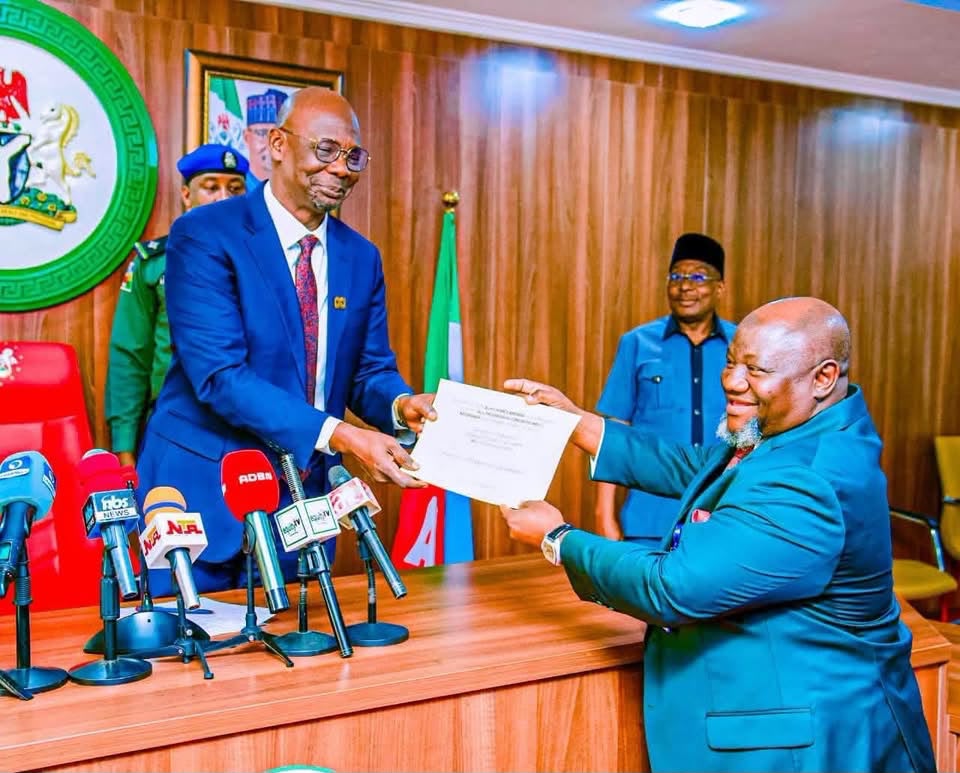
The presentation and collection of the Independent National Electoral Commission (INEC) Successful Candidate Upload Certificate by the Secretary to the Nasarawa State Government, Dr. Labaran Shuibu Magaji, SAN, on behalf of Senator Ahmed Aliyu Wadada, at the Government House in Lafia, has provided a decisive moment in the political journey towards the 2027 general elections.
The certificate, issued in respect of Senator Ahmed Wadada Aliyu as the All Progressives Congress (APC) governorship candidate for Nasarawa State, should put to rest the lingering speculations and deliberate narratives questioning whether he was duly elected as the party’s flagbearer. Facts have now spoken louder than rumours.
In politics, misinformation can travel faster than truth, but official records ultimately have the final word. The successful upload of Senator Wadada’s candidacy by INEC is therefore not merely a procedural development; it is an important confirmation that the APC has a recognised candidate to fly its flag in the 2027 governorship election.
Those who have continued to go from place to place creating doubts and deceiving unsuspecting citizens should now reconsider their approach. Political disagreement is legitimate in a democracy, but deliberately destroying the reputation of another person in the pursuit of power is dangerous. As the saying goes, when you set fire to your brother’s house, you may eventually discover that your own house is standing in the same neighbourhood.
The political class must therefore understand that Nasarawa State belongs to all of us. Political power is temporary, but the consequences of political actions can endure for generations. No ambition, no matter how important, should be pursued at the expense of peace, unity and the stability of the state.
With this development, the political road is clearer for Senator Ahmed Wadada Aliyu and other APC candidates to face the electorate in 2027. The responsibility now rests squarely on the candidates, their supporters and political opponents to take their messages to the people and allow citizens to make informed choices.
As campaigns for the presidential and National Assembly elections commence today, 19 August 2027, political parties and their candidates must embrace issue-based campaigns. Nigerians are tired of politics built around insults, character assassination, propaganda and the deliberate destruction of people’s reputations.
The real questions before the electorate are straightforward: Who can provide accountable leadership? Who can create opportunities for young people? Who can improve education, healthcare, agriculture, infrastructure and security? Who can manage public resources responsibly? These are the issues that should dominate political campaigns—not personal attacks and dangerous political rhetoric.
There is also an urgent need to warn our youths against becoming cannon fodder for desperate politicians. Young Nigerians should not allow themselves to be recruited to fight political battles for people who will never allow their own children to stand on the frontline of violence. The future belongs to the youths, and destroying that future in the name of politics is a tragic contradiction.
Security agencies must equally prepare for the challenges that may accompany the election season. Their responsibility is to protect every citizen, regardless of political affiliation, and to deal firmly and lawfully with individuals or groups that threaten public peace, intimidate voters or engage in violence and destruction.
Religious leaders also have an enormous responsibility at this critical moment. Churches and mosques must become voices of peace, tolerance and responsible citizenship. Religious leaders should speak against discrimination, hatred and violence because when society catches fire, nobody—rich or poor, Christian or Muslim, politician or ordinary citizen—is completely insulated from its consequences.
Traditional rulers, community leaders, civil society organisations and the media must also play their part. The media, particularly, must resist becoming an instrument for spreading unverified claims capable of inflaming political tensions. Journalism must remain anchored on facts, fairness, responsibility and the public interest.
To the people of Nasarawa State and Nigerians generally, the coming election offers another opportunity to decide the kind of leadership they want. Democracy is not merely about voting; it is about choosing leaders who understand that public office is a trust and that government exists to serve the people.
The electorate must therefore vote wisely, reject inducement and scrutinise the records, character, competence and programmes of all candidates. Political loyalty should never prevent citizens from asking legitimate questions about governance and accountability.
Nasarawa State deserves a campaign season characterised by ideas rather than insults, competition rather than confrontation, persuasion rather than intimidation, and service rather than selfish ambition. The 2027 election should be a contest over who can build a better future—not a contest over who can destroy an opponent faster.
The message at this moment should therefore be clear: the certificate has spoken, the political process has moved forward, and the people must now be allowed to decide. Let every candidate earn the confidence of the electorate through credible programmes, responsible conduct and a genuine commitment to the development of Nasarawa State.
The ultimate winner should not merely be a political party or an individual candidate. The ultimate winner must be the people, democracy and the peaceful future of Nasarawa State.
Israel JP is the Senior Special Assistant SSA on media to Senator Ahmed Wadada Aliyu.
