

By Joseph Adahnu, Yola
In the shadow of Adamawa’s Government House, where decisions for millions are made, more than a thousand children sit on bare floors, write their future under trees, and relieve themselves in the bush
Dougirei Government Day Secondary School, Yola, stands just beyond the walls of the seat of power. Its toilets are locked for want of water. Its classrooms lean under the weight of flood and erosion. Its students write WAEC and NECO examinations under trees. The Vice Principal receives visitors while seated on a mat at the staff-room door.
This is not a remote village school. It is in one of Yola’s better neighbourhoods, sharing a boundary with the Government House itself. Yet for its students—mostly children of vulnerable households—going to school is an exercise in endurance and quiet fear.
The Daily Reality
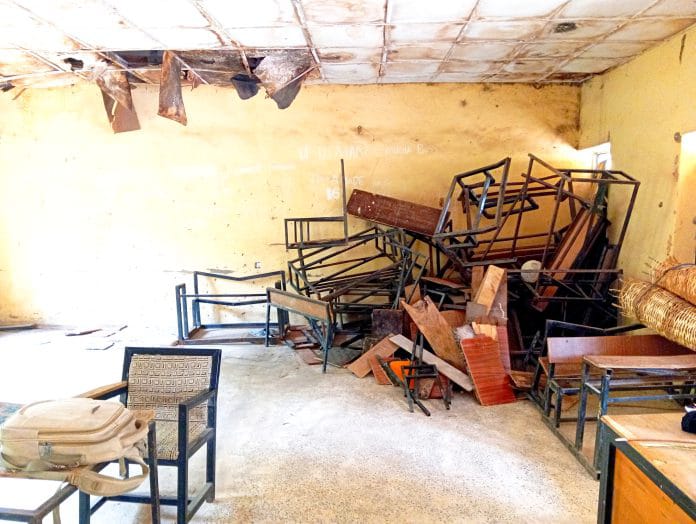
Classrooms have broken ceilings that open to the sky and invite reptiles. Roofs leak so badly that rainy-season lessons become an exercise in dodging water. Desks and chairs are scarce or broken beyond use; many students sit on the bare floor, on window ledges, or on blocks. Teachers bring their own mats. On hot days some leave the cramped staff room entirely and teach or mark papers under trees.
There is no functional water supply, despite the school’s proximity to the Adamawa State Water Board headquarters. The toilets are therefore unusable. Students—especially girls—must go into the surrounding bush. There is no science laboratory, though science subjects are taught. There is no examination hall. When external examinations arrive, candidates sit under trees and hope the weather holds.
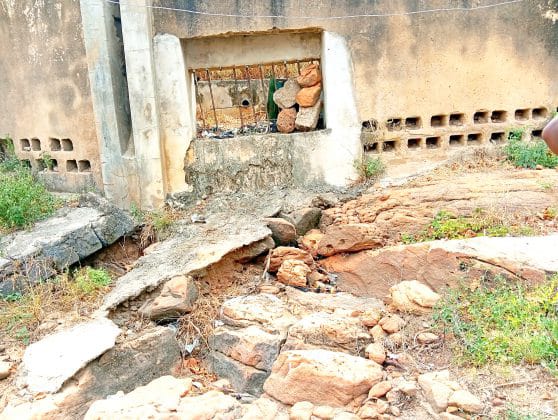
Only about 24 teachers serve more than 1,000 students. The shortage is felt in every overcrowded classroom. Water That Drowns Learning the most dangerous threat comes from above and from next door. Storm water from the Government House is channelled into the school grounds. After heavy rain the compound floods with force.
Academic activities have been suspended on such days. Gully erosion is steadily eating at the land. Some classrooms already show signs of structural strain. Journalists who visited the school stumbled on the uneven, water-scarred ground; the risk to children who walk those paths every day is obvious.
The school’s Parent-Teacher Association chairman, Alhaji Mohammed Usman, has written repeatedly to the Ministry of Education. “I am tired of writing letters,” he said. “We are now waiting for God’s intervention, not man’s.”
Promises and Budgets
Governor Ahmadu Fintiri’s administration has declared education a priority. It introduced free education and school-feeding programmes and announced plans for model secondary schools across the state’s 21 local government areas. Budget figures show substantial allocations to education in recent years—rising to more than ₦40 billion in 2025 and 2026.
Yet at Dougirei, established more than a decade ago and sitting almost within sight of power, basic facilities remain absent.
When journalists from the Correspondents’ Chapel visited, they found the school in open distress. Attempts to speak with the Commissioner for Education that week yielded no response.
The Unanswered Question
What becomes of the children already inside public schools while new “model” institutions are planned? At Dougirei the answer is visible every morning: bare floors, locked toilets, leaking roofs, examinations under trees, and the constant threat of floodwater from the very seat of government.
The school stands as a quiet, daily indictment—close enough to power to be seen, yet still waiting to be heard.
