
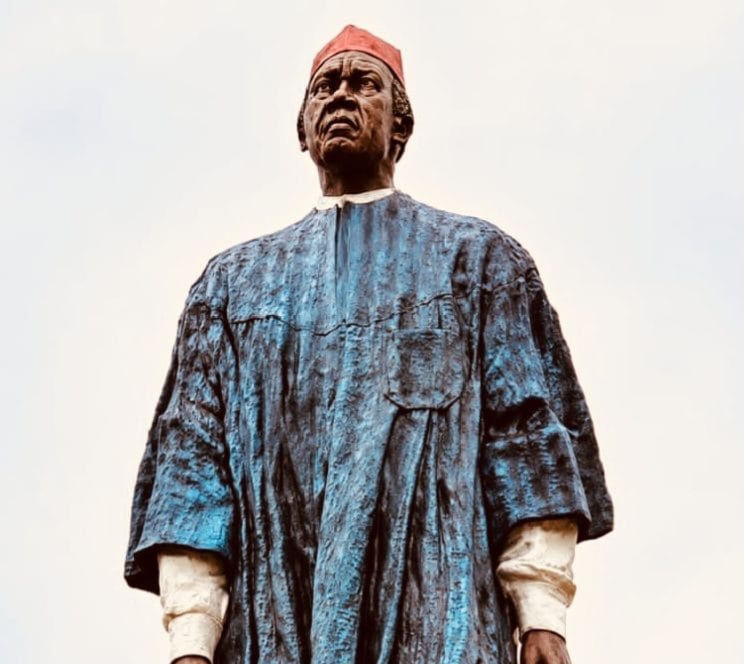

The public debate surrounding the newly unveiled statue of renowned novelist, Professor Chinua Achebe, at Ugwu Nwasike in Ogidi, Anambra State, has continued to generate reactions, with many questioning whether the sculpture bears a close resemblance to the late literary icon.
The discussion, which has gained traction on social media, has largely focused on the statue’s physical likeness to Achebe. However, commentators have argued that public monuments should be assessed not only by facial resemblance but also by their artistic value, symbolism and the legacy they seek to preserve.
According to the opinion, sculptures are traditionally regarded as artistic interpretations rather than exact replicas of their subjects. It noted that artists often express their creative vision through symbolism, style and technique, making it possible for different sculptors to produce varying representations of the same individual.
The article maintained that criticism of public artworks should be based on recognised artistic standards such as craftsmanship, composition, proportion, anatomical accuracy and creative interpretation, rather than solely on comparisons with photographs.
It also clarified that the Achebe monument was conceived, funded and executed by the Ogidi Town Union as a community project to honour one of its most distinguished sons. The Anambra State Government, it stated, did not commission or produce the sculpture, while Governor Chukwuma Soludo attended only to officially unveil the monument at the community’s invitation.
The opinion further cautioned against politicising the project, describing it as a cultural initiative aimed at preserving the memory and contributions of one of Africa’s most celebrated literary figures.
While acknowledging that public art should remain open to constructive criticism, the article stressed that such assessments should be informed and balanced, recognising both artistic interpretation and the intention behind the work.
It concluded that the true significance of the monument lies in its role in preserving Professor Chinua Achebe’s legacy, inspiring future generations and celebrating the global impact of the literary icon, rather than in achieving perfect physical resemblance.
