

Brilliance is not a commodity that can be purchased, inherited, or monopolized by the wealthy. If it were, the children of the rich would have bought every seat of influence, while the children of the poor would have been permanently confined to the lowest levels of society. Leadership, too, cannot be completely controlled by the powerful. If it could, the high and mighty would have kept it within their exclusive circle forever.
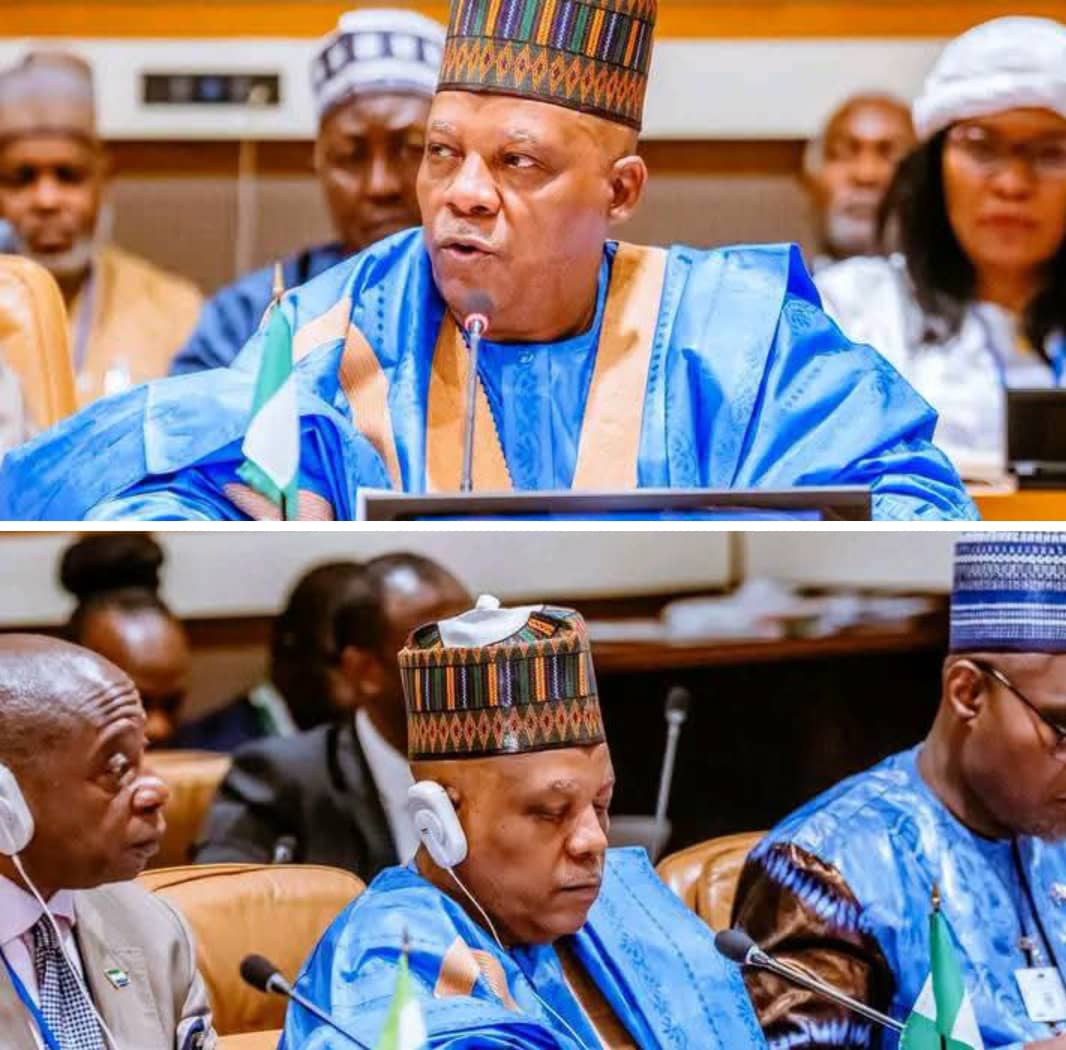
The rise and growing international visibility of Vice President Kashim Shettima provide a useful reminder of these truths. His repeated representation of President Bola Ahmed Tinubu at the United Nations General Assembly has generated criticism from political opponents, particularly former Vice President and African Democratic Congress presidential candidate Atiku Abubakar. Critics have questioned why President Tinubu has delegated his vice president to represent Nigeria at the world leaders’ meeting on three consecutive occasions. Some have interpreted the decision as evidence of political weakness, fear by the president to present himself on American soil.
These criticisms, however, reveal more about the anxieties of the opposition than about the actual state of the Tinubu–Shettima administration. The president’s decision to entrust the vice president with such important international responsibilities should be understood as a demonstration of confidence, strategic delegation, and recognition of competence. Rather than weakening the presidency, Shettima’s international engagements may be strengthening Nigeria’s diplomatic profile and presenting the country with a capable, articulate, and intellectually prepared representative.
The United Nations General Assembly is one of the most important diplomatic platforms in the world. It brings together presidents, prime ministers, vice presidents, foreign ministers, and high-ranking government representatives from across the globe. Not every national leader personally attends every session or engagement. Many countries are represented by delegations, depending on national priorities, scheduling, diplomatic strategy, and the division of responsibilities within government. Therefore, Nigeria’s decision to send its vice president should not automatically be treated as a constitutional crisis or political scandal.
The suggestion that President Tinubu must personally attend every international gathering in order to prove his authority is simplistic. Modern governance requires delegation. A president cannot be physically present at every meeting, conference, or diplomatic engagement. The quality of leadership is not measured by personal attendance at every event but by the ability to select competent representatives who can communicate national interests effectively. By repeatedly choosing Vice President Shettima, President Tinubu appears to be affirming his belief that Shettima possesses the intellect, confidence, and diplomatic skill required to represent Nigeria on the global stage.
The vice president’s performance has also challenged the old assumption that political influence belongs exclusively to people from privileged backgrounds. Shettima’s public engagements have demonstrated that competence can emerge from determination, education, experience, and character. His voice has been heard in international forums, and his interventions have attracted attention from world leaders and observers. His name has become increasingly associated with Nigeria’s participation in major diplomatic conversations.
For those who believe that the children of the poor should remain trapped beneath the limitations of their origins, this development may be uncomfortable. But society progresses when ability is allowed to rise above social class. A person’s background should not determine the maximum height of his or her achievement. Leadership should be a reward for capacity, service, and trust—not a private inheritance reserved for the children of the wealthy or politically connected.
Vice President Shettima’s emergence also carries symbolic significance. It tells young Nigerians that the nation’s highest institutions are not entirely closed to those who come from modest beginnings. It demonstrates that intellectual ability, courage, and public service can create opportunities that wealth alone cannot guarantee. This does not mean that Nigeria has eliminated inequality or that merit always triumphs over privilege. Clearly, the country still faces serious challenges involving poverty, unequal access to education, and political exclusion. Nevertheless, every credible example of a person rising through competence contributes to a broader culture of hope.
Shettima’s role in representing Nigeria at international events has further demonstrated the importance of preparation and effective communication. At a global meeting, a representative must understand the country’s political position, economic interests, security concerns, and development objectives. He or she must also possess the ability to speak with confidence while balancing national pride with diplomatic responsibility. A representative who lacks knowledge or composure can damage the image of the country. Conversely, a prepared and confident representative can improve international understanding and attract cooperation.
The vice president’s recent engagement in India was similarly presented as evidence of his capacity, integrity, and diligence. Whether addressing economic issues, technology, development, security, or international cooperation, such engagements require more than ceremonial attendance. They require an understanding of complex global realities and the ability to connect Nigeria’s interests to wider international opportunities. A vice president who can perform these duties effectively should be regarded as an asset to the country, not as a threat to anyone’s political ambition.
Much of the criticism surrounding Shettima’s representation of Nigeria appears to arise from political calculations. Opposition leaders may fear that repeated international exposure is increasing his popularity and strengthening his reputation among foreign leaders. They may also worry that the Tinubu–Shettima partnership is building an image of cohesion and competence that could influence future electoral contests. Such concerns are understandable within the competitive world of politics, but they should not be disguised as purely patriotic objections.
Atiku Abubakar and other critics have questioned President Tinubu’s absence from the United Nations General Assembly and offered several explanations, including the claim that he may be avoiding arrest by American authorities. This allegation is serious, but it requires evidence rather than speculation. Political opponents have a right to scrutinize the government, yet responsible criticism must be based on facts. Suggesting that a sitting Nigerian president avoided an international event because he feared arrest, without presenting credible proof, risks reducing public debate to rumor and political theater.
The United States has mechanisms for pursuing individuals it considers subject to legal action, but no responsible analysis should assume that every absence from an international event is evidence of fear. Heads of government frequently alter their schedules for medical, administrative, security, political, or diplomatic reasons. They also routinely delegate representatives. If a government chooses to send a vice president, that decision does not automatically indicate weakness or guilt. The burden of proof rests with those making the allegation.
Moreover, the focus on President Tinubu’s physical presence has distracted attention from the substance of Nigeria’s representation. The central question should be: Did Nigeria communicate its interests effectively? Did its delegation participate meaningfully in conversations about global development, investment, peace, security, and economic cooperation? Did the representative present a credible vision for Nigeria and Africa? If the answer to these questions is affirmative, then the country has not been poorly served merely because the president was not personally in attendance.
The Tinubu–Shettima partnership should therefore be assessed by its outcomes, not by the discomfort it creates among political opponents. President Tinubu is responsible for setting the broad direction of government, while the vice president is expected to support implementation, represent the country, and perform duties delegated by the president. A functioning administration requires trust between both offices. If the president is comfortable assigning major international responsibilities to his deputy, critics should explain why that is inherently wrong.
Indeed, a strong vice president can enhance presidential leadership. The office of the vice president should not be reduced to ceremonial participation or political decoration. It should be occupied by someone who can contribute ideas, speak authoritatively, and represent the nation when necessary. A president who allows his vice president to exercise responsibility may be demonstrating confidence rather than insecurity. Similarly, a vice president who performs effectively is not necessarily attempting to outshine or undermine the president. Both can succeed within the same administration.
The opposition’s difficulty in understanding the Tinubu–Shettima approach may stem from an outdated view of political power. In that view, the president must personally dominate every platform, while the vice president remains in the background. But contemporary governance can benefit from shared visibility and coordinated leadership. When responsibilities are distributed intelligently, government can communicate more effectively and respond more quickly to national and international demands.
This does not mean that the administration should be exempt from criticism. The government must still be held accountable for economic hardship, insecurity, unemployment, inflation, and other challenges affecting Nigerians. International visibility alone does not feed families, create jobs, or improve public services. Diplomatic speeches must be matched with measurable domestic progress. The value of the Tinubu–Shettima partnership will ultimately depend not only on how well it is perceived abroad but also on whether it improves the lives of ordinary citizens at home.
Nevertheless, legitimate criticism must be distinguished from envy, conspiracy theories, and fear of another politician’s success. It is possible to question government policy without denying a public official’s ability. It is possible to demand accountability without claiming that every delegation is evidence of cowardice. It is possible to compete politically without treating the success of a Nigerian representative on the international stage as a national embarrassment.
Nigeria needs leaders who can rise above narrow interests and represent the country with competence. If Vice President Shettima is performing that role effectively, Nigerians should recognize it. His growing visibility does not diminish the president; it can complement the president’s leadership. His success does not belong only to him or to his political party; it also reflects the possibility that Nigeria can produce capable representatives who command attention in the international community.
The broader lesson is that talent cannot be permanently contained by wealth, class, or political tradition. Brilliance is not for sale. If it were, the children of the rich would have purchased every opportunity, and the children of the poor would have remained at the bottom of every choice. But history repeatedly shows that ability can emerge from unexpected places. Leadership, likewise, cannot be kept forever within the control of the powerful. The people may rise, and when they do, their success often unsettles those who believed power belonged exclusively to them.
While opposition politicians continue to interpret the president’s decisions through the lens of suspicion, the Tinubu–Shettima administration is moving towards changing the narratives again, and by the time this opposition would awake from their slumber, a new dawn would have been announced.
Bwala, PhD, writes from Abuja
