
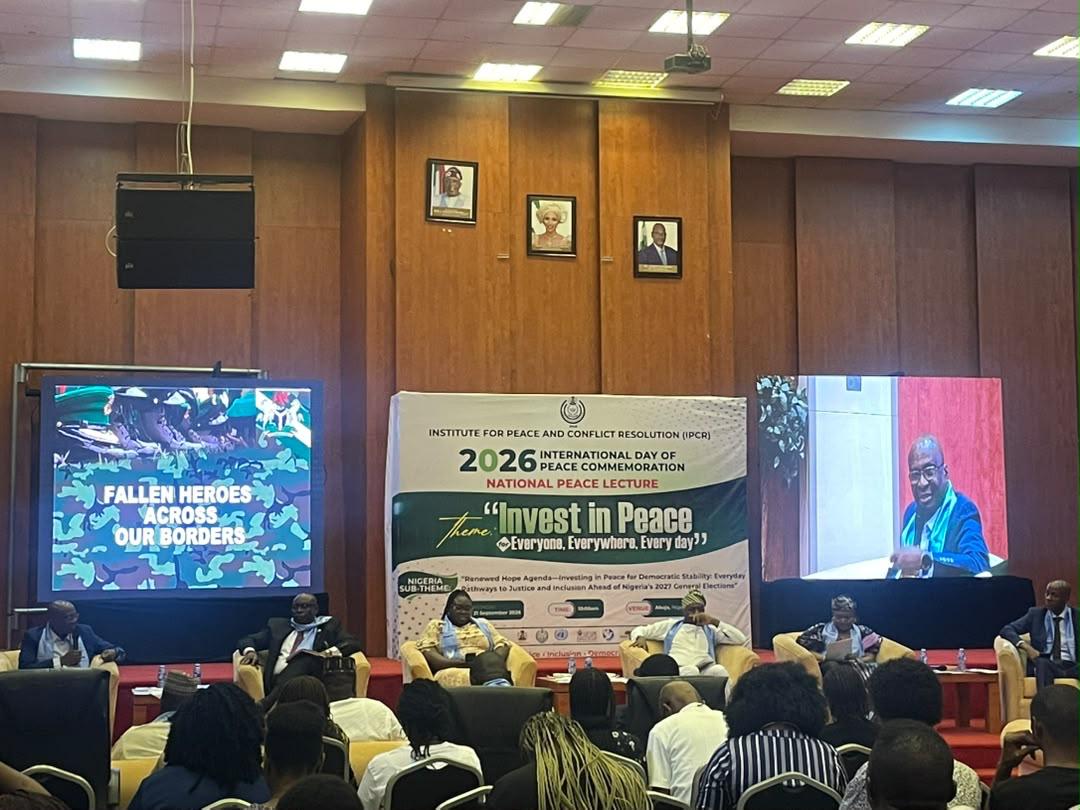

In a stark warning ahead of Nigeria’s 2027 general elections, the Director-General of the Institute for Peace and Conflict Resolution, Dr. Joseph Ochogwu, on Monday declared that Nigeria must stop treating peace as a seasonal intervention and start funding it like roads and power
Speaking at the IPCR Conference Hall, Abuja, during the Institute’s 2026 International Day of Peace Commemoration Lecture, Ochogwu said the country’s democratic stability and development prospects now depend on deliberate, daily investment in peace, justice, fairness and inclusion.
The lecture coincided with the global observance of the International Day of Peace, marked annually on September 21 in accordance with a United Nations General Assembly resolution, under the 2026 UN theme “Investing in Peace for Everyone, Everywhere, Every Day.”
Ochogwu said the theme marks a critical shift from viewing peace merely as the absence of war to recognising it as a continuous investment essential to national survival.
He domesticated the theme for Nigeria as “Renewed Hope Agenda: Investing in Peace for Democratic Stability – Everyday Pathways to Justice and Inclusion Ahead of Nigeria’s 2027 General Elections.”
According to him, the ballot alone will not guarantee credible polls. What happens between now and 2027 – in communities, on social media, in markets and in local government councils – will determine whether the elections are peaceful, credible and inclusive.
Ochogwu listed Nigeria’s interconnected fault lines that must be addressed urgently, including violent extremism, farmer-herder conflicts, banditry, youth restiveness, communal tensions, climate-induced competition for resources and misinformation.
He added to the list, grievances among youths and women, hate speech, weak access to justice at community level, and exclusion from the Nigerian project.
In his bluntest message, the IPCR boss warned of the economic cost of failure: “Without peace, we cannot have food security. Without peace, we cannot have quality education, healthcare, or attract investment,” he stated, noting that the absence of peace undermines development by disrupting livelihoods, weakening institutions and discouraging investment.
His prescription: treat peace infrastructure like physical infrastructure. “Every naira, every hour, every platform invested in dialogue is an investment in Nigeria’s survival,” he declared.
Ochogwu disclosed that IPCR has intensified election-related conflict prevention and will activate its national conflict telephony system to monitor and report incidents of electoral and political violence ahead of the 2027 elections, with reports to be escalated to relevant stakeholders for early intervention.
The Institute is also coordinating the National Conflict Early Warning and Early Response Platform, which connects state-level platforms to improve conflict monitoring and response.
Other measures include dialogues with political actors and traditional institutions, engagement with women and youth networks across the six geopolitical zones, and policy briefs on electoral violence mitigation.
Ochogwu, however warned that government alone cannot deliver peaceful elections. He called for a collective compact involving the Independent National Electoral Commission, security agencies, the National Assembly, the private sector, traditional and religious leaders, civil society, the media and international development partners.
He urged the National Assembly to strengthen legislation supporting social cohesion, security agencies to deepen non-kinetic, community-centred approaches, businesses to treat peace as a business imperative, and the media to invest in peace journalism to counter hate speech and misinformation.
He charged Nigerians at home and in the diaspora to “Speak peace. Share peace. Fund peace. Teach peace.”
Also speaking, Yobe State Governor, Hon. Mai Mala Buni, said his administration has deliberately invested in Yobe’s peace architecture by strengthening early warning and response mechanisms, building residents’ capacity in conflict management, advancing peace education and dialogue, and deploying technology to counter information disorder.
Buni, represented by his Special Adviser on Security Matters, Brig. Gen. Dahiru Abdulsalam (rtd), said the interventions were targeted at “conflict entrepreneurs” who profit from instability, and reaffirmed Yobe’s alignment with President Bola Tinubu’s Renewed Hope Agenda on durable peace, improved security and inclusive growth.
