
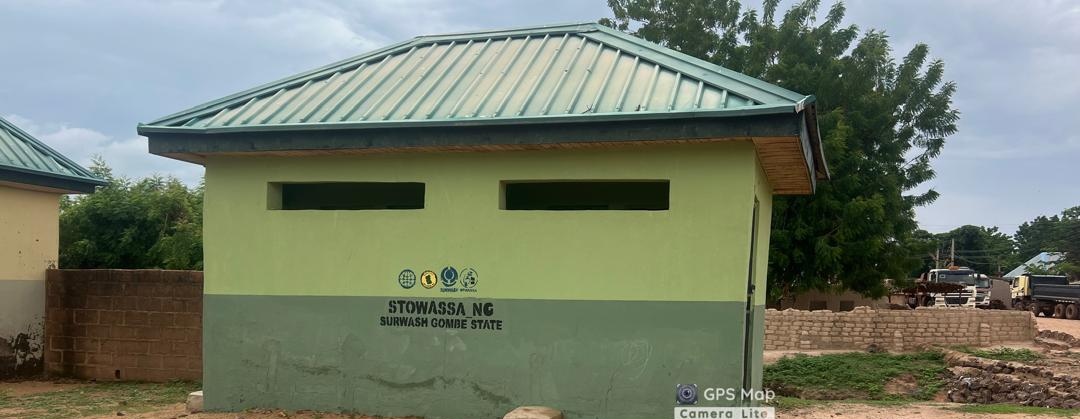

By Femi Ajimuda
In Nigeria, water remains a major challenge. Many communities still walk kilometres to fetch water. Many households still have no toilet. Many schools still have no decent sanitation. Many markets still operate in unhygienic conditions. The result is preventable diseases, high child mortality, and loss of dignity
Despite being Africa’s largest economy, access to safe water and basic sanitation remains low in many states. The Federal Government, in partnership with the World Bank, therefore designed the NG-SURWASH programme — a 0 million intervention covering 7 initial states from 2021 to 2027 — to tackle this challenge head-on.
The objective was clear: Provide sustainable water supply, end open defecation, improve sanitation in schools, markets, health centres, churches and mosques, and promote hygiene and environmental cleanliness
In Gombe State, that story has changed. And the man who changed it is Engr. Aliyu Usman, the Programme Coordinator of the Nigeria Sustainable Urban and Rural Water Supply, Sanitation and Hygiene (NG-SURWASH) programme in Gombe State.
What he has done is not just construction. It is a revolution. A revolution that has made water an easy thing in Gombe, sanitation a way of life, and a clean environment a reality. A revolution so brilliant that 14 States of the Federation with over 1,200 delegates are now preparing to storm Gombe to learn the secret.
Among the 7 states, Gombe state has performed exceptionally, and is the one state that has become Number One in implementation, in financial management, and in community impact.
The brilliance of the Gombe model is not just in construction, but in sustainability. Engr. Aliyu Usman’s model is now being studied as a national gold standard. It is: Build – Train – Hand over – Sustain.
Another unique aspect of the Gombe success is the deployment of solar-powered water systems. In a world battling climate change and energy costs, Gombe opted for sustainability and the future.
The boreholes and water schemes are powered by solar, ensuring that water flows even without public electricity and without burdening poor communities with diesel costs. Water is now flowing in urban and rural communities alike, clean, safe, affordable and sustainably. This is engineering with foresight.
The impact goes beyond water. Because every household now has access to a toilet, because schools and public places are clean, the environment has been protected. Waterborne diseases are reducing. Children, especially girls, stay longer in school. Women in markets trade in cleaner environments. Communities now live with dignity.
This is what the Sustainable Development Goals, particularly Goal 6 — Clean Water and Sanitation for All — preach. And Gombe is already achieving it, years ahead of the 2030 target. The UN’s recognition is therefore not a surprise. Gombe has cleaned its environment because everybody now has a toilet and everybody now has water. And it is sustainable because the communities own it.
The NG-SURWASH programme started with 7 states. Among the 7, Gombe emerged as number one. The results were so outstanding that the World bank , the Federal Government and development partners have now chosen Gombe as a National Learning Centre.
In what is unprecedented in the history of Nigeria’s WASH sector, no fewer than fourteen (14) states of the federation, with over 120 delegates, are set to storm Gombe State to learn the secret of the Gombe SURWASH success.
One hundred and twenty people, including Programme Coordinators, Water Engineers, Sanitation Specialists, Environmental Health Officers, and Commissioners for Water Resources, will converge on Gombe to understudy how to make every household own a toilet.
The message is clear: If Gombe can do it, Nigeria can do it. If Nigeria can do it, Africa can do it.
The Gombe model is simple but powerful: Do not just build for the people; build with the people. Train them. Trust them. Hand over to them. Let them own it.
Ajimuda wrote from Gombe, Nigeria and can be reached at
thestakeholdersmedia.com
