
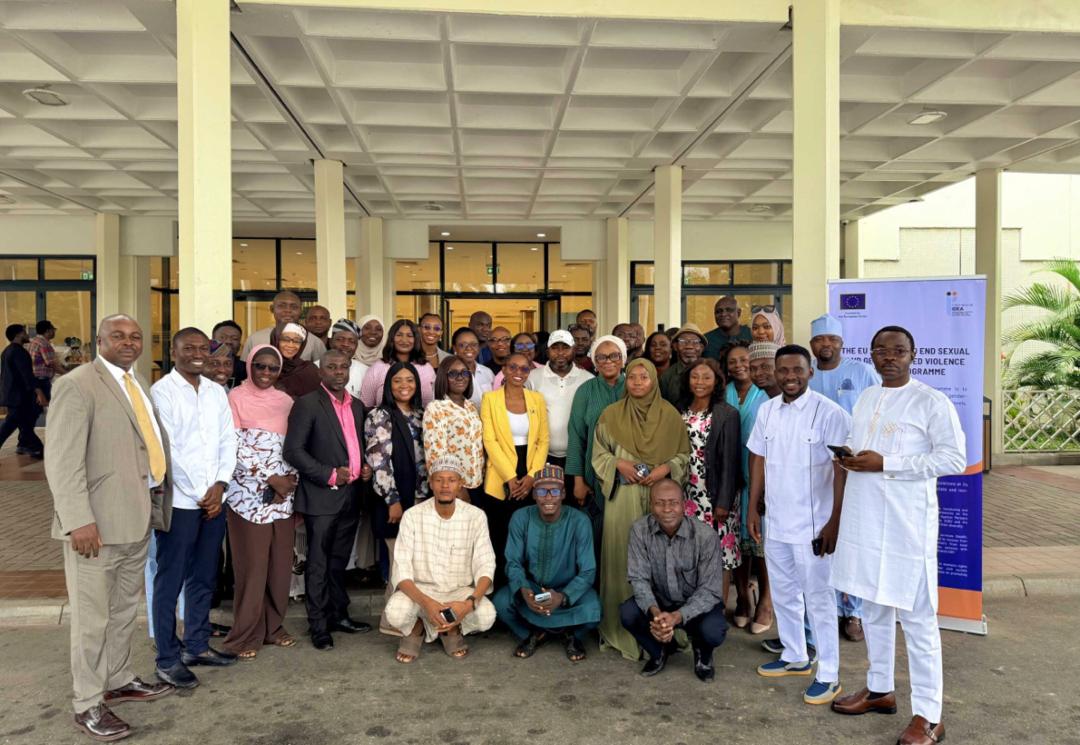

International Institute for Democracy and Electoral Assistance(International IDEA), has launched a dedicated media corps to strengthen the capacity of journalists to investigate, report and sustain public attention on sexual and gender-based violence (SGBV) in Nigeria.
The initiative, unveiled in Abuja under the EU-supported End Sexual and Gender-Based Violence Programme, is designed to move media coverage of SGBV beyond episodic reporting and towards sustained investigative journalism capable of exposing perpetrators, institutional failures and the social conditions that allow violence against women, girls and other vulnerable persons to persist.
The partnership reflects growing recognition among stakeholders that the fight against sexual and gender-based violence cannot be won through law enforcement and judicial action alone, but requires a powerful and informed media capable of breaking the culture of silence surrounding abuse.
The dedicated Media Corps is expected to provide journalists with specialised knowledge and tools to report SGBV cases more accurately, ethically and sensitively, while ensuring that victims and survivors are not subjected to further harm through irresponsible reporting.
At the launch, stakeholders stressed the strategic role of the media in shaping public attitudes, holding institutions accountable and ensuring that cases of sexual violence do not disappear from public consciousness after the initial news cycle.
The intervention also seeks to strengthen collaboration between journalists, government agencies, civil society organisations and other actors involved in the prevention and response to SGBV.
For NAPTIP, the partnership comes at a critical time as Nigeria continues to confront the complex and often interconnected challenges of trafficking, sexual exploitation, violence against women and girls, and other forms of abuse.
Beyond reporting individual cases, the new media corps is expected to deepen public understanding of the structural dimensions of SGBV and draw attention to gaps in prevention, protection, prosecution and survivor support.
The EU, through its support for the programme, has continued to position strategic communication and public awareness as important components of efforts to combat gender-based violence and strengthen institutional responses.
Participants at the Abuja engagement emphasised that journalists must be equipped not only with reporting skills but also with an understanding of the legal, psychological and social dimensions of SGBV.
This, they noted, would enable the media to report cases without sensationalism, protect the identities and dignity of survivors where necessary, challenge harmful stereotypes and ensure that coverage does not inadvertently reinforce the very culture that enables abuse.
The initiative is therefore being viewed as more than another capacity-building programme. It represents an attempt to create a specialised community of journalists who can make SGBV a sustained national accountability issue.
Stakeholders maintained that effective journalism can help expose patterns of abuse, amplify the voices of survivors, interrogate institutional responses and place pressure on relevant authorities to act.
They also called for stronger cooperation between the media and agencies responsible for tackling sexual violence, arguing that journalists should have access to credible information while respecting due process, privacy and the rights of survivors.
The launch comes against the backdrop of persistent concerns over under-reporting of sexual and gender-based violence, fear of stigmatisation, victim-blaming, weak access to justice and the reluctance of many survivors to speak publicly about their experiences.
These challenges, stakeholders observed, make responsible journalism particularly important in ensuring that victims are heard without being re-victimised.
With the establishment of the Media Corps, NAPTIP and the EU are seeking to build a more informed and specialised media response that can help transform public discourse around SGBV from one driven largely by isolated incidents into a sustained national conversation on prevention, accountability and justice.
The ultimate test of the initiative, however, will lie not merely in the number of journalists trained, but in whether the intervention produces deeper investigations, stronger accountability journalism and greater public pressure for institutions to protect victims and prosecute perpetrators.
For a country confronting persistent cases of sexual and gender-based violence, stakeholders said, silence remains one of the most powerful allies of perpetrators.
The new media corps is intended to make sure that silence no longer has the final word.
