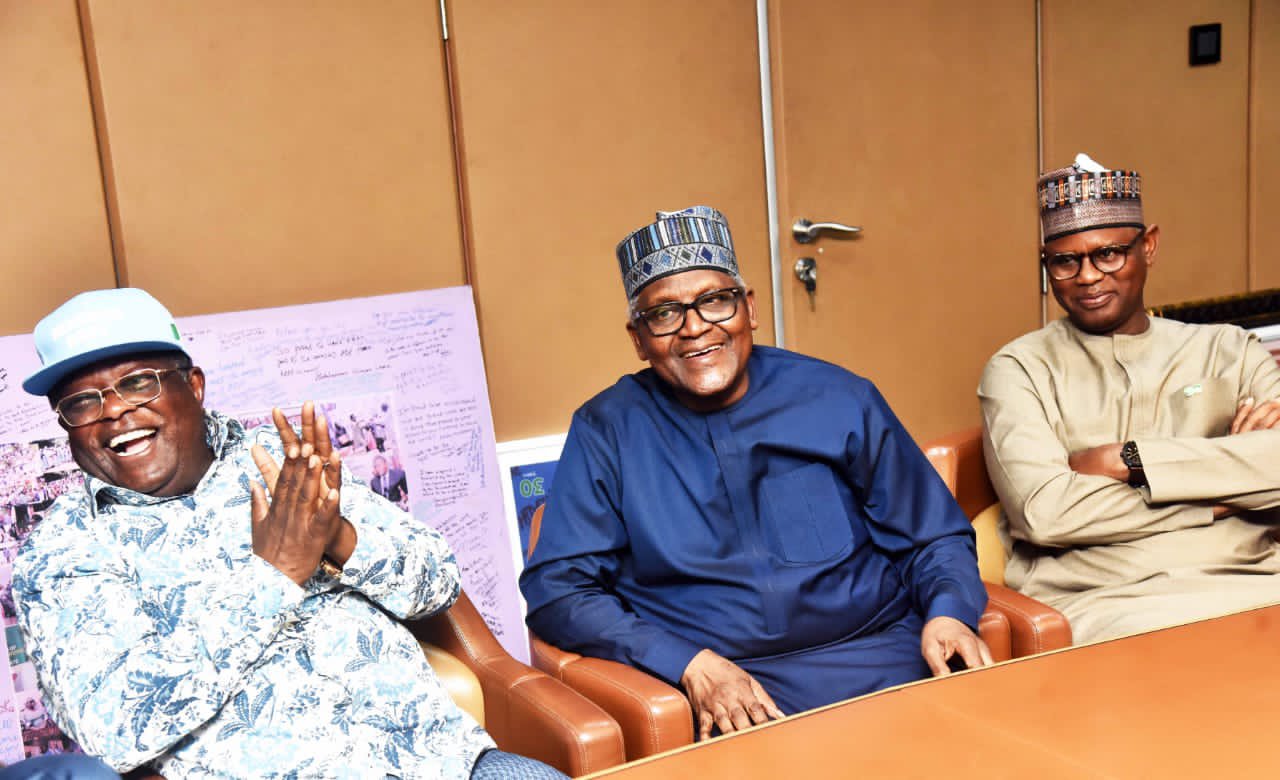

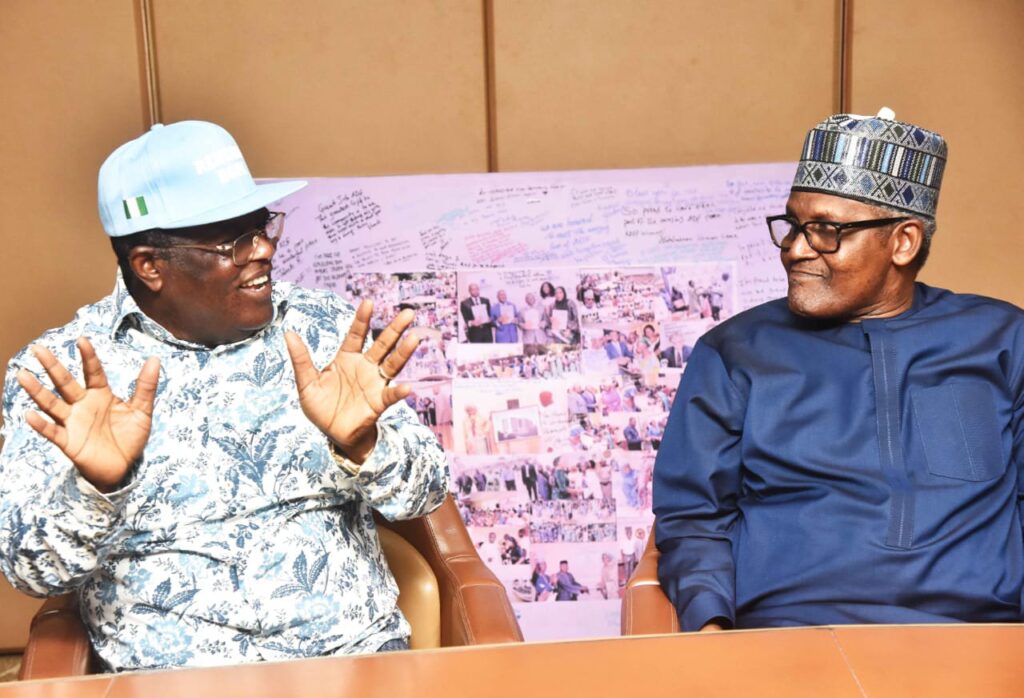
Following the inspection and oversight visit to the Lagos-Calabar Coastal Highway, undertaken on the directive of President Bola Tinubu to assess allegations linking the project to flooding along parts of the corridor, the Honourable Minister of Works, Senator (Engr.) David Umahi, accompanied by members of the National Assembly Committees on Works, the six geopolitical zones Senior Special Assistants to the President on Community Engagements, and the Senior Special Assistant to the Minister on Community Engagement (Highways), paid a courtesy visit to the Chairman of the Dangote Group, Alhaji Aliko Dangote, at the Group’s Head Office in Lagos.
The meeting provided an opportunity for both parties to further strengthen the existing partnership between the Federal Ministry of Works and the Dangote Group, particularly in the delivery of strategic national infrastructure projects. Discussions focused on ongoing collaborative projects and other areas of mutual interest aimed at accelerating Nigeria’s infrastructure development.
A significant aspect of the deliberations centred on the recent allegations that the Lagos-Calabar Coastal Highway contributed to flooding in parts of Lagos. The Honourable Minister clarified that available engineering assessments do not support such claims.
He stressed that indiscriminate dumping of refuse into drainage systems and natural water channels by residents and communities along the highway corridor remains one of the major causes of flooding. He further explained that the increasing impact of climate change has compounded the challenges associated with urban flooding.
The Minister noted that while the Federal Government has incorporated adequate drainage and hydraulic infrastructure into the Coastal Highway project, the development and maintenance of urban drainage networks remain primarily the responsibility of the Lagos State Government.
He added that, in some locations, structures and estates obstructing natural waterways had to be removed to allow the free flow of water into the Atlantic Ocean, thereby mitigating future flooding risks and protecting surrounding communities.
Speaking on behalf of the Dangote Group, Alhaji Aliko Dangote provided valuable insights into the realities of Nigeria’s cement industry. He explained that contrary to public perception, profit margins within the sector remain relatively modest due to high production costs.
He noted that despite these challenges, the Dangote Group remains committed to supporting the Federal Government’s infrastructure agenda through sustained investment in cement production and road construction.
He identified foreign exchange volatility as one of the most significant challenges confronting manufacturers, explaining that many production inputs and equipment are procured in foreign currencies, while finished products are sold in Naira.
He also highlighted the enormous capital requirements for establishing and operating integrated cement plants, including the necessity of dedicated power generation facilities to ensure uninterrupted production.
Alhaji Dangote further discussed the financing structure of large-scale industrial projects, emphasizing the importance of long-term financing instruments such as international bond markets in sustaining major investments. He observed that local financial institutions often face limitations in providing the level of capital required for projects of such magnitude.
