Lafia mega rally: The political dividends for Nasarawa, Sule’s legacy and Wadada’s governorship prospects

By Sam Israel
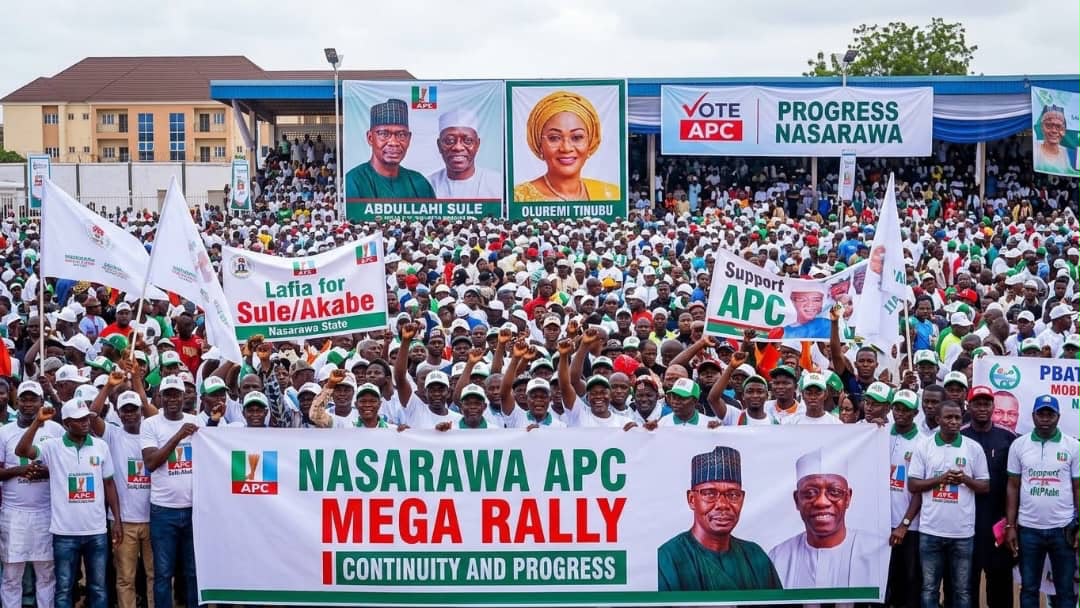
The dust has settled on the historic North Central mega rally held in Lafia, the capital of Nasarawa State, but its political significance continues to reverberate across the state and the wider Nigerian political landscape. What unfolded at Lafia Square on Saturday, October 10, 2026, was more than a gathering of party faithful. It was a major demonstration of political organisation, regional solidarity and the strategic importance of Nasarawa State in the unfolding calculations ahead of the 2027 general elections. The presence of the First Lady, Senator Oluremi Tinubu; the Secretary to the Government of the Federation, Senator George Akume; the APC National Chairman, Professor Nentawe Yilwatda; governors and other prominent political leaders elevated the event beyond an ordinary party rally. .
The rally has come and gone, but the questions it leaves behind are important: What has Nasarawa State gained from hosting such a gathering? What does it mean for Governor Abdullahi Sule’s political standing and development legacy? And how might the event influence the prospects of Senator Ahmed Wadada Aliyu, the APC governorship candidate for 2027? These questions deserve serious consideration because the real value of a political gathering lies not merely in the number of people who attend, but in the opportunities, relationships, confidence and development commitments that can emerge from it.
LAFIA’S MOMENT IN THE NATIONAL SPOTLIGHT
First, the rally placed Nasarawa State firmly at the centre of national political attention. For a state that occupies a strategic position in the North Central and shares proximity with the Federal Capital Territory, hosting a gathering of this magnitude represents an important opportunity to project its political relevance, hospitality and capacity to organise major national events.
The presence of influential national leaders gave Lafia an opportunity to showcase its potential to a wider audience. The images, speeches and discussions generated by the rally travelled beyond the boundaries of Nasarawa, presenting the state as a significant meeting point for political engagement. This kind of visibility can strengthen a state’s profile, encourage future engagements and create opportunities for discussions about investment, infrastructure and development. However, the lasting benefit will depend on how effectively the state converts this exposure into practical economic and social gains.
ECONOMIC ACTIVITY: THE IMMEDIATE DIVIDEND
The rally also presented an opportunity for local businesses to benefit from the influx of visitors. Hotels, restaurants, transport operators, food vendors and other small-scale traders had the potential to record increased patronage as supporters and political stakeholders arrived from different parts of the North Central region.
For ordinary residents, such commercial activity is a reminder that major gatherings can generate economic opportunities beyond the political arena. Yet, it is important to distinguish temporary business activity from sustainable economic growth. The greater opportunity for Nasarawa is to build on its visibility by attracting conferences, investment forums, tourism activities and other events that can generate recurring patronage for local businesses.
The lesson is straightforward: a successful rally should not be the end of the story. It should become a platform from which Lafia and other parts of the state can pursue greater commercial visibility, stronger local enterprise and wider economic opportunities.
GOVERNOR ABDULLAHI SULE: THE ADVANTAGE OF HOSTING NATIONAL LEADERS
For Governor Abdullahi Sule, the rally represented an important political moment. As host governor, he received national and regional leaders at a time when political parties are preparing for a highly consequential electoral contest. Successfully convening such stakeholders can reinforce a governor’s standing within his party and demonstrate his capacity to bring political actors together around a common objective.
The event also gave Sule an opportunity to present Nasarawa State as a willing partner in the political and development agenda of the Federal Government. His participation in the rally’s mobilisation effort was consistent with the APC’s call for coordinated support for President Bola Ahmed Tinubu and other party candidates in 2027.
Nevertheless, a governor’s enduring legacy is not determined by the grandeur of a single event. It rests on the quality of public institutions, roads, schools, healthcare services, security, employment opportunities and the general welfare of the people. The rally may strengthen Sule’s political profile, but the ultimate measure of his administration will remain the tangible improvements citizens experience in their daily lives.
THE SULE LEGACY AND THE QUESTION OF CONTINUITY
As the 2027 transition approaches, the question of continuity will naturally attract increasing attention. Governor Sule’s supporters can reasonably argue that preserving useful development policies, completing ongoing projects and maintaining effective relationships with the Federal Government are important considerations in choosing his successor.
However, continuity should never mean the suspension of new ideas or the avoidance of honest evaluation. A successful transition should preserve what works, correct what has fallen short and introduce fresh solutions to emerging challenges.
This is where the political conversation surrounding Senator Ahmed Wadada Aliyu becomes significant. As the APC’s governorship candidate, Wadada has an opportunity to explain how he intends to build on the existing administration’s achievements while addressing areas requiring stronger intervention. His task is not simply to inherit a political structure; it is to demonstrate that he has a credible plan for the next phase of Nasarawa’s development.
WADADA AND THE POLITICAL SIGNIFICANCE OF THE RALLY
For Senator Ahmed Wadada Aliyu, the Lafia mega rally offered a prominent platform to participate in a major gathering of national political leaders and reinforce his association with the APC’s 2027 political project. His presence alongside Governor Sule and other party stakeholders placed him within the wider conversation about the party’s electoral ambitions in Nasarawa State.
Wadada’s governorship prospects, however, must be understood within the broader realities of state politics. National recognition can be valuable, but it does not automatically translate into victory in a governorship election. Electoral success requires a combination of public confidence, credible policy proposals, effective grassroots engagement, party unity and the ability to respond to the everyday concerns of voters.
The rally therefore represents an opportunity rather than a guarantee. Wadada must convert the visibility it provided into sustained engagement with communities across the 13 local government areas, ensuring that his message reaches farmers, traders, civil servants, young people, women, traditional institutions, professionals and other constituencies whose interests will shape the election.
FROM NATIONAL CONNECTIONS TO LOCAL DEVELOPMENT
One of the strongest arguments Wadada can advance is the importance of constructive cooperation between the state and federal governments. In his remarks at the rally, he highlighted federal infrastructure and educational initiatives, including the proposed transformation of the Federal Polytechnic, Nasarawa, into a specialised university of mining and engineering technology. Such initiatives, where effectively implemented, could expand technical education and strengthen the skills base required for economic diversification. .
For Nasarawa, the critical issue is how these relationships can translate into visible improvements in the lives of citizens. Better roads can connect farmers to markets, strengthen rural commerce and reduce transport difficulties. Investment in education can equip young people with relevant skills. Improved healthcare can protect families from avoidable hardship, while agricultural development can expand productivity and strengthen food security.
If Wadada intends to make these priorities central to his governorship, he must explain the policies, budgets, partnerships and accountability mechanisms through which they would be delivered. Political connections are most valuable when they produce measurable public benefits.
THE HEARTS AGENDA AND THE TEST OF GOVERNANCE
A compelling governorship campaign must offer more than political endorsements and expressions of loyalty. It must present a clear development framework capable of addressing the aspirations of a diverse population.
Wadada’s proposed HEARTS development framework—covering Health, Education, Agriculture, Rural Development and Transportation or infrastructure—provides an opportunity to organise his policy message around sectors that directly affect the lives of ordinary people.
The challenge is to translate each component into practical commitments. In health, citizens need accessible and adequately equipped facilities. In education, they need better learning conditions, competent teachers and opportunities for skills development. In agriculture, farmers need access to inputs, extension services, storage, processing facilities and markets. Rural communities need reliable infrastructure, while transportation projects must be selected and implemented according to public need and available resources.
A credible agenda must also explain how the government would finance its commitments, establish implementation timelines and measure results. If Wadada can demonstrate that his programme is realistic, transparent and responsive to the needs of all parts of Nasarawa, he will give voters substantive reasons to evaluate his candidacy.
PARTY UNITY: THE BRIDGE BETWEEN MOMENTUM AND ELECTORAL SUCCESS
Another important lesson from the Lafia rally is the value of political coordination. The presence of senior party figures and stakeholders from across the North Central demonstrated the APC’s ability to convene a broad political gathering. But assembling leaders on one occasion is only the beginning of the work required to sustain a united political organisation.
For Nasarawa APC, the period ahead calls for reconciliation, inclusive consultation and disciplined engagement with stakeholders. Differences within a political party cannot always be eliminated, but they can be managed through fairness, dialogue and respect for legitimate interests.
For Wadada, this presents both a responsibility and an opportunity. He must demonstrate that his governorship project is capable of accommodating different interests while maintaining a coherent policy direction. A candidate who can combine political organisation with an inclusive development message will be better positioned to build confidence among a diverse electorate.
THE PEOPLE MUST REMAIN AT THE CENTRE
Amid the excitement generated by the rally, one principle must not be forgotten: political parties exist to compete for the mandate of the people, and the people retain the ultimate authority to decide who governs them.
The size of a crowd may demonstrate mobilisation capacity, but it cannot by itself establish the wishes of every voter. Nor should the attendance of national leaders be mistaken for a substitute for local accountability. The real test of political leadership is whether it can listen to citizens, understand their problems and develop workable responses.
For Wadada, the road to 2027 should therefore be marked by meaningful public engagement, open discussion of his manifesto and a willingness to explain how his proposals would improve living standards. His campaign will be stronger if it encourages citizens to assess policies, competence and integrity rather than relying exclusively on political excitement.
THE ROAD FROM LAFIA TO 2027
The mega rally has provided Nasarawa State with national visibility, created an occasion for commercial activity and reinforced the importance of the state in the APC’s North Central mobilisation strategy. For Governor Sule, it was an opportunity to demonstrate political coordination and strengthen relationships with influential party leaders. For Senator Wadada, it was a significant platform from which to advance his governorship ambitions.
But the decisive work begins after the crowds have dispersed. The state’s leadership must pursue development opportunities that can outlast the political season. The governor’s legacy will be judged by the institutions, infrastructure and opportunities left behind. Wadada’s prospects will depend on whether he can turn political recognition into a convincing programme for governance and earn the confidence of voters across the state.
The coming months will demand more than speeches, banners, endorsements and rallies. They will require policy clarity, organisational discipline, public accountability and sustained contact with communities. Those who understand this distinction will appreciate both the opportunities created by the Lafia gathering and the work still required to make its significance endure.
CONCLUSION: THE RALLY IS OVER, BUT THE RESPONSIBILITY REMAINS
The Lafia mega rally will remain an important moment in Nasarawa’s political calendar, but its greatest value will be determined by what follows. Will the visibility attract new investment? Will political cooperation improve the delivery of federal and state projects? Will the transition to a new administration preserve useful achievements while introducing effective new solutions? And will the aspirations expressed on the rally ground be matched by policies that improve the lives of ordinary people?
These are the questions that matter beyond the excitement of the occasion.
For Governor Abdullahi Sule, the opportunity is to consolidate his development record and facilitate a transition that places the interests of Nasarawa above partisan considerations. For Senator Ahmed Wadada Aliyu, the challenge is to present a credible, inclusive and measurable programme that convinces voters he is prepared for the responsibilities of the governorship.
The political significance of the Lafia rally is clear: it placed Nasarawa at the centre of a major North Central mobilisation effort and gave Wadada a valuable opportunity to advance his 2027 message. But history will ultimately be written not by the size of the crowd alone, but by the quality of leadership, the credibility of promises and the practical results delivered to the people.
Lafia has hosted the rally. Nasarawa has received the spotlight. The task now is to turn political momentum into lasting development—and to let the people decide, through a credible and peaceful election, who is best prepared to lead the state into its next chapter.
Sam Israel is the Senior Special Assistant SSA on media to Senator Ahmed Wadada Aliyu.
