
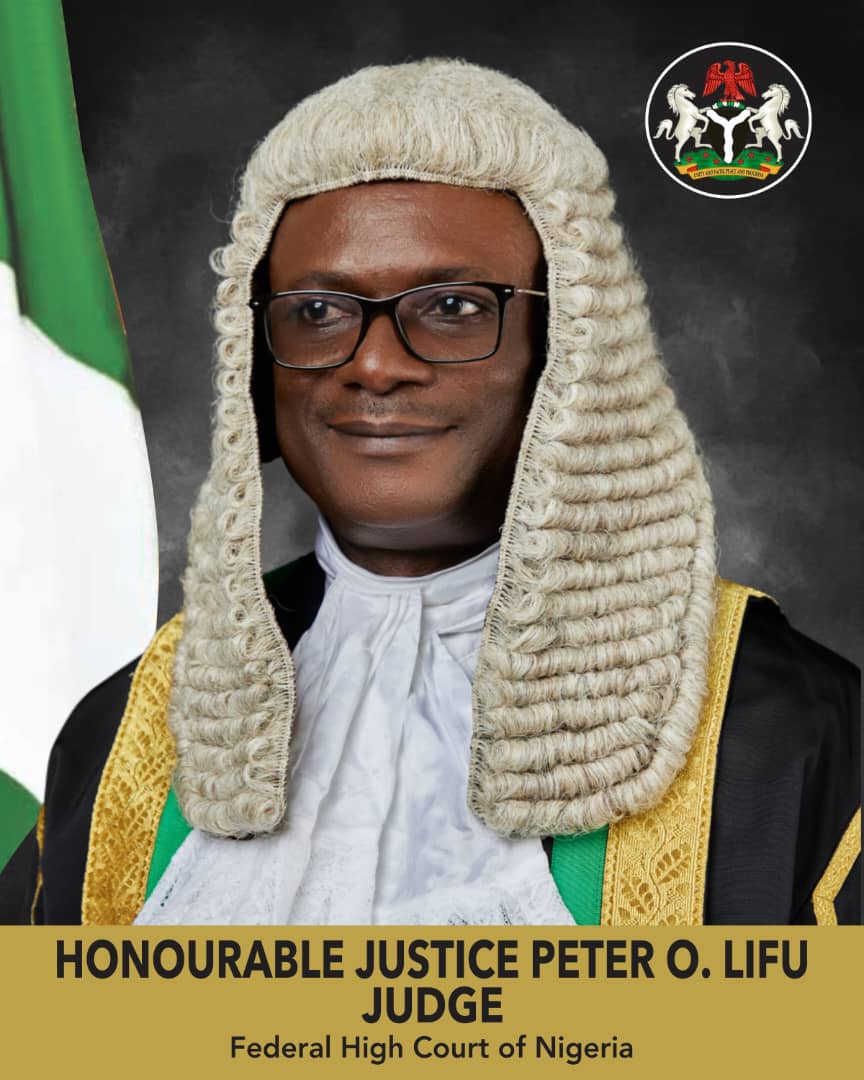

Beyond the courtroom, beyond the headlines surrounding his judgments, lies the story of a man whose journey reflects the intersection of education, law, discipline, and the enormous responsibility of judicial service.
Every judicial officer has a journey, but not every journey attracts national attention. Some judges quietly dispense justice and remain largely unknown to the public, while others, through the nature of the cases before them and the weight of their decisions, become figures of national conversation. Hon. Justice Peter Odo Lifu belongs to the latter category.
From Okpoma in Yala Local Government Area of Cross River State, to the academic environment of Ibadan, the legal corridors of Lagos, and eventually the Federal High Court in Abuja, Justice Lifu’s professional journey is one that deserves to be examined beyond the ordinary narration of appointments and qualifications.
His story is not simply that of a man who studied law, became a lawyer, and eventually ascended the judicial bench. It is a story of professional evolution, intellectual preparation, and a career that has placed him at the centre of some of Nigeria’s most politically
From legal practice to the bench
In May 2013, Justice Peter Odo Lifu was appointed to the National Industrial Court by President Goodluck Jonathan.
The National Industrial Court occupies an important place in Nigeria’s judicial structure, particularly in matters involving employment, labour relations, industrial disputes, workplace rights, trade unions, and other issues connected to the relationship between employers and employees.
His years on the Industrial Court bench marked a transition from representing clients and teaching legal principles to the responsibility of interpreting the law and resolving disputes from the position of a judicial officer.
In June 2018, he was appointed to the Federal High Court of Nigeria, a court whose jurisdiction places its judges in the middle of issues involving the federal government, public institutions, political parties, elections, constitutional questions, regulatory bodies, and matters of national importance.
He served in Lagos before his transfer to Abuja in January 2024.
LANDMARK CASES IN LAGOS
- 70 Trillion Naira Case (2023):Struck out FG suit to recover funds in 29 accounts for lack of diligent prosecution.
- MC Oluomo / Transport Unions Case (2022): Restrained unions from collecting levies from non-member drivers in Lagos.
- Sanwo-Olu Disqualification Case (2023): Dismissed PDP suit — affirmed on appeal.
- Auditor-General Report Case (2023): Ordered President Tinubu to investigate alleged $2.1bn + ₦3.1trn unaccounted oil/subsidy funds.
- ECO Atlantic City Case (2022):Granted injunction against management despite powerful interests.
- Labour Party Mandamus (2022): Ordered real-time transmission of 2023 election results despite APC opposition.
LANDMARK CASES IN ABUJA (2024-2026)
Most of his judgments were affirmed on appeal, some by Supreme Court:
- APC vs INEC (Rivers LG Election) — Laid foundation for emergency rule in Rivers.
- Labour Party Leadership — Nenadi Usman vs Abure— Recognised Usman-led caretaker committee. Affirmed by Appeal Court, April 2026.
- PDP Crisis — Umar Maina Case — On replacement of Acting National Chairman. Affirmed.
- PDP Chairmanship — Sule Lamido Case— Affirmed.
- Goodluck Jonathan Eligibility (2026) — Ruled Jonathan can contest 2027 Presidential Election. Affirmed.
- Ekiti Governorship — Abimbola Olawunmi vs APC— Cleared Gov. Oyebanji. Affirmed by Supreme Court.
- APC Primaries — Arobo vs APC (Owo/Ose)— First pre-election judgment on APC primaries. All 5 appeals dismissed.
- Ogun PDP — Adebutu Case (Nov 2026) — INEC cannot omit duly nominated candidate. Affirmed.
It is easy to celebrate a judge when a judgment favours one’s preferred political position. It is equally easy to condemn the same judge when a decision goes against one’s interests.
But the true test of judicial independence is not whether a judgment satisfies political actors or public sentiment. It is whether the decision is rooted in the law, the evidence before the court, due process, and the principles of justice.
Justice Peter Odo Lifu’s growing public profile is a reminder of the weight carried by judicial officers in Nigeria’s democratic system.
Judges do not campaign for public approval. They are not elected to satisfy political constituencies. Their responsibility is to interpret the law and adjudicate disputes without fear, favour, affection, or ill will.
However, judicial decisions are not immune from scrutiny. The public has a legitimate interest in understanding court rulings, particularly where those decisions affect elections, public institutions, political parties, or the exercise of democratic rights.
The fact that some of his decisions have reportedly been affirmed by appellate courts, including the Supreme Court in certain matters, is an important part of assessing his judicial record. Equally, any judgment reversed on appeal must be viewed within the proper judicial process. Appellate review is an essential mechanism for correcting errors, clarifying legal principles, and ensuring that the justice system remains accountable to the law.
A judge’s legacy should not be measured simply by the number of cases handled, the political personalities involved, or the headlines generated. It should ultimately be assessed by the quality of legal reasoning, consistency, fairness, courage, and respect for the Constitution and that is justice Peter Odo Lifu.
For the people of Okpoma, Yala, and Cross River State, the journey of Justice Peter Odo Lifu is also a story of representation and pride.
It is always significant when a son of a community rises to occupy a position of national responsibility, particularly in an institution as important as the judiciary. His journey from the classrooms of Okpoma to the Federal High Court in Abuja demonstrates how education, professional commitment, and years of experience can lead an individual into positions where the decisions made affect millions of Nigerians.
Yet, the true significance of such a journey lies not merely in the office occupied, but in the impact of the responsibility entrusted to its holder. The judiciary is one of the pillars upon which democracy rests. It is the institution citizens turn to when they believe their rights have been violated, when political disagreements become legal disputes, when government actions are challenged, and when powerful interests must be subjected to the rule of law.
For any judge who occupies such a position, the expectations are high, and the responsibility is lifelong.
As Nigeria approaches the 2027 general elections, the courts are likely to remain central to the country’s political journey. The decisions of judges will continue to influence how political disputes are resolved, how electoral rights are interpreted, and how institutions respond to legal challenges.
Justice Peter Odo Lifu will undoubtedly remain one of the judicial officers whose work attracts considerable attention in that process.
But beyond the cases, the political implications, and the headlines, there remains the individual journey: a young boy from Okpoma who pursued education, entered the legal profession, built experience in practice and academia, and eventually rose to the bench of one of Nigeria’s most important courts.
That is the journey worth reflecting upon.
The November 2026 ADC leadership judgment is the Latest significant development in his unfolding story.
Because while court judgments may be debated, appealed, affirmed, or reversed, the enduring measure of judicial service is the courage to uphold the law, the discipline to remain impartial, and the wisdom to understand that every decision carries consequences for human lives, institutions, and the future of the nation.
From Okpoma to Abuja, Justice Peter Odo Lifu’s journey is more than a professional rise. It is a story of responsibility, judicial influence, and the enduring power of the law in shaping the destiny of a nation.
By Friends of Justice Peter Odo Lifu
