

As Nigeria inches closer to the 2027 general elections, the Centre for Social Justice (CSJ) has challenged political parties and aspirants seeking elective positions to place the economy at the centre of their campaigns by presenting realistic and measurable plans capable of tackling poverty, unemployment and declining living standards.
The advocacy organisation warned that Nigerians could no longer afford election campaigns built around slogans, personalities and unfulfilled promises, insisting that the next electoral contest must be defined by serious debates on economic recovery, job creation and improved welfare.
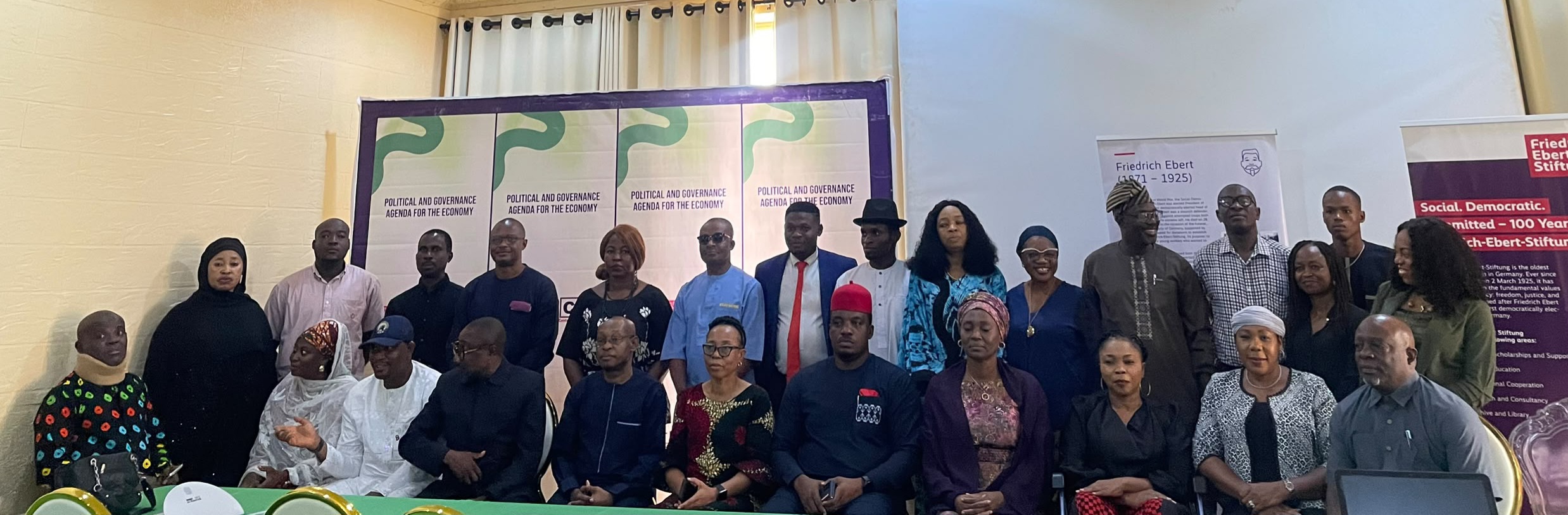
The call was made in Abuja during a high-level political and governance dialogue on the economy organised by CSJ with support from the Friedrich-Ebert-Stiftung (FES) Nigeria.
The forum brought together representatives of political parties, civil society groups, policy experts, professional bodies and the media to deliberate on how economic development can become the driving force of political campaigns ahead of the 2027 elections.
CSJ Executive Director, Eze Onyekpere, said elections should no longer be treated as contests of personalities but as opportunities for citizens to examine competing policy ideas and determine which political platforms offer realistic solutions to Nigeria’s challenges.
He criticised the culture where political parties release manifestos during election seasons but fail to subject their proposals to public scrutiny or explain how they intend to fund and implement their promises.
“It should not only be during election debates that candidates explain how they intend to solve Nigeria’s problems. Political parties must continuously engage Nigerians on their vision and policy direction because there are usually no consequences when candidates refuse to discuss critical national issues,” he said.
Onyekpere said Nigeria’s economic crisis was the result of years of policy choices that have produced widespread poverty, unemployment, food insecurity, inflation and declining purchasing power.
He noted that despite recorded economic growth, many Nigerians have not experienced meaningful improvements in their daily lives because population growth has continued to outpace economic expansion.
“If the economy grows by about four per cent while the population is expanding at almost the same rate, the growth is effectively cancelled out. Nigeria requires sustained annual growth of between seven and ten per cent over at least a decade to begin making significant progress in reducing poverty,” he stated.
According to him, Nigeria’s population of over 230 million people presents both an opportunity and a challenge, with more than 145 million citizens estimated to be living in multidimensional poverty while millions of young Nigerians struggle to find decent employment.
He argued that the country needs to create about four million jobs within three years to begin addressing unemployment and underemployment.
The CSJ boss stressed that economic transformation would require coordinated policies across sectors, including fiscal management, monetary policy, industrialisation, agriculture, education, healthcare and infrastructure.
He warned that inconsistent government policies have continued to weaken economic planning, particularly in agriculture.
Onyekpere questioned the approach of reducing import tariffs while simultaneously borrowing heavily to support domestic agricultural production, arguing that such contradictions could undermine Nigerian farmers by exposing them to cheaper imported products.
He called for stronger investment in agricultural productivity through mechanisation, improved inputs, fertiliser support and access to markets rather than policies that discourage local production.
He also urged voters to demand accountability from political parties by assessing whether campaign promises are specific, measurable, achievable, realistic and time-bound.
To support better policy debates, Onyekpere disclosed that CSJ had developed a governance handbook covering over 20 critical economic issues, including budgeting, taxation, debt management, employment creation, poverty reduction, agriculture, trade and investment.
He said the document would be made available to political parties and stakeholders to encourage stronger economic planning ahead of the elections.
Earlier, Juliana Anusike of Friedrich-Ebert-Stiftung Nigeria said the dialogue was aimed at moving economic development from the margins of political discussions to the centre of electoral debates.
She said Nigerians deserved to hear practical solutions from those seeking public office, particularly on issues affecting everyday life such as food prices, unemployment, energy supply, healthcare, education and access to basic services.
“The aim of this initiative is straightforward—to move economic development from the margins of political conversation to its centre,” she said.
Anusike added that the 2027 elections should provide citizens with an opportunity to assess candidates based on the strength and feasibility of their policy proposals rather than political personalities.
She encouraged political parties and candidates to participate in debates, town hall meetings and policy engagements, describing such platforms as evidence of preparedness and respect for voters.
At the event, Labour Party presidential aspirant Chibuzor Okereke rejected concerns over Nigeria’s democratic future, insisting that the country’s political space remained open.
“I am running to win this election not against anybody but for the Nigerian people,” he said.
Okereke promised to focus on youth and women empowerment, innovation, accountability and reforms aimed at strengthening citizens’ ability to demand better governance.
The CSJ warning comes against the backdrop of growing public anxiety over Nigeria’s economic situation, with millions of households facing pressure from high food prices, rising living costs, unemployment and reduced purchasing power.
Since the removal of fuel subsidy in 2023 and subsequent economic reforms by the Federal Government, Nigeria has recorded changes in key economic indicators, but many citizens continue to complain that reforms have not translated into immediate relief.
The World Bank and other development partners have repeatedly highlighted the need for stronger job creation, improved productivity, better social protection and human capital investment to ensure economic growth benefits ordinary Nigerians.
Political observers believe economic issues are likely to dominate the 2027 elections as voters increasingly demand answers on how future governments intend to create jobs, reduce poverty and improve living conditions.
For CSJ, the message to political actors is unmistakable: the next election must be a competition of ideas and workable economic solutions, not another cycle of promises without accountability.
