
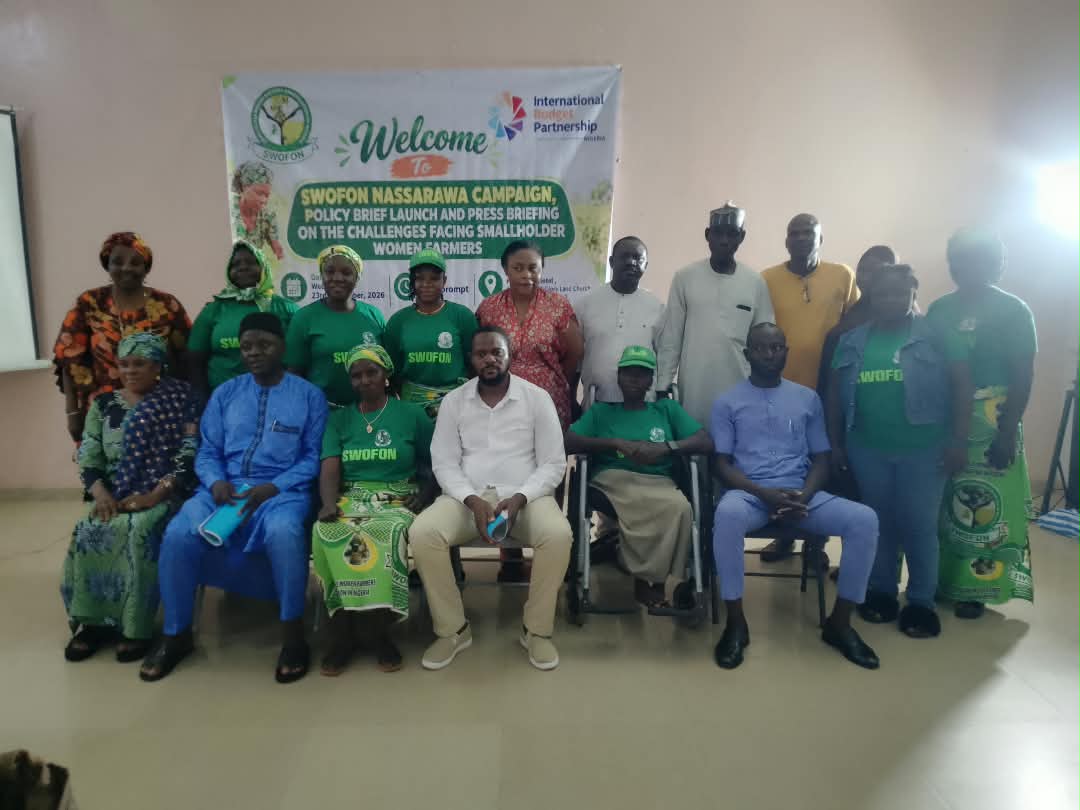

The Small-Scale Women Farmers Organisation in Nigeria (SWOFON) Nasarawa State Chapter has called on the state government to convert its Charter of Demands into costed, traceable budget commitments to accelerate food security.
Mrs Jummai Yohanna, Nasarawa State Coordinator, made the call on Wednesday in Lafia during a press briefing on the SWOFON Campaign on Accelerating Women Farmers’ Impact Towards Food Security.
According to Yohanna, agriculture remains the mainstay of Nasarawa State’s economy, with smallholder women farmers central to production, processing, marketing and household food security.
She, however, lamented that women farmers were constrained by land, inputs, finance, mechanisation, infrastructure, markets and insecurity.
She said between 2019 and 2025, the International Budget Partnership (IBP) and SWOFON implemented an initiative across five states to strengthen women’s participation in public budgeting, and Nasarawa has made progress.
Yohanna, however, said participation has not consistently translated into dedicated budget commitments on the part of government.
Yohanna said SWOFON’s Charter of Demands received partial expression through communal land at Kokona, but no dedicated budget line was found linked to it.
She noted that while communal land at Kokona was an important response, it remains incomplete without clarity on terms of access, duration, beneficiary selection, tenure security and productive decision-making rights.
“Acknowledging priorities is different from budgeting for them. For accountability, each major demand should be traceable to a responsible MDA, a budget line, approved and released amounts, implementation location, beneficiary numbers and evidence of delivery.
“Across the five states, 84.9 per cent of surveyed members reported improved land access, while 24.5 per cent reported not owning land, showing that improved access does not guarantee ownership,’ she said.
On inputs, Yohanna said only seedlings for 10 members and 25 bags of fertiliser reached SWOFON members, small compared to its roughly 2,000 members in the state.
She said Nasarawa has substantial potential with private investments including 14,000 hectares of rice in Toto LGA with Azman Farm and a planned 20,000-hectare cassava and sugar plantation near Umaisha with Flour Mills of Nigeria, plus mechanisation efforts, but women must be included in value chains.
SWOFON listed nine priorities for the state: Institutionalise women’s participation at state and local government levels, convert charter demands into costed budget commitments and improve budget transparency on allocations, releases and expenditure.
Other priorities are to track beneficiaries with sex-disaggregated data
Strengthen land access with transparent selection and documented tenure; expand affordable mechanisation services for women cooperatives.
Strengthen community-level extension services, invest in processing, storage, aggregation and market linkages and strengthen accountability through regular documented reviews.
She called on local government councils to engage women farmers directly during budget planning, the State House of Assembly to scrutinise agricultural allocations, and civil society and development partners to support citizen-led monitoring.
Presenting an impact assessment conducted between 2019 and 2025 by SWOFON and the International Budget Partnership (IBP), Hajara Ramson, SWOFON’s National Secretariat Monitoring and Evaluation Officer, noted that agriculture accounted for an average of just 5.82% of Nasarawa State’s approved budgets between 2021 and 2025.
This, she said, falls well short of the 10% benchmark recommended under the African Union’s Maputo and Malabo Declarations.
Ramson pointed out that while Nasarawa recorded a 72.6% capital budget execution rate in agriculture, the highest among the five focal states assessed (Nasarawa, Niger, Anambra, Oyo, and Jigawa), critical needs remain underfunded.
”For instance, while communal land at Kokona was allocated as a partial response to SWOFON’s Charter of Demands, no specific, traceable line item was created in the state budget to support its development.
“Additionally, past input distributions reached only a small fraction of SWOFON’s 2,000 state members, highlighting a gap in scale and reach,” Ramson added.
Mr Muhammad Bashir, representing the Federal Ministry of Agriculture and Food Security, commended SWOFON members who participated in federal home gardening initiatives, noting that updates on their yam harvests were shared with headquarters to high praise.
Responding on behalf of the government, the Director of Agricultural and Engineering Services at the Nasarawa State Ministry of Agriculture, Mrs Lydia Habila Kyari, applauded SWOFON’s persistent advocacy and assured members of the ministry’s dedication to gender inclusion.
”If there are no farmers in the nation, there is no food. We support all women and persons with disabilities to be included in agricultural activity to increase food security across Nasarawa State. Our doors remain open to ensure women farmers are supported,” Kyari said.
On his part, Umar Jibril, Programme Manager, Nasarawa State Agricultural Development Programme, described smallholder women farmers as vital to food production, household livelihoods and local economies.
He said the SWOFON policy briefing provides a platform to advocate for inclusive solutions and ensure women’s voices are included in policy discussions, stressing that sustainable progress requires stronger implementation of existing policies and meaningful participation in decision-making.
Also speaking, Mr Ahmed Yakubu, Commissioner for Budget and Economic Planning, represented by Mr Achiaku Ezekiel, said the national campaign on accelerating women farmers’ impact towards food security was timely as the state began the budget process.
He said he has worked hand-in-hand with SWOFON for many years and has seen its advocacy for interventions to better the lives of women and encouraged them to engage directly with relevant MDAs under the agricultural sector, assuring that the Budget Department was ready to cooperate.
