
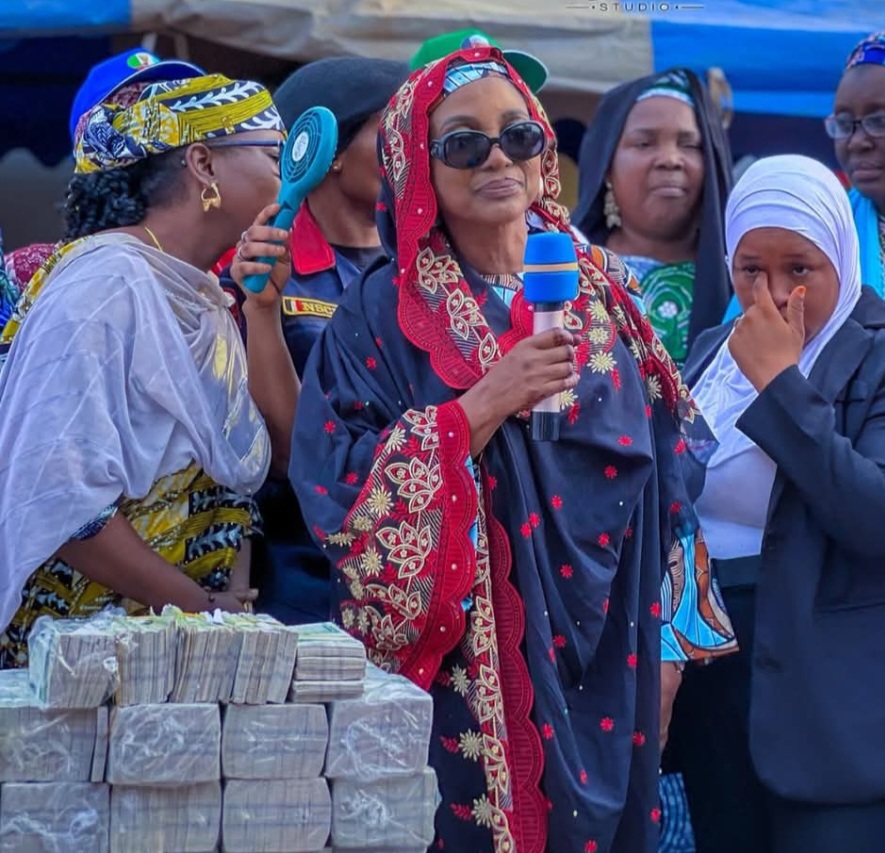
N50,000 in their hands, hope in their hearts: Obi LG women send powerful message to Nasarawa

By Sam Israel
There are moments in politics when speeches become unnecessary because the people themselves speak louder than any microphone can ever do. There are also moments when the sincerity of an intervention is measured not by the size of the crowd assembled, but by the emotions written on the faces of those whose lives have been touched. Monday was one of such moments in Obi Local Government Area of Nasarawa State.
Five hundred women, dressed in colourful attires and filled with excitement, gathered at the Obi Local Government Secretariat and returned home with something more than ₦50,000 each. They returned with renewed hope, a sense of dignity and, perhaps most importantly, the feeling that somebody remembered them at a time when the harsh realities of the economy have made survival increasingly difficult.
The ₦25 million distributed to the 500 women was facilitated through the Hajiya Maryam Ahmed Wadada Aliyu Women Empowerment Programme, an initiative that is steadily becoming a significant intervention in the lives of women across Nasarawa State.
For many of the beneficiaries, the money was not merely cash handed out at a political gathering. It represented an opportunity to start or strengthen a petty business, support a household, pay a pressing bill or simply breathe a little easier in an economy where the purchasing power of ordinary families has been severely tested.
The emotional reactions of some of the women said everything.
Some shed tears of joy. Others could hardly contain their excitement. Some openly declared that it was the first time in their lives that they had held ₦50,000 of their own.
That statement should not be dismissed as an ordinary expression of gratitude. It is a reflection of the depth of economic hardship confronting many ordinary citizens, particularly women who carry enormous responsibilities within their families and communities.
It is also why empowerment programmes of this nature deserve to be judged by what they do to the lives of beneficiaries after the cameras have gone and the crowd has dispersed.
Speaking on behalf of the beneficiaries, Hajiya Sa’adatu Agade, Mohammed Iyimoga and Mr. Edward Agade described the intervention as one of the most robust poverty-alleviation programmes targeted at women in Nasarawa State. They expressed appreciation to Hajiya Maryam Ahmed Wadada Aliyu and prayed for God to continue to strengthen her.
But their message did not end with appreciation.
They promised that the people of Obi would reciprocate the gesture with massive support for Senator Ahmed Aliyu Wadada in the 2027 governorship election.
Whether political promises made in the euphoria of an empowerment event will ultimately translate into votes is a matter that only the ballot box can determine. But there is no denying the political significance of what happened in Obi on Monday.
People remember how they were treated.
They remember those who visited them when things were difficult.
They remember those who listened.
They remember those who offered them opportunities rather than excuses.
And above all, they remember those who made them feel that their struggles mattered.
That is why the intervention of Hajiya Maryam Wadada carries significance beyond the ₦50,000 placed in the hands of each beneficiary.
It is a political statement about the importance of women in the development of society.
It is also a reminder that empowerment is most meaningful when it gives people the means to become economically active rather than permanently dependent.
The Chairman of Obi Local Government Council, Hon. Sani K. K., understood this point clearly when he appealed to the beneficiaries to invest the money wisely, particularly in petty trading and other small-scale businesses capable of generating sustainable income.
His message was simple but important: the ₦50,000 should not end with today’s celebration; it should become the beginning of tomorrow’s economic opportunity.
That is the real test of empowerment.
Earlier, Hajiya Maryam had paid homage to the Osukwo of Obi, His Royal Highness Alhaji Aliyu Dangiwa Ogiri Orume, in a visit that further demonstrated the importance of traditional institutions in maintaining peace and stability within the state.
The royal father used the occasion to make a timely intervention that deserves the attention of every political actor in Nasarawa State.
He called on politicians to concentrate on issue-based politics and avoid violence.
His concern was particularly significant in view of the reported attack on Hajiya Maryam’s convoy in Lafia on Sunday where some vehicles were damaged by some tugs around the over head bridge in the heart of Lafia city on Sunday.
Politics is supposed to be a contest of ideas, programmes, competence and vision. It should never become a contest of intimidation, threats and violence.
The warning from the palace should therefore not be viewed through partisan lenses. It is a warning for everybody.
Nasarawa State belongs to all of us.
No political ambition is worth the blood of a single citizen, and no election is important enough to justify destroying the peace that generations have worked to build.
The security agencies must consequently remain vigilant and ensure that incidents capable of escalating into wider conflict are investigated and dealt with appropriately before they become more dangerous.
Against this backdrop, Hajiya Maryam’s message to the women was equally instructive.
She explained that her husband, Senator Ahmed Wadada Aliyu , is deeply concerned about the welfare of ordinary people and that his desire to support women is driven by his understanding of the enormous pressure they face in today’s economy.
She urged the women not merely to celebrate the assistance but to use it as capital for small businesses that can improve their financial circumstances.
That philosophy is important.
A handout can provide temporary relief, but productive capital can create a stream of income.
And when thousands of women become economically stronger, entire families and communities become stronger.
This is where the political conversation surrounding women empowerment must move: from distribution to sustainability, from immediate relief to economic independence, and from political slogans to measurable impact.
Yet perhaps the most striking feature of the Obi gathering was the spontaneous enthusiasm that followed the intervention.
The songs of praise for Senator Ahmed Wadada Aliyu came from the hearts of the women.
The excitement was visible.
The gratitude was audible.
The political message was unmistakable.
But there is an important distinction that must be made: songs are not votes, and political enthusiasm is not the same thing as an election result.
The final verdict in 2027 will belong to the people when they stand before the ballot box.
However, if the extraordinary enthusiasm displayed by the women in Obi is any indication of the political mood developing around the Wadada campaign, then his supporters have every reason to be confident.
What happened in Obi was therefore much bigger than a ceremony where 500 women received ₦50,000 each.
It was a demonstration of what happens when political engagement reaches beyond party offices and conference halls and enters the lives of ordinary citizens.
It was a reminder that women are not merely spectators in the political process. They are mothers, entrepreneurs, community mobilisers, voters and powerful voices within their families and neighbourhoods.
And when women begin to feel that a political movement understands their struggles, their voices can become a formidable force.
The road to 2027 is still long.
There will be arguments.
There will be counterclaims.
There will be propaganda.
There will be attempts to redefine political narratives.
There will undoubtedly be new alliances and new calculations.
But one thing is certain: the people of Nasarawa State will ultimately judge every candidate by the credibility of his promises, the quality of his record, the strength of his vision and the confidence they have in his ability to lead.
For Senator Ahmed Aliyu Wadada, the challenge is now to ensure that the goodwill generated by interventions such as this one is converted into a broader, credible and sustainable development agenda for Nasarawa State.
And for the women of Obi who danced, sang, celebrated and went home with ₦50,000 in their hands, Monday was more than another political event.
It was a day they felt seen.
A day they felt remembered.
A day they felt empowered.
And perhaps, as the 2027 political journey gathers momentum, it was also a day that sent a message far beyond Obi:
The woman who once struggled to survive is beginning to demand a place at the centre of the development conversation—and whoever truly understands the power of that woman may well understand the future of Nasarawa politics.
Israel JP is the Senior Special Assistant SSA on media to Senator Ahmed Wadada Aliyu.
