

By A.G. Abubakar
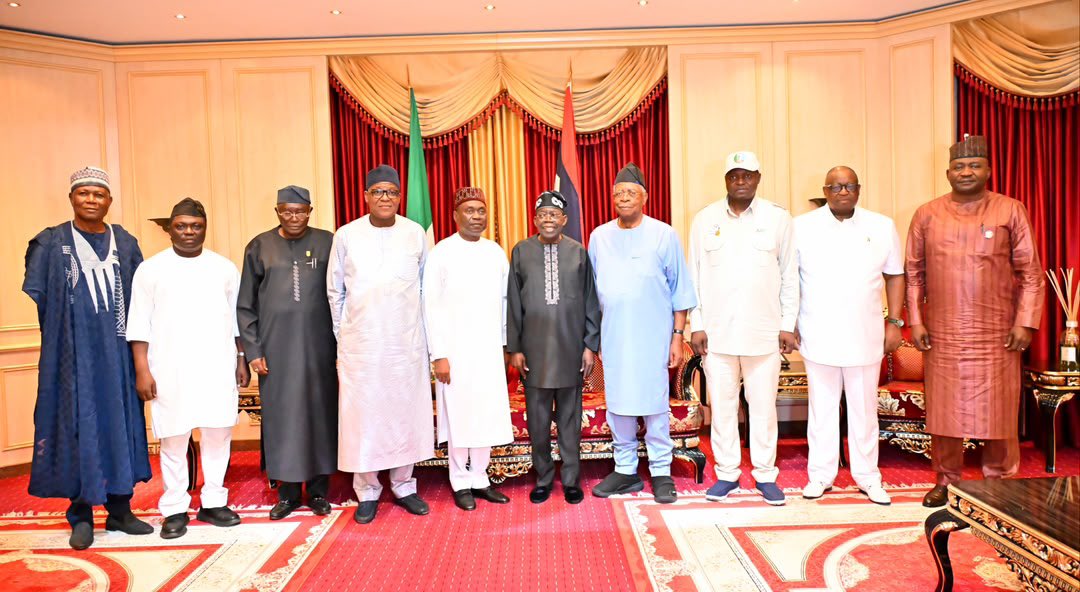
The visit by some Northern Christian leaders to President Tinubu has once again brought the question of regional unity to the fore. The issue is not their right to pay homage to or pledge support for the President, but the platform they chose: the Middle Belt. Elementary geography and common sense dictate that the area encompasses more than Christians. Indeed, the religious composition of the North Central zone, the geographical nucleus of the Middle Belt, makes it untenable for any group to claim to speak for the entire region without accommodating its other ethno-religious constituencies
The delegation, led by elder statesman, General T.Y. Danjumma, rtd, (Taraba) included Christopher Musa (Kaduna), Yakubu Dogara (Bauchi), General Bamaiyi (Kebbi), Bitrus Pogu (Borno), Governor Mutfwang of Plateau State, and Governor Kefas,Taraba State. However, the delegation made no provision for over 60 per cent of non-Christians in the “region” it pretends to represent, except maybe a couple of states. An honest regional representation must reflect the region’s diversity, history and aspirations. Indeed, this is the very founding principle underpinning the concept and vision of the Middle Belt.
It has been over seven decades since the concept and political entity of the Middle Belt found their way into Nigeria’s political lexicon. Going by information currently in the public domain, the Middle Belt as a concept and as an expression of a geopolitical entity dates back to 1949 and 1956, respectively. The former was when a private bill was raised in the defunct Northern Parliament calling for the creation of a body known as the Northern Non-Muslim League (NNML), under the leadership of Pastor David Lot, a member representing Plateau Province. The latter—a call for a political entity with defined boundaries—was made by Ibrahim Imam, a Borno political figure.
Lot and his colleagues had, ironically, given the raison d’être for the NNML as the need to “curb missionary activities” in Northern Nigeria. His co-travellers included S.O. James, a Yoruba from the then Northern Province of Kabba; J. Assadugu from Adamawa; Sukuks from Borno; Musa Kuku from Plateau; and Pastor Bagaya from Zaria.
The NNML was renamed the Middle Zone League (MZL) in 1950 to give it a wider scope and perhaps broader appeal. Two years later, in 1952, it metamorphosed into the Middle Belt Movement as it became more politically conscious. A faction, however, soon broke away to align politically with Sardauna’s ruling Northern People’s Congress (NPC). The faction reasoned thus: “We are still in the North, and if we are to get anything, it will come from the NPC.”
A second splinter group within the Movement pitched its tent with Aminu Kano’s Northern Elements Progressive Union (NEPU), still a Northern political formation. A third element of the group, which loosely called itself the Middle Belt People’s Party, entered into an alliance with Zik’s National Council of Nigerian Citizens (NCNC) and later with Awolowo’s Action Group (A.G.). Two of the splinter groups would later coalesce into what came to be known as the United Middle Belt Congress (UMBC) in Kafanchan on 10 June 1955.
J.S. Tarka was marginally involved in the process because he was then leading the Tiv Progressive Union (TPU). At the time, it was fashionable for political associations to be confined to cultural or tribal enclaves. The TPU was therefore no different from others, such as the Borno Youth Movement, Gwari Progressive Union, Igala Progressive Union, Biu Division Union, and Bauchi General Improvement Union, among others. None of them had any inherent agenda of undermining one another or the larger North, regardless of the usual political positioning to maximise their respective interests. After all, politics is defined as “who gets what, when, and how” (Lasswell, 1936).
Beyond the concept of the Middle Belt, the earliest proposal regarding its geopolitical constituents was made in 1956 by Mallam Ibrahim Imam, from Borno Province, during one of the Constitutional Conferences convened to usher in Nigerian independence. He cited the provinces of Niger, Ilorin, Kabba, Benue, Plateau, and parts of Adamawa and Zaria as the proposed political Belt.
Imam’s reasoning was the need for a “smoother administration in the Northern Region.” It was not a case of identity politics based on Christian, Muslim, or even tribal considerations. The motion was said to have been seconded by Ibrahim, the Wazirin Gumel, from the old Kano Province.
For political reasons, Mr. Benjamin Akiga (Benue) challenged the motion. He was alleged to have asserted that “there is no reason to divide the North; this will weaken this strong region.” He went on to say, “Our people are not aware of this demand at all. If they had been aware of it, this motion would have come from us (the Benue members) on their behalf, because we are their elected and accredited representatives.” He ended by saying, “We are just talking about something that is impracticable. It is just a fable.” (Northern Regional Legislature: House Debates, 1956, Kaduna).
One may not know what informed Mr. Akiga’s position against the concept of the Middle Belt. It could have been his party’s (NPC) stance or suspicion of Imam (Borno) and Ibrahim (from the defunct Kano Province), as the NPC in those days never tolerated voices of dissent. One thing is certain: Ibrahim Imam was a good friend of the Middle Belt. He related well with J.S. Tarka, to the extent that when he was denied the opportunity to contest for a seat in the Northern Parliament from Borno, Tarka invited him to contest in Benue—and he won. That was in 1962. Imam would not have been flippant in his call for a Middle Belt political identity built around the Tiv within the North.
According to Tyoden S. (1993), the Middle Belt’s pro-single North posture, which had become shaky before the 1966 coup, crystallised into the “One North” sentiment when the post-coup regime of Ironsi failed to accommodate the group. The coup saw the killing of prominent individuals across the region, including Prime Minister Balewa, Lt. Col. Yakubu Pam, Mai Malari, Largema, and many others. The romance with the Southern political class eventually collapsed.
Northern military officers, irrespective of their ethno-religious backgrounds, who perceived the coup as sectional, rose up to counter it. The major players included T.Y. Danjuma, Hassan Usman Katsina, Shehu ‘Yar Adua, Murtala Mohammed, and others. Gowon emerged as Head of State after Ironsi.
A united Northern think tank and advocacy body, the Northern Leaders of Thought (NLT), was established in 1966 to stabilise the budding Gowon regime. J.S. Tarka, Sir Kashim Ibrahim, Makaman Bida, Ibrahim Imam, and Aminu Kano were at the forefront of the move. The group proposed a federal system as opposed to Ironsi’s unitary system, as contained in Decree 34. Although some members initially resisted the proposal, the group later united behind it. The NLT’s proposal for the creation of between eleven and thirteen states was accepted by the Gowon regime. A twelve-state structure was subsequently created in 1967.
Tarka became a Federal Commissioner in the Gowon administration. He and other members of the NLT toured the North together to preach unity and stability, regardless of their previous political platforms of NPC, UMBC, and NEPU. Corruption charges brought by a fellow Tiv man, Dabo, led to J.S. Tarka’s resignation from the Federal Cabinet in 1974.
At the dawn of the Second Republic, Tarka and his bosom friend, Aliyu Makaman Bida, emerged as Chairman of the Coordinating Committee and Protem Chairman, respectively, of a Northern-based political movement that gave birth to the NPN. He delivered the highest number of votes in Benue State for the NPN in the 1979 presidential election, which paved the way for Shehu Shagari to become President.
So, where has the anti-Northern and anti-Muslim sentiment come from? At what point did the peoples of the Middle Belt begin to see themselves as strangers in the North? At what point did the majority groups force their outlook on the minorities? What makes one believe that Islam does not have its own internal divisions to contend with? Or that the Hausa and Fulani groups have no dichotomies along clan and ancestral lines? Perhaps the inability of modern-day Middle Belt promoters to come to terms with these questions has made them resort to blame games and divisive tendencies along ethno-religious lines.
The reality on the ground is that the Middle Belt is too diverse to be defined by narrow Christian interests. Geographically and constitutionally, four out of the six states—Kwara, Kogi, Nasarawa, and Niger—have comparatively larger Muslim populations, judging by the fact that they have consistently elected Muslim governors. It is recalled that, in Nigeria, voting is largely based on ethno-religious considerations.
From Tarka to David Mark, the vision of the Middle Belt has not been one of mutual exclusion from the larger North but of how to make the region beneficial to all—a more equitable relationship, which is normal in the age of democracy. After all, similar expectations exist between Tiv and Idoma in Benue; Igala and Ebira/Okun in Kogi; Fulani and Yoruba in Kwara; Nupe and Gbagi/Hausa in Niger; Gwandara/Eggon and Kambari/Hausa in Nasarawa; and Berom and Angas/Tarok/others in Plateau.
The dramatis personae—Tarka, Lot, Aliyu Makaman Bida, Dabo, and others—were among the main actors. They never allowed political differences to define their social relationships. Tarka was a bosom friend of Ibrahim Imam, who facilitated his election on the Tiv platform. Tarka used to stay with Makaman Bida, a right-hand man of Sardauna and the NPC, whenever he was in Kaduna. The then-budding Nigerian military was firmly under the influence of officers from the geographical Middle Belt, some of whom eventually became Heads of State. They included Gowon (1966–1975), IBB (1985–1993), and Abdulsalami (1998–1999).
The trio ruled for a combined period of over 16 years—longer than any other geopolitical region. If Taraba and Southern Kaduna are added, the likes of T.Y. Danjuma and, now, Christopher Musa have given the zone powerful voices in Nigeria. Could the issue of Middle Belt agitation therefore be based on a complex? Maybe. But that should not be the case, because the region is home to the prehistoric Nok culture and the famous Kwararafa Empire—heritage its people should be proud of.
Could it then be socioeconomic challenges? Not likely. The quality of life of the average Middle Belter is not worse than that of his counterparts in the far North. Nor are the performances of leaders in the far North better than those in the Central region. The indices on education, health, sports, agricultural output, and other indicators in the Middle Belt even fare better. The issue might therefore largely be a matter of perception—”the grass looks better on the other side.” As for the tyranny of numbers, the phenomenon is universal. The difference lies only in degree.
Maybe it is this confused perception that has led agitators to promote the dismemberment of the North or to sever ties with what some describe as Hausa, Fulani and Muslim hegemony and oppression, without considering the fact that there are more Muslims in the Belt than Christians. They also have sizeable and decisive numbers of indigenous Hausa and Fulani among them, who cannot simply be wished away. This is the reality of the Middle Belt.
This, however, does not negate the existence of intra- and interregional disagreements. The North as a whole has had its fair share of such disagreements—the Shari’a debates in 1979, the implementation of Shari’a law in parts of the region and its unintended fallout, political positioning, etc. Some of these issues could have been better handled in the spirit of togetherness. They are, however, by no means sufficient to tear a region or nation apart—unless doing so serves some self-serving interests.
Middle Belt agitators should therefore return to history and study the politics of their forefathers, who were guided by a joint vision for the progress of the North and Nigeria as a whole, instead of spewing hateful narratives. The ethno-religious overdose in the Middle Belt movement has largely alienated non-Christian faithfuls from it. This is unlike what obtains in the Niger Delta, where bona fide groups have reasonably embraced the zone’s common identity and collective political vision.
The Middle Belt stands today at a crossroads—not of geography, but of memory and imagination. Its history does not tell a story of isolation, but of engagement; not of victimhood, but of agency; not of perpetual grievance, but of negotiation and shared destiny. The generation of Tarka, Imam, and Makaman Bida understood that influence is not built through withdrawal, nor is dignity secured through division. They fought, disagreed, aligned, and realigned—but always within the larger Northern and Nigerian framework.
If the Middle Belt must rise, it will not be by redrawing maps or rehearsing resentments. It will rise by strengthening institutions, deepening internal cohesion among its own diverse peoples, and negotiating power with clarity rather than anger. Geography has tied its fate to the North; history has tied its fate to Nigeria. No rhetoric can undo that reality.
The fundamental question, therefore, is not simply where the Middle Belt belongs but how it chooses to define its identity realistically. That choice will determine whether tomorrow becomes a story of renewal and progress or yet another repetition of unresolved historical and political debates. The search for a political anchor must not become an endless pursuit.
The Middle Belt deserves sustainable peace, an ideal that cannot be achieved through a divisive religious clique masquerading as either “leaders from Northern Nigeria” or “Middle Belt leaders.” Speaking for an entire region or geopolitical zone demands fair and inclusive representation of its constituent parts.
President Tinubu would have questioned the delegation’s claim to represent the region had he not been a politician desperately seeking re-election.He would have asked: Where are IBB, Abdulsalami, Saraki, Sani Bello, Adamu Abdullahi, Al’makura, Suleiman Y. Kwande, Yahaya Jingir, Abdullahi Ibrahim, Yahaya Bello, Bala Lau, Bala ibn Na’Allah, Adamu Mu’azu, etc.? Of course, it is a game, but one with multidimensional costs for the region and, invariably, the nation.
Abubakar can be reached at agbarewa@gmail.com
